
 November 5, 2026
Introduction: In this article, Katie Rebecca Merkley gives tips for researching your colonial and early American ancestors. Katie specializes in U.S. research for family history, enjoys writing and researching, and is developing curricula for teaching children genealogy. She has a website: krgarnergenealogy.com
Colonial and early American research can be tricky. Before 1790, there was no federal census. Birth and death registration weren’t common until the early 20th century. The existence of these records makes more recent research easier. Different strategies are needed for researching the earlier days.
In New England, many towns recorded births, marriages, and deaths. If you know what town your ancestors lived in, you know where to search for the records. Some of these records are online. Some are on microfilm at the FamilySearch Library. Others can be ordered by contacting the town clerk.
Colonial New England is well covered in compiled sources, as many have already researched that time and place. These earlier researchers wrote books and histories, but many are not appropriately cited. Some books are compilations of births, marriages, and deaths, copied from other records. These types of records are prone to errors. Therefore, it’s advisable to use them as clues to find original records.
Starting with What Is Known
When embarking on any research project, you want to start with what is known and work your way into the unknown. I started this research project from the newspaper clipping below, which I found in GenealogyBank’s Historical Newspaper Archives.
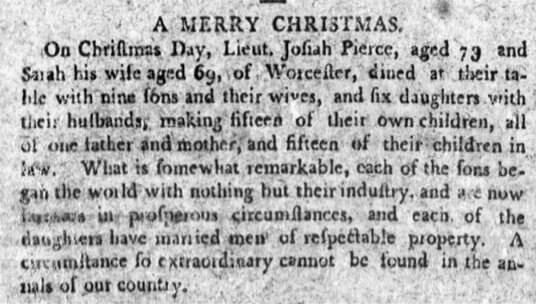
This news about Lieutenant Josiah Pierce and his wife hosting a large family dinner was published in Massachusetts and New York papers in January 1799, referring to the prior Christmas. The newspaper announcement states that Josiah Pierce is a lieutenant, that his wife is Sarah, that he’s 73 and she’s 69, and that they have 15 children together. The 15 children consisted of nine sons and six daughters, all married. The article does not name the children or the in-laws.
The article concludes:
What is somewhat remarkable, each of the sons began the world with nothing but their industry, and are now [situated] in prosperous circumstances, and each of the daughters have married men of respectable property. A circumstance so extraordinary cannot be found in the annals of our country.
The article states that the family is “of Worcester” [Massachusetts], so the search should begin with sources and records in Worcester for the Pierce family.
Historical context tells us how extraordinary this situation was. Mortality rates were high back then. Many children died young. Men or women died young, leaving behind minor children, and the surviving spouse often had to remarry. Josiah and Sarah not only had 15 children together, but all of them lived to adulthood.
It is essential to evaluate a source’s reliability. This family news was posted in at least two newspapers because people back then found it noteworthy. It is unknown who the informant was, whether it was a member of the Pierce family or someone else. The safest assumption is that the informant was in the same community as the Pierces.
Another side to consider in the reliability factor is whether anyone had reason to intentionally falsify information. This commonly happened when families were trying to cover up an illegitimate birth. This also happened if a boy tried to pass as a man to enlist in a war. There is no apparent reason for Josiah or Sarah Pierce to intentionally falsify information to the newspaper.
If there are errors in the newspaper report about Josiah and Sarah Pierce’s family, it’s most likely due to misinformation rather than intentional falsification. This is why it’s important to verify findings by checking other sources. Even with the possibility of errors, this newspaper clipping gives clues for further research.
New England Colonial Research Methodology
I began my research with history books about Worcester. Many of these books are digitized on FamilySearch. One history listed committee members chosen to inspect Loyalists in 1775. One of the committee members was Josiah Pierce, indicating he was on the Patriot side during the Revolution. Other committee members were Samuel McCracken, David Bigelow, Samuel Woodburn, and Nathan Baldwin. (1)
Another account described the establishment of the Second Church of Worcester. That church was established on 1 December 1785, and one of the original members was Sarah Pierce, wife of Josiah Pierce. The other people listed were her fellow churchgoers. (2) This is a clue indicating where to search for church records, which is very important in colonial American research.
That same history also listed elected officers of the Second Parish: Captain John Pierce and Lieutenant Josiah Pierce. (3) No relationship was stated; however, it is common to assume people with the same surname were related. (However: it is important to note that the more common the surname is, the less safe it is to assume a relation solely due to sharing the surname.)
I can speculate that Captain John Piece and Lieutenant Josiah Pierce were related, and that they were brothers or father and son. The important thing with such speculation is to develop a research plan to test my hypothesis.
Since I had a short research session, I could only go through a few histories. I identified several and made a list for the next research session. None of them identified all the children, but they did give me the names of associates.
I can search online family trees to see if other researchers have identified all the children of Josiah and Sarah Pierce. This requires the same cautious approach used for published histories and genealogies: I must verify that the information has sources to prove it.
Church Records
Church records are helpful when researching areas before civil registration was implemented. When it comes to church records, it’s important to learn the history of your ancestor’s church. The Second Church of Worcester was established in December 1785, so it won’t be helpful to look for records of that church earlier.
My research also revealed that the Second Church of Worster was also known as the Second Parish and the First Unitarian Church. Knowing these alternate names will help in looking for church record collections.
Name Variations
In my research, I came across several alternative spellings of the surname Pierce. Spelling back then wasn’t standardized, so it’s essential to know how to “misspell” your ancestor’s name. These are the other spellings I encountered:
- Pearce
- Piers
- Pierse
- Peers
- Peeres
- Pearse
- Perse
- Pearse
- Pearce
Do you have early or colonial American ancestors? Look for clues in online trees and published books, then continue to original records, including newspapers.
Create a free account at GenealogyBank for 7 days to start your journey and discover the stories your ancestors left behind.
Note on the header image: brick Josiah Day House, West Springfield, Massachusetts, c. 1754. Credit: Thomas E. Martin Jr.; Wikimedia Commons.
_____________
(1) History of Worcester County, Massachusetts, embracing a Comprehensive History of the County from its First Settlement to the present Time with a History and Description of its Cities and Towns, Volume 2. (Boston, MA: C. F. Jewett and Company, 1879), p. 579; digital images, FamilySearch (https://familysearch.org : accessed 22 July 2025), film no. 007492540 Item 3, image no. 331.
(2) Caleb A. Wall, Reminiscences of Worcester from the Earliest Period, Historical and Genealogical: With Notices of Early Settlers and Prominent Citizens, and Descriptions of Old Landmarks and Ancient Dwellings, Accompanied by a Map and Numerous Illustrations. (Worcester, MA: Tyler & Seagrave, 1877), p. 132 (image 139). FamilySearch books.
(3) Ibid., p. 133 (image 140). FamilySearch books.
Related Article:
