
 November 6, 2026
Introduction: In this article, to help celebrate Veterans Day, Melissa Davenport Berry tells the gripping story of Medal of Honor recipient Sergeant William Harvey Carney, recognized for his bravery during the Civil War’s Battle of Fort Wagner. Melissa is a genealogist who has a website, americana-archives.com, and a Facebook group, New England Family Genealogy and History.
While browsing the scrapbook collections of the New Bedford Library, Massachusetts, I came across a photo of John Carney Mendes, performing in Footprints, a historical pageant created by Mrs. Ethel Riley Cark in 1925.
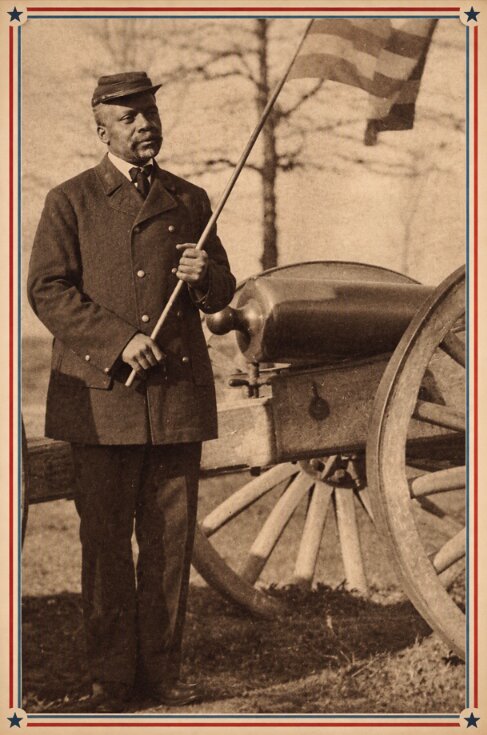
Mendes was portraying the role of his uncle, Sergeant William Harvey Carney (1840-1908), who served in Co. C, 54th Massachusetts Colored Infantry Regiment. Carney is the famed Union hero of the Civil War’s Battle of Fort Wagner for saving the regimental colors during the battle on 18 July 1863. He received the Congressional Medal of Honor on 23 May 1900.
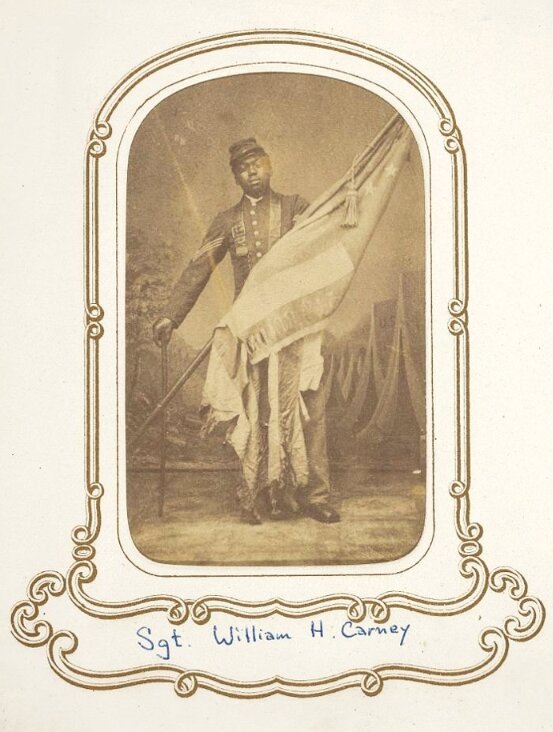
Below is a tintype of Sergeant Carney taken in 1864.
I found an article on Sgt. Carney in the Boston Journal that offers some background.
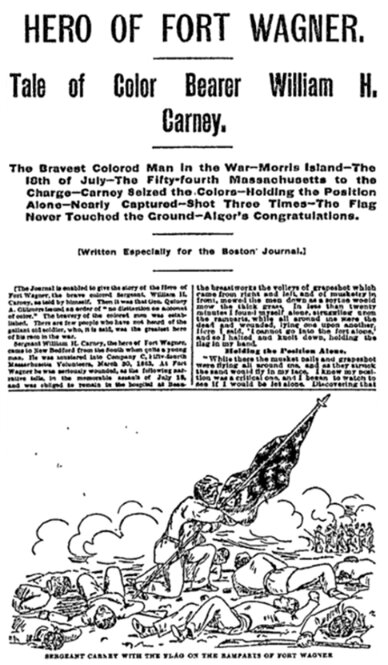
This article reports:
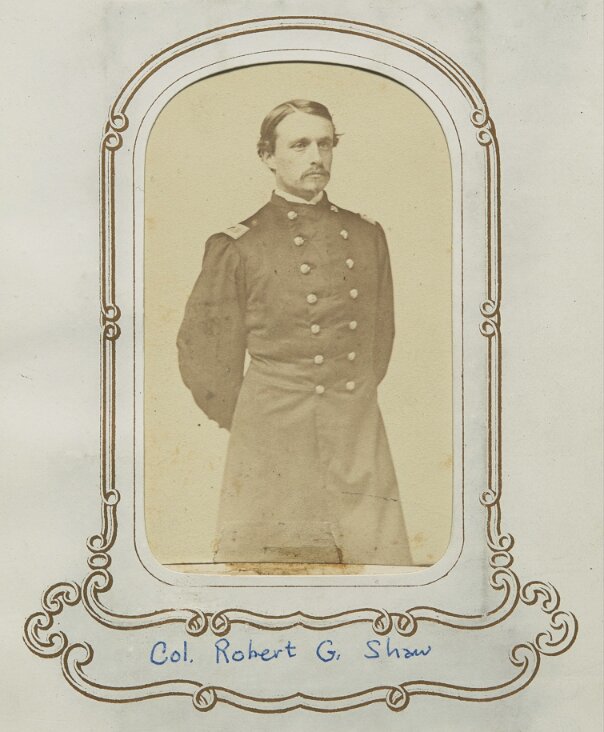
Sergeant William H. Carney, the hero of Fort Wagner, came to New Bedford from the South when quite a young man. He was mustered into Company C, Fifty-fourth Massachusetts Volunteers, March 30, 1863. At Fort Wagner he was seriously wounded, as the following narrative tells, in the memorable assault of July 18, and was obliged to remain in the hospital at Beaufort, [South Carolina], until December of that year. Then he rejoined his regiment, participating in its fortunes until the command was mustered out, Aug. 20, 1865. Sergeant Carney helped organize Robert G. Shaw Post 146, G.A.R., of New Bedford, named in memory of his old Colonel, and was its first commander.
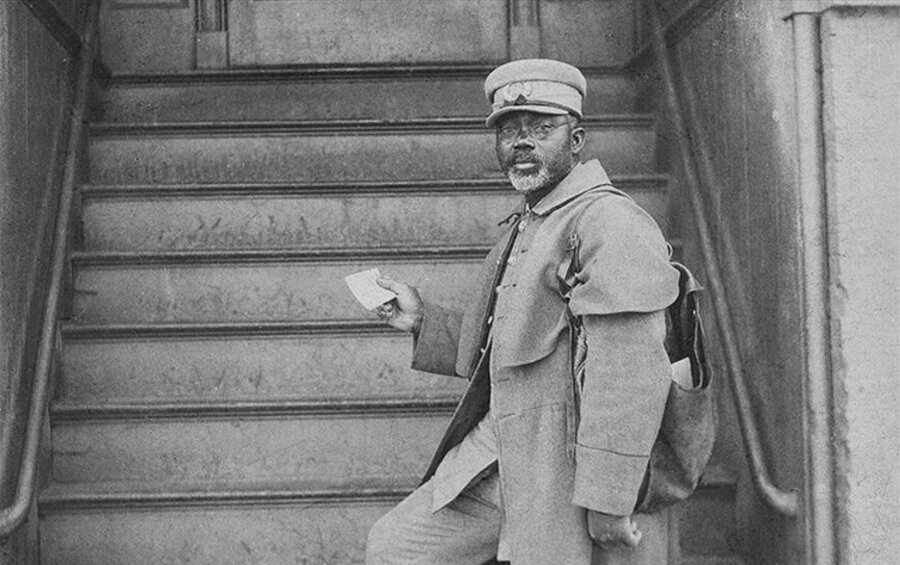
Among the most honored of New Bedford’s brave will ever be held the name of Sergeant William H. Carney, the hero of Fort Wagner, and as long as deeds of valor shall be told, the story of this colored soldier’s bravery will be repeated.
Many years has his familiar form been seen passing through New Bedford’s busiest streets, clad in the uniform which Uncle Sam furnishes for his letter carriers, and while time has generously sprinkled his beard with gray, and has forced upon him the use of spectacles, the springy step of the gallant Sergeant has lost little of his youthful vigor. It needs but a mention of Ford Wagner to cause the kindly eyes to snap and the well-knit form to straighten back proudly as befits one who remembered his duty to his country before himself.
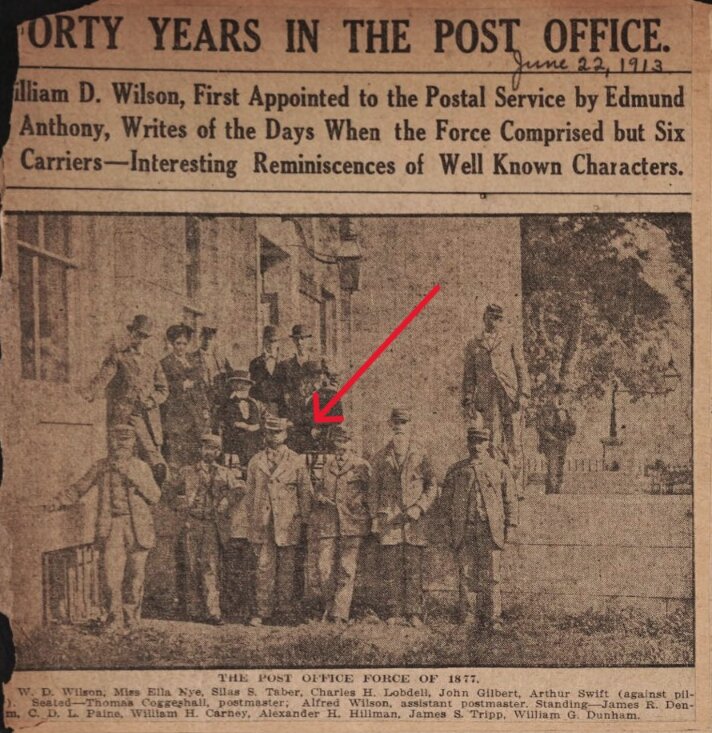
Below is a scrapbook photo of William Harvey Carney and his fellow postal workers from 1877.
In 1863 a letter submitted by Colonel Milton Smith Littlefield was published in the Liberator newspaper regarding Sgt. Carney’s bravery in the battle of Fort Wagner.
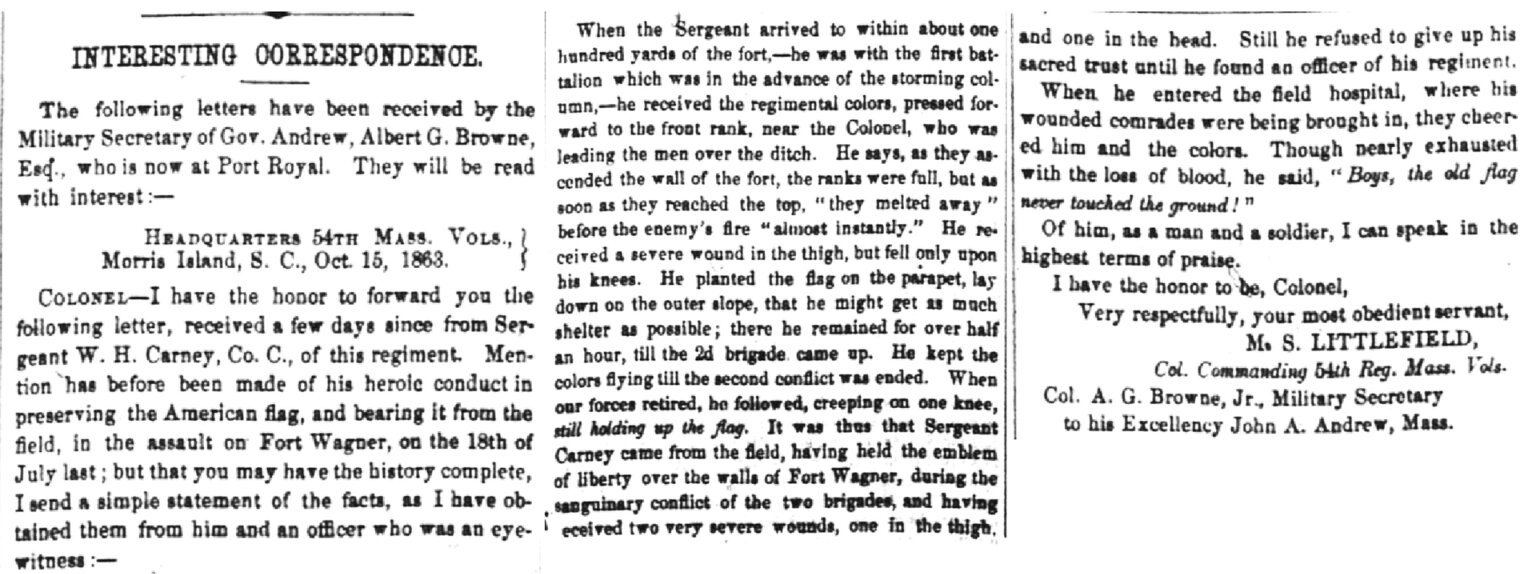
This article reports:
The following letters have been received by the Military Secretary of Gov. Andrew, Albert G. Browne, Esq., who is now at Port Royal. They will be read with interest:
Headquarters 54th Mass. Vols.,
Morris Island, S. C., Oct. 15, 1863.Colonel – I have the honor to forward you the following letter, received a few days since from Sergeant W. H. Carney, Co. C., of this regiment. Mention has before been made of his heroic conduct in preserving the American flag, and bearing it from the field, in the assault on Fort Wagner, on the 18th of July last; but that you may have the history complete, I send a simple statement of the facts, as I have obtained them from him and an officer who was an eyewitness:
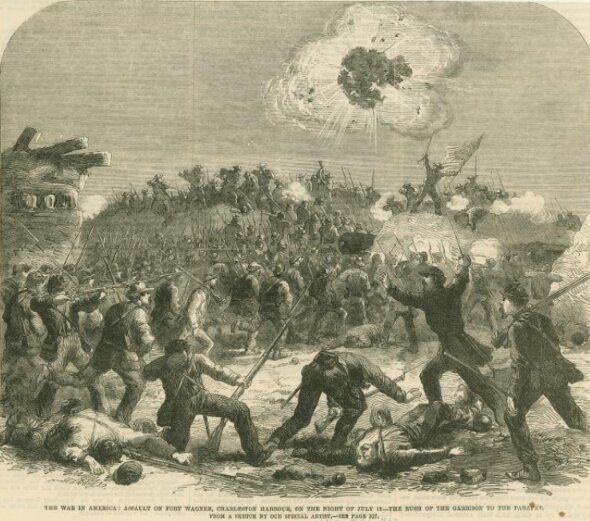
When the Sergeant arrived to within about one hundred yards of the fort – he was with the first battalion which was in the advance of the storming column – he received the regimental colors, pressed forward to the front rank, near the Colonel, who was leading the men over the ditch. He says, as they ascended the wall of the fort, the ranks were full, but as soon as they reached the top, “they melted away” before the enemy’s fire “almost instantly.” He received a severe wound in the thigh but fell only upon his knees. He planted the flag on the parapet, lay down on the outer slope, that he might get as much shelter as possible; there he remained for over half an hour, till the 2d brigade came up. He kept the colors flying till the second conflict was ended. When our forces retired, he followed, creeping on one knee, still holding up the flag. It was thus that Sergeant Carney came from the field, having held the emblem of liberty over the walls of Fort Wagner during the sanguinary conflict of the two brigades, and having received two very severe wounds, one in the thigh and one in the head. Still he refused to give up his sacred trust until he found an officer of his regiment.
When he entered the field hospital, where his wounded comrades were being brought in, they cheered him and the colors. Though nearly exhausted with the loss of blood, he said, “Boys, the old flag never touched the ground!”
Of him, as a man and a soldier, I can speak in the highest terms of praise.
I have the honor to be, Colonel,
Very respectfully, your most obedient servant,M. S. Littlefield,
Col. Commanding 54th Reg. Mass. Vols.
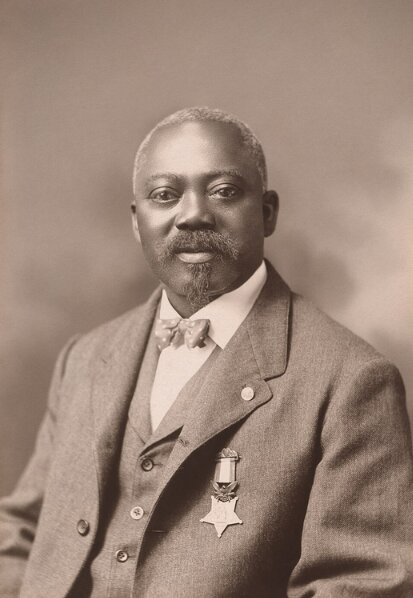
Below is a photo of Sgt. Carney wearing his Medal of Honor.
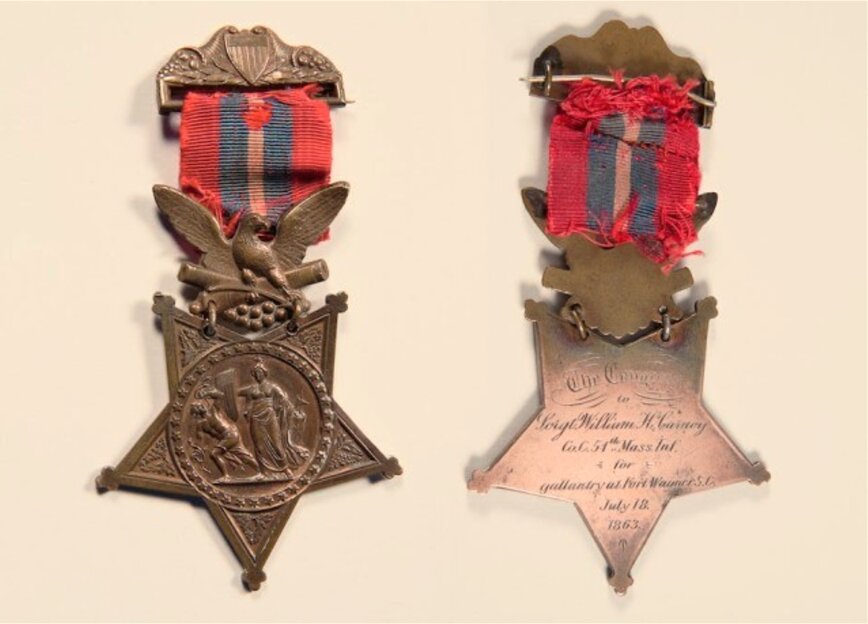
Here are front and rear views of William Harvey Carney’s Medal of Honor.
Note: some of the graphics in this article have been AI enhanced.
Create a free account at GenealogyBank for 7 days to start your journey and discover the stories your ancestors left behind.
Note on the header image: depiction of the Battle of Fort Wagner in the painting “The Old Flag Never Touched the Ground.” Credit: Rick Reeves; U.S. National Guard; Wikimedia Commons.
Related Articles:
