
 November 20, 2025
Introduction: In this article – the first in a series of three – Katie Rebecca Merkley writes about our ancestors celebrating Thanksgiving, in this case 300 years ago. Katie specializes in U.S. research for family history, enjoys writing and researching, and is developing curricula for teaching children genealogy. She has a website: krgarnergenealogy.com
How did our ancestors celebrate Thanksgiving three centuries ago? Newspapers from the 1720s can tell us.
Thanksgiving was not yet a national holiday with a fixed day. It was mainly celebrated in New England and was observed when the governor declared a day of Thanksgiving. (1)
1725
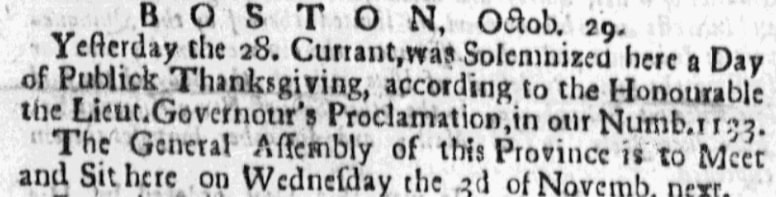
An example of that is shown in the clipping below, where the lieutenant governor of the Province of Massachusetts Bay proclaimed 28 October 1725 a “Day of Publick Thanksgiving.”
A more detailed proclamation had been posted a fortnight in advance. William Dummer, the province’s lieutenant governor, issued the declaration on October 9 and published it in the newspapers on the 14th.
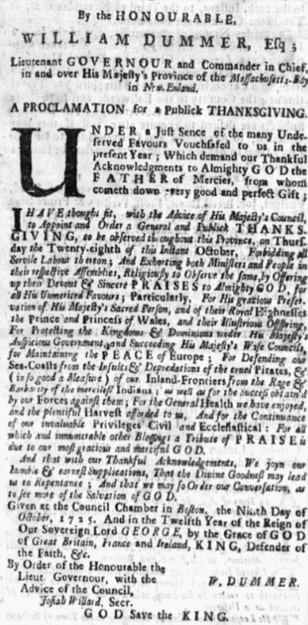
The proclamation placed heavy emphasis on religion, as Thanksgiving was primarily a religious holiday at the time. It opens with:
Under a Just Sence of the many Undeserved Favours Vouchsafed to us in the present Year; Which demand our Thankful Acknowledgements to Almighty GOD the FATHER of Mercies, from whom cometh down every good and perfect Gift;
According to Merriam-Webster’s online dictionary, vouchsafe means “to grant or furnish often in a gracious or condescending manner,” which seems an appropriate description for blessings from God.
Much of the announcement from Lieutenant Governor Dummer focused on giving thanks and praise to God. It also talked about how the royalty in the British Isles had maintained peace in Europe, protected the coasts, and protected the colonists from the natives.
On the Day of Publick Thanksgiving, servile labor was forbidden. Ministers and members of their respective assemblies were exhorted to observe Thanksgiving religiously.
Indeed, Thanksgiving was a religious holiday, celebrated by going to church to hear a sermon on giving thanks to God. After church, families and neighbors would gather to feast on local, seasonal food. Many invited widows, the elderly, and the poor to their feasts. Typical fare included wild turkey, duck, or goose; beef and pork; seafood (in coastal areas); squash, pumpkin, and root vegetables; corn dishes; bread; pumpkin pies; and fruit preserves. After the feast, there was time for leisure. (2)
1727
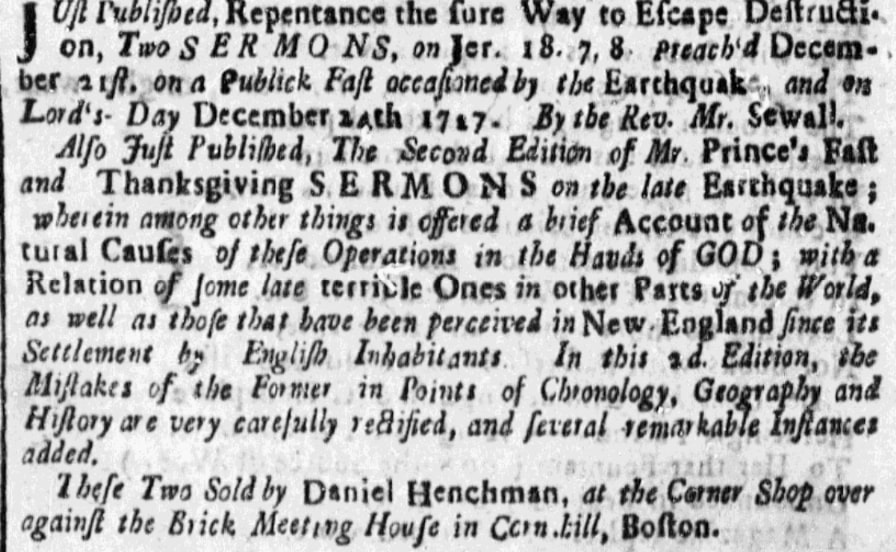
There was an earthquake shortly before 21 December 1727, which occasioned a day of public fasting. Reverend Mr. Sewall and Mr. Prince gave sermons of fasting and thanksgiving in relation to the earthquake, and these sermons were published and sold in local bookshops. Here is a newspaper ad from 1 February 1728 publicizing these sermons.
1729
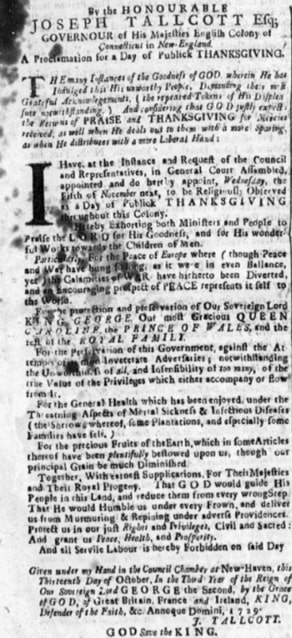
In Connecticut in 1729, Governor Joseph Tallcott proclaimed November 5 as a Day of Publick Thanksgiving. After making a similar exhortation as the one above to his people and ministers to religiously observe Thanksgiving, he listed what they as a people should be grateful for: the peace of Europe, protection and preservation of the king and queen, preservation of the government, general health, and “precious fruits of the earth.”
It is interesting to note that the article was published in Boston the day after. This suggests that the editor of that newspaper was interested in Thanksgiving celebrations in other colonies.
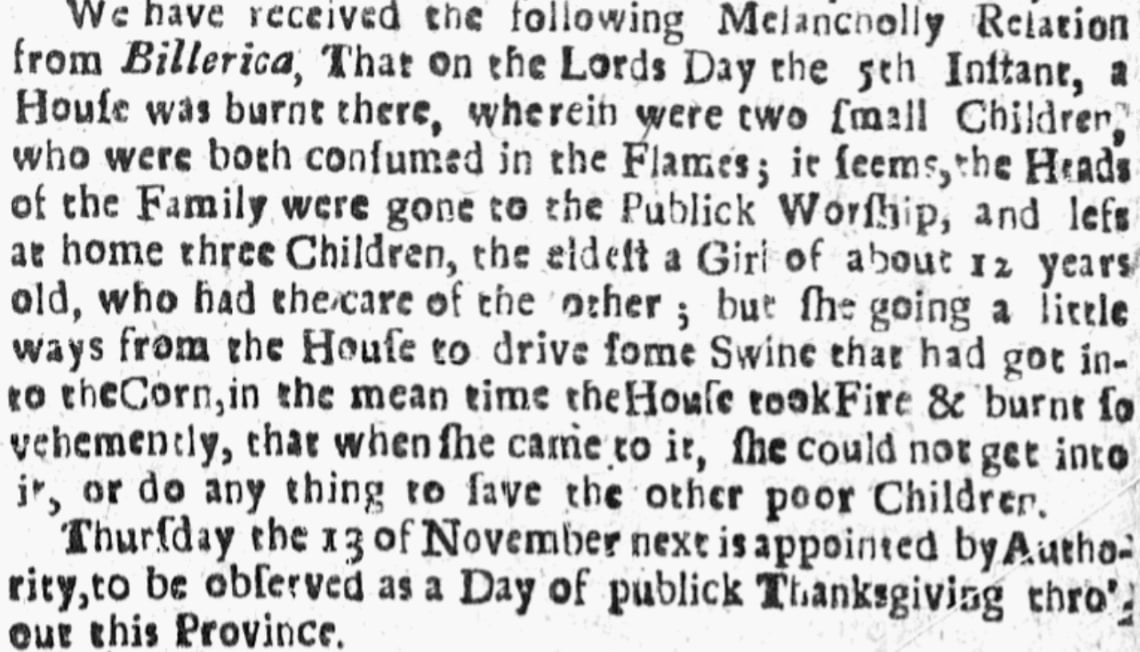
Another 1729 newspaper announced a tragedy and the upcoming Thanksgiving back-to-back. On October 5, the parents of a family went to Publick Worship and left three children at home. The oldest was a 12-year-old girl “who had care of the other[s].” She went outside to drive away some swine that had gotten into the corn. Meanwhile, the house caught fire, with the other two kids inside. The girl was unable to get back into the house to rescue the other children.
Right after that tragic tale, the newspaper announced that November 13 would be a Day of Publick Thanksgiving throughout the province.
Thanksgiving was not yet regulated three centuries ago. Our New England ancestors had to rely on newspapers or other public announcements to know when a Thanksgiving celebration was approaching. The governors declaring the day of Thanksgiving would also post in the newspapers what the colony was grateful for.
To be continued…
Happy Thanksgiving everyone!
Explore your family history by creating your free account at GenealogyBank for 7 days, because every life deserves to be remembered, recorded, and rediscovered.
Note on the header image: Happy Thanksgiving display. Photo credit: https://depositphotos.com/home.html
___________________
(1) History of Thanksgiving in Colonial America, report, Perplexity, Perplexity AI (https://www.perplexity.ai/search/how-was-thansgiving-celebrated-5vVG7kGTT2SUQWZij83QoQ: generated 9 October 2025); generated from query “how was thanksgiving celebrated in the american colonies in 1725?”
(2) Ibid.
