
 November 3, 2026
Introduction: In this article, Gena Philibert-Ortega explains some of the reasons why your ancestor may not have an obituary. Gena is a genealogist and author of the book “From the Family Kitchen.”
When I started researching my family history, historical newspapers were not digitized. Without the ease of an online search engine, most of the time we focused our research on finding an obituary. After all, once we knew a death date, we could read through the newspapers the days or weeks after the death and hopefully find an obituary.
Notice I said “hopefully.” Even the most tenacious researcher learns a hard truth: not all ancestors had newspaper obituaries. And that truth has to do with several factors.

Photo credit: https://depositphotos.com/home.html
Why Does Someone Have an Obituary?
Before I get into why someone doesn’t have an obituary, let me address why someone might have an obituary. We assume everyone does, but in reality you’re lucky if your ancestor or family member’s life was memorialized with an obituary.
You can find an ancestor’s obituary if:
- The newspaper is available to research via website or physical form.
- The ancestor died at a time when obituaries were common.
- A family member, friend, funeral home, or newspaper wrote an obituary.
- The newspaper accepted the obituary.
- The deceased’s family was able to pay (if required) for an obituary.
- The deceased (or the family) wanted an obituary.
Why Your Ancestor or Family Member Doesn’t Have an Obituary
Now that I’ve listed some reasons why someone had a newspaper obituary, let’s look at why someone wouldn’t have an obituary.
- The newspaper isn’t available to research via website or physical form.
Not all historical newspapers are available. Some don’t exist anymore in any form, while others haven’t been stored in an archive or library, or haven’t yet been digitized. We are incredibly lucky to live in a time where we have access to so many historical newspapers online (GenealogyBank has over 16,000 digitized newspapers).
That’s why it’s important to first identify the location of your ancestor, and what newspapers were available at that time and location. Next, you would need to find where – and even if – the newspaper is extant (meaning still in existence), and if so, where it is archived.
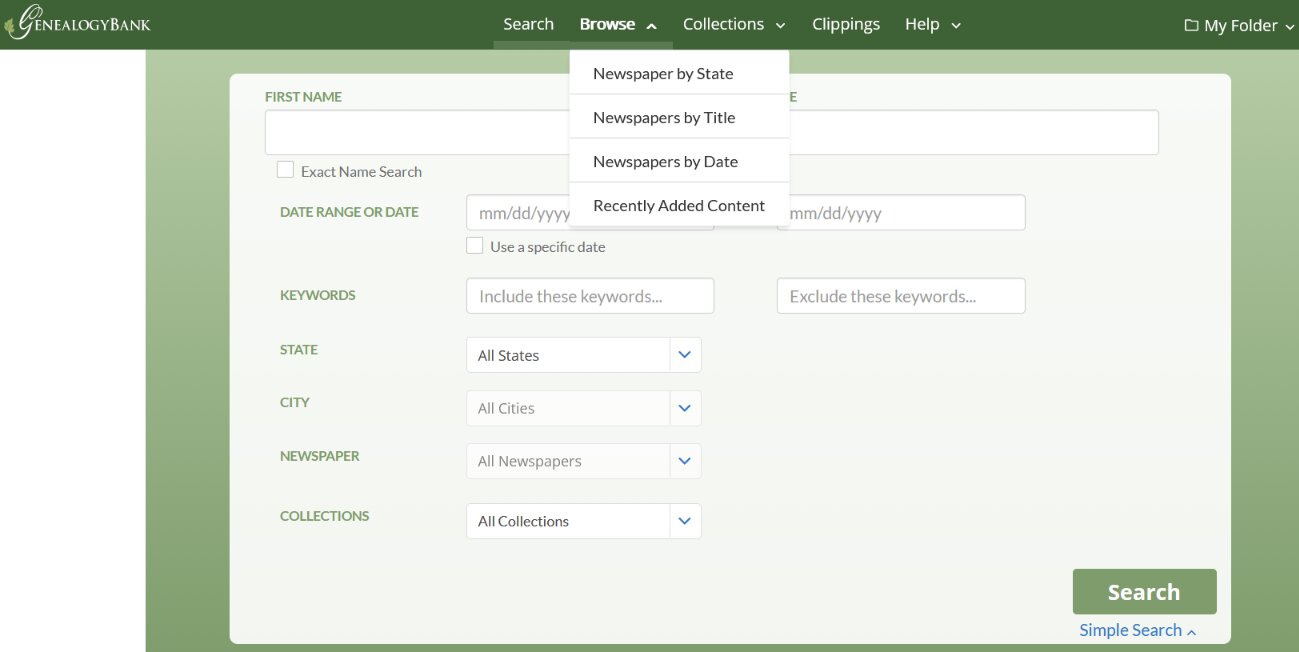
Tip: To locate digitized historical newspapers available on GenealogyBank, click on Browse at the top of the GenealogyBank toolbar. The drop-down menu provides you with ways to search newspapers by state, titles, and date.
- They died at a time when obituaries were not common.
Keep in mind the history of newspapers. Although the first American newspaper was published in 1690, it only lasted one issue. After that, newspapers started cropping up in the American colonies in the early part of the 1700s. “At the end of the eighteenth century, the Reverend Samuel Miller boasted that the United States had more than two-thirds the number of newspapers available in England and yet had only half the population of England.” (1)
Even with such an early history for newspapers, that doesn’t mean obituaries were present. These early newspapers didn’t print obituaries. They did have some death notices for prominent people or those who died “newsworthy deaths,” but it’s not until later in the 1800s when you start seeing some obituaries and paid death notices. (2) It’s really the 20th century (especially 1900-1970) that is the “great age of obituaries” according to author James Beidler. (3)
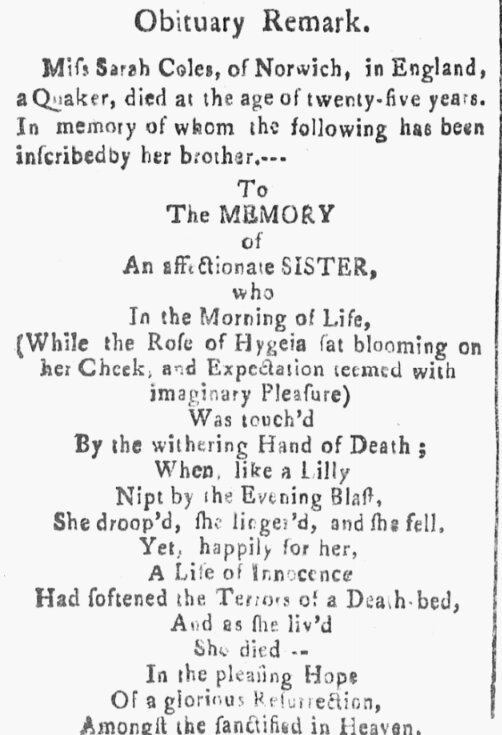
Here’s an example of an “obituary” in a 1789 newspaper. From it, we learn that Miss Sarah Coles was from Norwich, England, was a Quaker, and died at the age of 25. She also had a brother, who left this poem in her memory.
But as you study it, you’ll see that it lacks much detail: it’s a memorial poem to an English woman who died at an unknown time and location. These early newspapers reported on national and international news and did not always closely document their community.
In reality, we don’t see many women memorialized with an obituary in the 18th century or even early 19th. This is especially true for immigrants, people of color, and the poor. In addition, it’s not until later in time that we start seeing more biographical obituaries in the newspaper.
Tip: Death resulted in more than just obituaries. Make sure to also check for probate notices in the legal section and mentions of illness or a funeral in the gossip columns.
- A family member, friend, funeral home, or newspaper didn’t write an obituary.
The problem with obituaries is you don’t know who wrote them or who the informant was. Now, there are exceptions; I’ve seen some more recent obituaries that make it apparent that the deceased or a specific family member wrote it. But, in general you won’t know who informed or wrote the obituary.
So, what that means is that it’s not always clear that there was someone to write, pay and ask the newspaper to print the obituary. Consider who, if anyone, survived the person. Maybe the deceased were last in their family to die, so there was no one to inform or write the obituary. Maybe the remaining family didn’t think it was necessary. Maybe they died in poverty and so they were unlikely to have an obituary.
- The newspaper did not accept the obituary.
Not all newspapers accepted or printed obituaries, historically. Some may have demanded money to publish one. They may not have accepted content about all citizens. For example, they may not have accepted an African American’s obituary. Some citizens may have published an obituary in a newspaper that represented their community – but that would only be if they had the money or the newspaper printed obituaries. There are so many factors to consider whether an obituary was published or not. Reading more about the history of your ancestor’s local newspaper or reading the newspaper itself can help in determining whether a death notice or obituary would have been published at all.
- They couldn’t pay (if required) for an obituary.
Today, newspaper obituaries can be so expensive that they can be an out-of-reach cost for many families. Paying for a death notice or an obituary isn’t just a modern-day issue. Yes, historical newspapers often charged for an obituary.
This notice in an 1889 newspaper states that “Marriages, deaths, and contributed obituary notices at the same rates.” What are those rates? Well above that sentence are a series of prices, including 25 cents for notices of five lines in length, with 5 cents for each additional line.
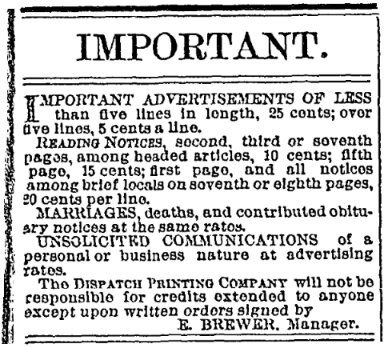
Assuming that a family was charged 25 cents for a 5-line obituary back in 1889, in today’s dollars that would be about $8 to $9. Not bad considering that today that same obituary may cost you $50 or more. But we need to remember that not everyone had the money to pay that $9 when you consider the other costs they would have incurred with a death.
- The deceased (or the family) did not want an obituary.
Are there people who don’t want a printed obituary after they die? Of course. Today, with funeral home pre-planning, a person can request or even write (and pay for) an obituary. But a person may have told their family they did not want an obituary for any number of reasons. In my family, one of my grandfathers did not want an obituary and neither he nor my grandmother had one. Why? I’m not sure but I think they may have felt that their death/life was information they did not want to share with the public. It’s just not a priority for everyone. Interestingly enough, he made sure his mother had a short obituary when she died.
Did They Have an Obituary?
I often say that I’m surprised when a researcher finds a grave marker on an ancestor’s burial place, because there are so many factors to consider when we think about whether a person gets a marker or not. Or even if it’s still legible and in the right place decades after their death.
The same could be said for newspaper obituaries. Not everyone had an obituary, so as you contemplate where your ancestor might appear in the newspaper, don’t stop at the obituary – look for other newspaper articles that document their death and life.
Create a free account at GenealogyBank for 7 days to start your journey and discover the stories your ancestors left behind.
Note on the header image: Common Burying Ground and Island Cemetery in Newport, Rhode Island. Credit: Matt H. Wade; Wikimedia Commons. [081016]
_______________
(1) Postman, Neil. Amusing Ourselves to Death. Public Discourse in the Age of Show Business. 20th Anniversary Edition. Penguin Books, 2005, p. 37.
(2) Beidler, James M. The Family Tree Historical Newspaper Guide. How to Find Your Ancestors in Archived Newspapers. Family Tree Books, 2018, p. 55.
(3) Ibid., p. 57.
