
 November 18, 2026
Introduction: In this article, to celebrate Thanksgiving, Melissa Davenport Berry describes the special Pilgrim Progress parade in Plymouth, Massachusetts. Melissa is a genealogist who has a website, americana-archives.com, and a Facebook group, New England Family Genealogy and History.
Pilgrim Progress is an annual reenactment honoring the 51 Mayflower passengers who survived their first harsh winter in the New World, 1620-1621, in Plymouth Colony, Massachusetts. According to this 1955 newspaper clip, the Pilgrim Progress reenactment started in 1921.
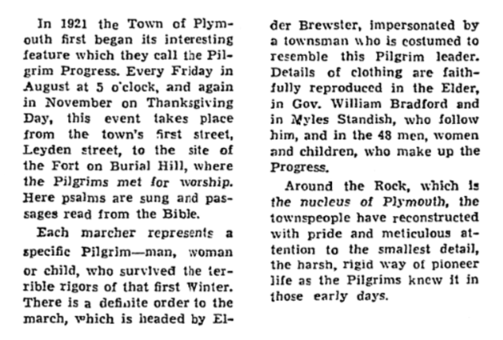
This article reports:
In 1921 the Town of Plymouth first began its interesting feature which they call the Pilgrim Progress. [It was in connection with the Plymouth Tercentenary celebration.]
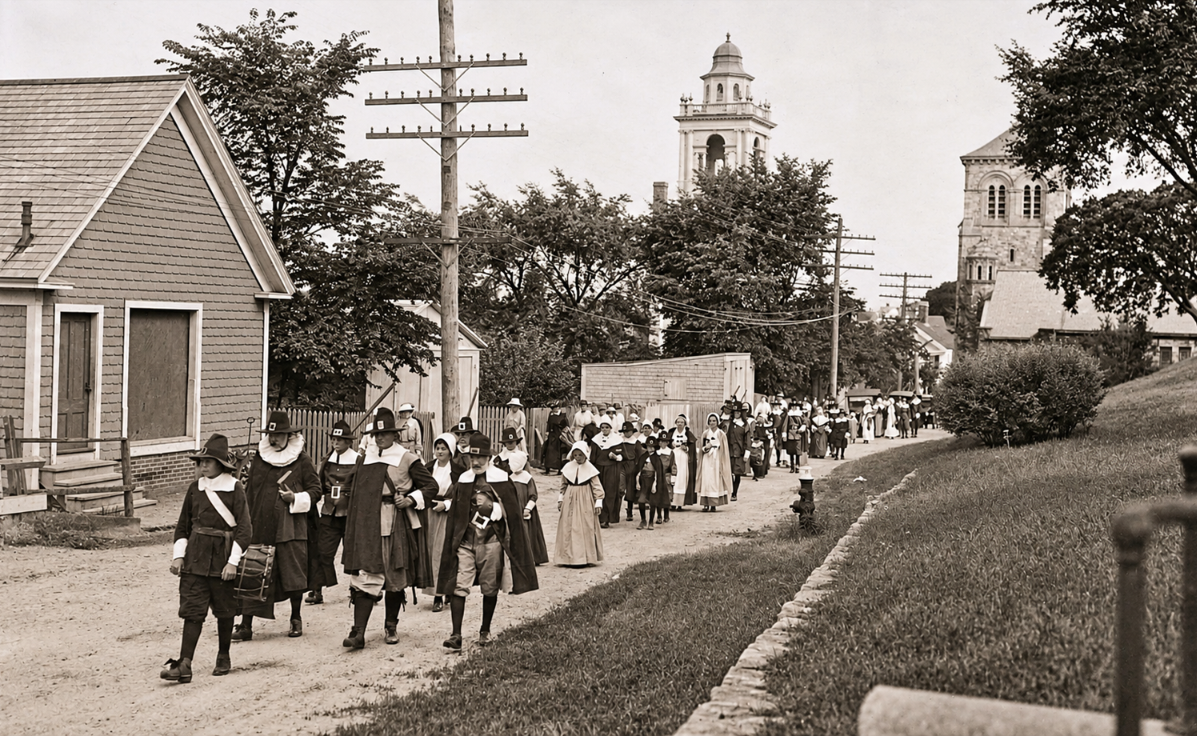
Every Friday in August at 5 o’clock, and again in November on Thanksgiving Day, this event takes place from the town’s first street, Leyden Street, to the site of the Fort on Burial Hill, where the Pilgrims met for worship. Here psalms are sung and passages read from the Bible. [Passages read by Elder Brewster are usually from Governor Bradford’s History or other Pilgrim sources.]
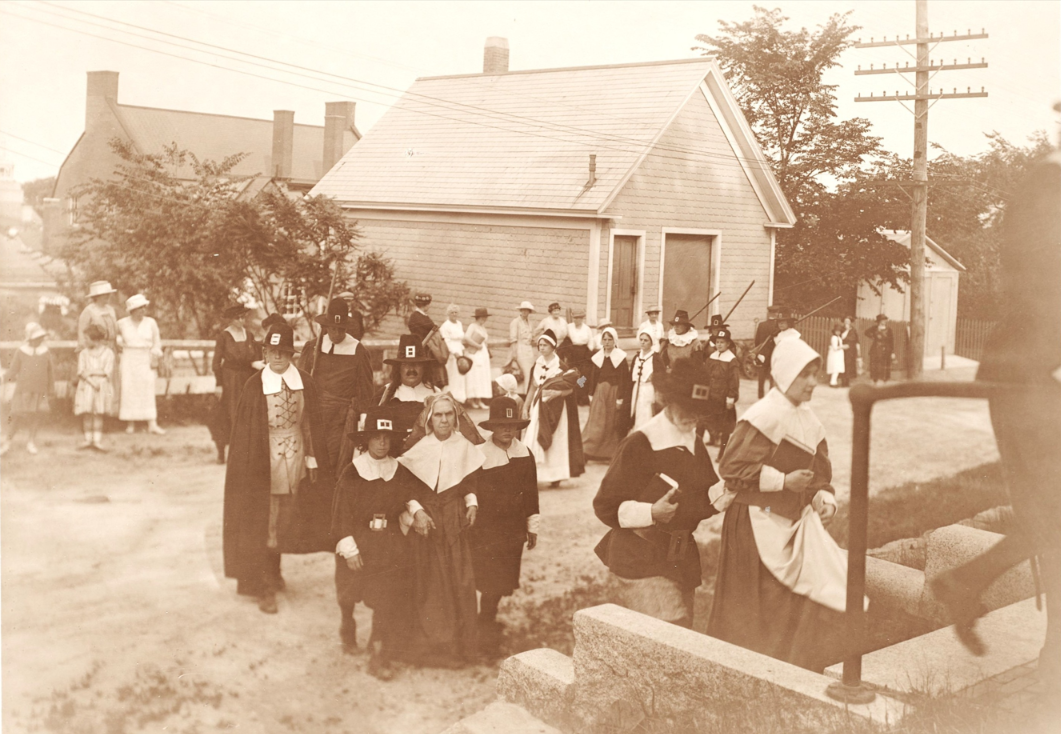
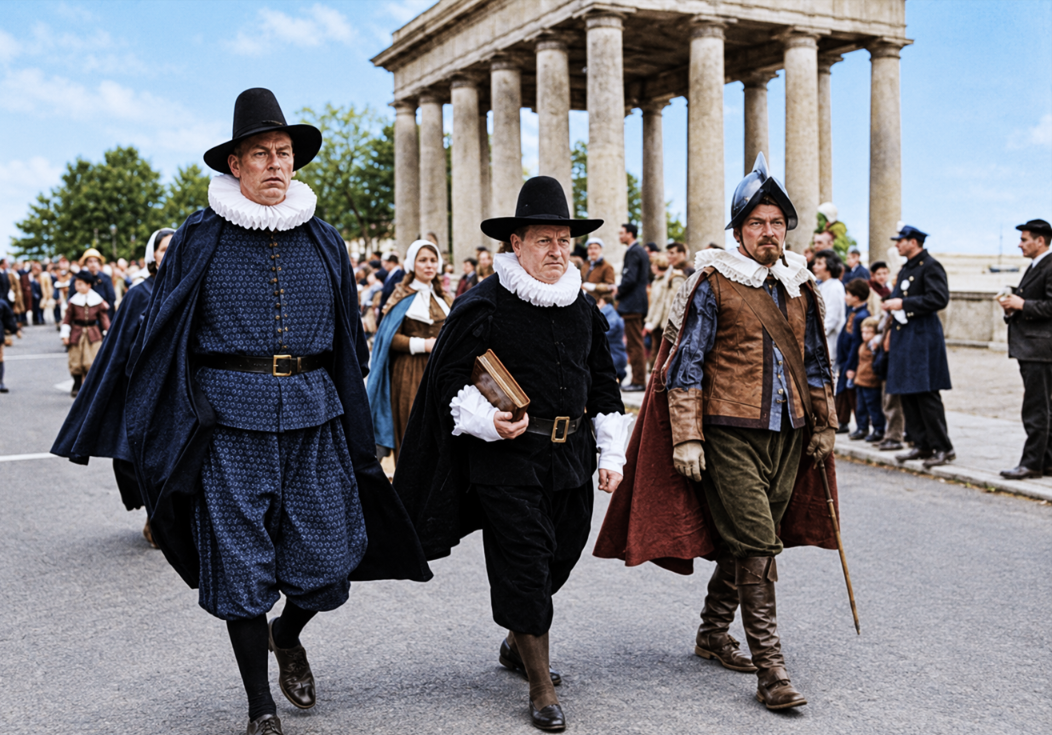
Each marcher represents a specific Pilgrim – man, woman, or child, who survived the terrible rigors of that first Winter. There is a definite order to the march, which is headed by Elder [William] Brewster, impersonated by a townsman [or descendant from anywhere in the United States] who is costumed to resemble this Pilgrim leader. Details of clothing are faithfully reproduced in the Elder, in Gov. William Bradford and in Myles Standish, who follow him, and in the 48 men, women, and children, who make up the Progress.
Around the Rock, which is the nucleus of Plymouth, the townspeople have reconstructed with pride and meticulous attention to the smallest detail, the harsh, rigid way of pioneer life as the Pilgrims knew it in those early days.
Some sources say the historical setting for this reenactment is taken from the account of a Dutch visitor, Isaack de Rasieres, secretary of the Dutch colony of New Netherland, who visited Plymouth in 1627 and described in a letter how the Pilgrims gather for worship, but it does not mention it was for this definite purpose. The passage comes from Three Visitors to Early Plymouth: Letters About the Pilgrim Settlement in New England During Its First Seven Years:
“New Plymouth lies on the slope of a hill stretching east towards the sea-coast, with a broad street about a cannon shot of 800 feet long, leading down the hill; with a [street] crossing in the middle, northwards to the rivulet and southwards to the land. The houses are constructed of clapboards, with gardens also enclosed behind and at the sides with clapboards, so that their houses and courtyards are arranged in very good order, with a stockade against sudden attack; and at the ends of the streets there are three wooden gates. In the center, on the cross street, stands the Governor’s house, before which is a square stockade upon which four patereros are mounted, so as to enfilade the streets. Upon the hill they have a large square house, with a flat roof, built of thick sawn planks stayed with oak beams, upon the top of which they have six cannon, which shoot iron balls of four and five pounds, and command the surrounding country. The lower part they use for their church, where they preach on Sundays and the usual holidays. They assemble by beat of drum, each with his musket or firelock, in front of the captain’s door; they have their cloaks on, and place themselves in order, three abreast, and are led by a sergeant without beat of drum. Behind comes the Governor, in a long robe; beside him on the right hand, comes the preacher with his cloak on, and on the left hand, the captain with his side-arms and cloak on, and with a small cane in his hand; and so they march in good order, and each sets his arms [guns] down near him. Thus, they are constantly on their guard night and day.”
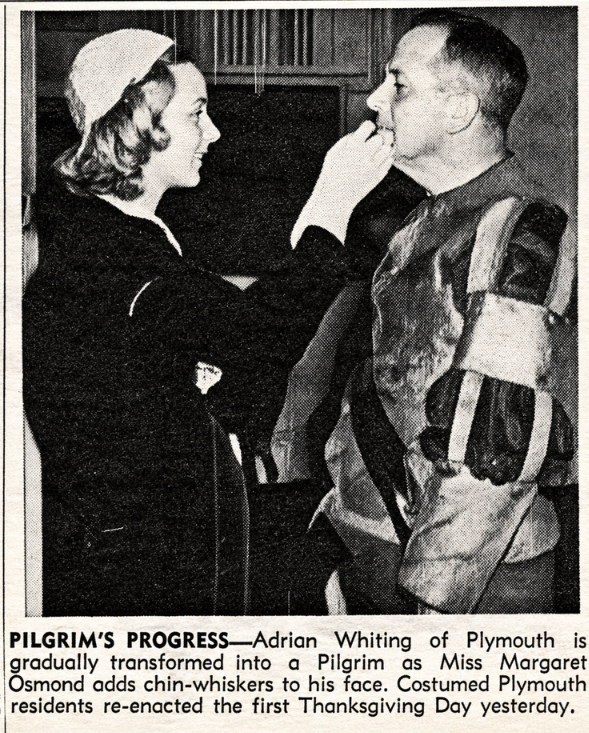
Here is a clip from 1946 featuring Adrian Whiting, who plays Capt. Myles Standish, being transformed into a Pilgrim as Miss Margaret Osmond helps with his makeup.
During the month of November in 1959, the Pilgrim Progress portrayal took place Thursday and Friday afternoons at Plymouth.
Here is a photo from the Daily Record.
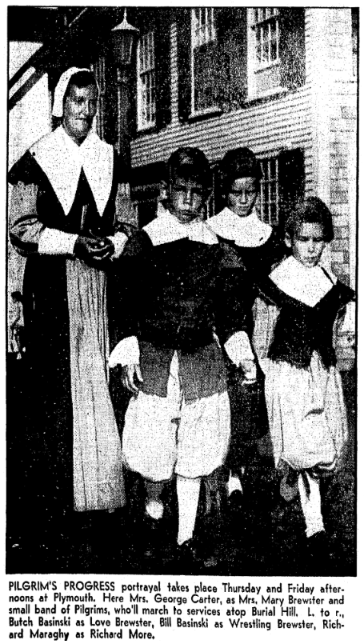
The photo caption reads:
Pilgrim’s Progress portrayal takes place Thursday and Friday afternoons at Plymouth. Here [are] Mrs. George Carter as Mrs. Mary Brewster and [a] small band of Pilgrims, who’ll march to services atop Burial Hill. Left to right: Butch Basinski as Love Brewster, Bill Basinski as Wrestling Brewster, Richard Maraghy as Richard More.
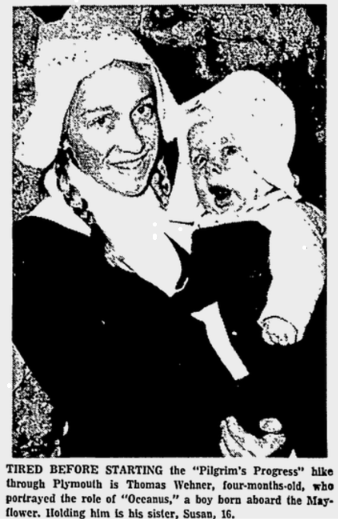
In 1966 the Patriot Ledger reported, “Thousands Mark Thanksgiving at Plimoth Plantation,” and featured a photo spread of some of the young children who were making the Pilgrim Progress that year.
The little costumed reenactors included four-month-old Thomas Wehner, playing Oceanus, a son born on the Mayflower to Stephen Hopkins and his wife Elizabeth, who is being held by his sister Susan Wehner. Oceanus is already yawning and the Pilgrim Progress parade has not even started!
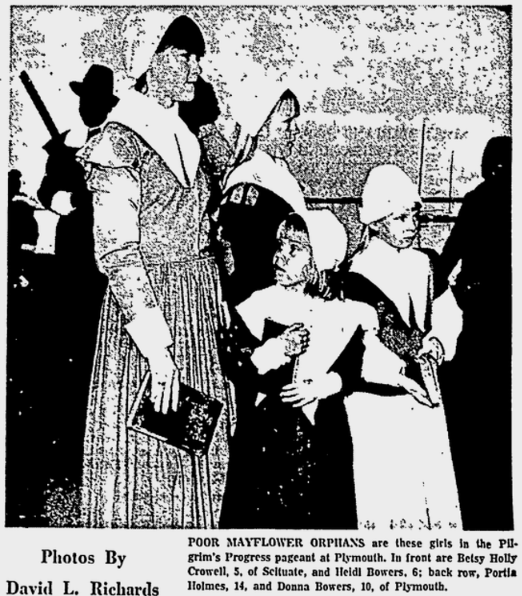
In this next photo, the “poor Mayflower orphans” who lost their parents in the first winter are played by the following: (front row left to right) Betsy Holly Crowell, 5, of Scituate; and Heidi Bowers, 6, of Plymouth; (back row left to right) Portia Holmes, 14, and Donna Bowers, 10, of Plymouth.
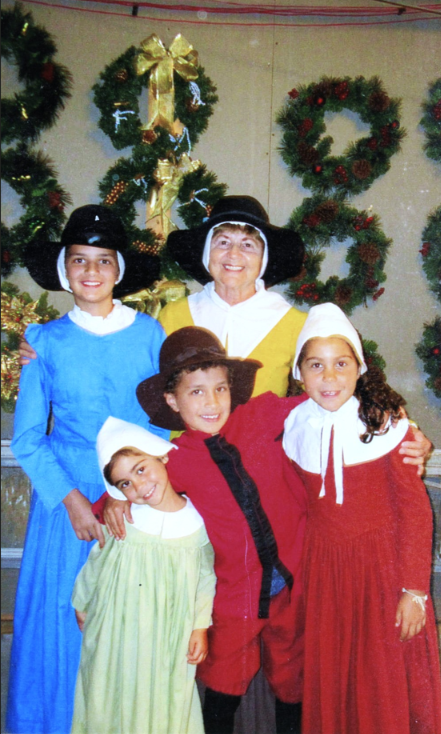
Below is a photo of Mayflower descendant Joanne Corrigan with her grandchildren taken at Mayflower Society House in 2017, ready for reenactment of Pilgrim Progress: (back row left to right) Lucely Duell, and Joanne Corrigan; (front row left to right) Ayla Pervier, Nathaniel Duell, and Anna Pervier.
Check out this video from the 2014 Pilgrim Progress, courtesy of Plymouth Community Network.
Happy Thanksgiving Peeps!
Note: some of the graphics in this article have been AI enhanced.
Create a free account at GenealogyBank for 7 days to start your journey and discover the stories your ancestors left behind.
Note on the header image: Pilgrim Progress postcard. Credit: New York Public Library’s Digital Library; Wikimedia Commons.
