
 November 16, 2026
Introduction: In this article, Katie Rebecca Merkley briefly describes Jane Austen’s life and works. Katie specializes in U.S. research for family history, enjoys writing and researching, and is developing curricula for teaching children genealogy. She has a website: krgarnergenealogy.com
English author Jane Austen (1775-1817) wrote six novels in the late 18th and early 19th centuries, and her books are still popular today. Many movie adaptations have been made of each book. Her works are considered a major inspiration to the Regency romance genre.
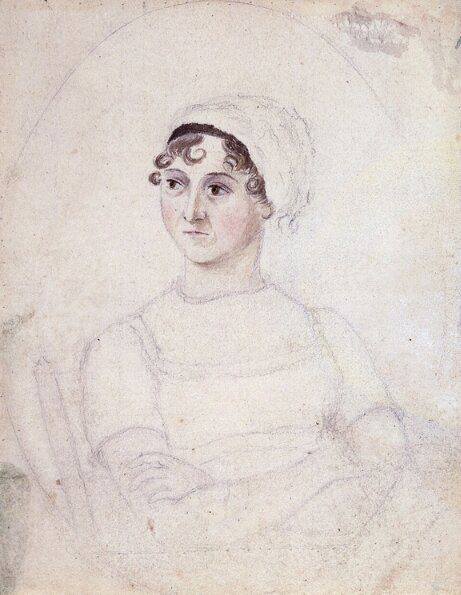
Jane Austen lived and wrote in England, yet she and her books were mentioned in U.S. newspapers. A brief biography of Jane Austen was written by her brother Henry Thomas Austen and printed in her novel Northanger Abbey (published posthumously). This biography was published in newspapers.
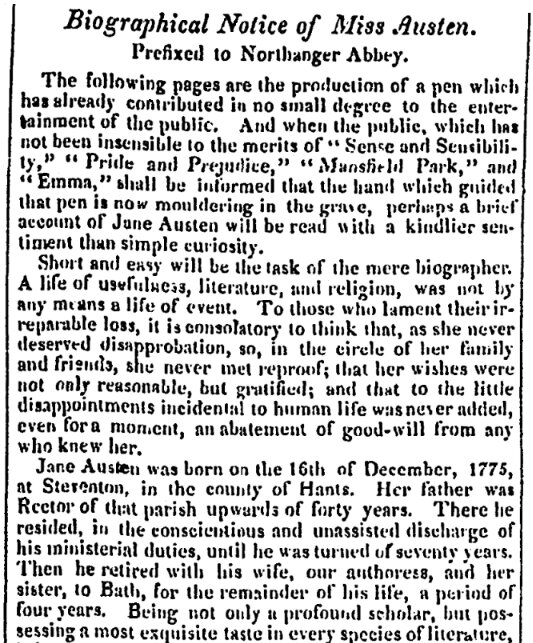
This article begins:
Biographical Notice of Miss Austen.
Prefixed to Northanger Abbey.“The following pages are the production of a pen which has already contributed in no small degree to the entertainment of the public. And when the public, which has not been insensible to the merits of “Sense and Sensibility,” “Pride and Prejudice,” “Mansfield Park,” and “Emma,” shall be informed that the hand which guided that pen is now mouldering in the grave, perhaps a brief account of Jane Austen will be read with a kindlier sentiment than simple curiosity.”
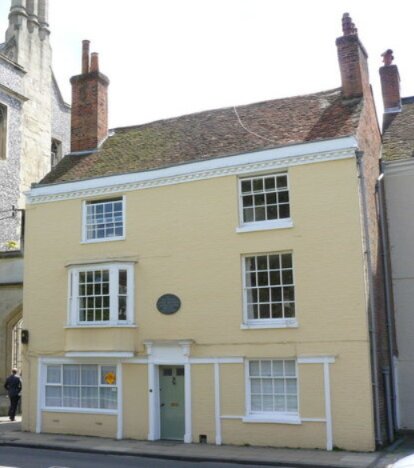
Jane Austen was born on 16 December 1775 in Steventon, Hampshire, England, where her father had been rector for at least four decades. He retired at 70 and took his family to Bath. They remained there until he died four years later. Then Jane Austen, along with her mother and sister, moved to Southampton for a short time, then to the “pleasant village of Chawton” in 1809.
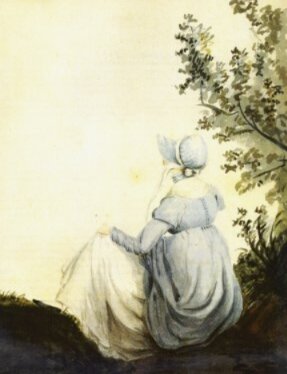
“From this place, she sent into the world those novels, which by many have been placed on the same shelf as the works of a D’Arblay and an Edgeworth. Some of these novels had been the gradual performances of her previous life. For though in composition she was equally rapid and correct, yet an invincible distrust of her own judgment induced her to withhold her works from the public, till time and many perusals had satisfied her that the charm of recent composition was dissolved.
“The natural constitution, the regular habits, the quiet and happy occupations of our authoress, seemed to promise a long succession of amusement to the public, and a gradual increase of reputation to herself. But the symptoms of a decay, deep and incurable, began to show themselves in the commencement of 1816. Her decline was at first deceitfully slow; and until the spring of this present year [1817], those who knew their happiness to be involved in her existence, could not endure to despair.
“But in the month of May 1817, it was found advisable that she should be removed to Winchester for the benefit of constant medical aid, which none even then dared to hope would be permanently beneficial. She supported, during two months, all the varying pain, irksomeness, and tedium, attendant on decaying nature, with more than resignation, with a truly elastic cheerfulness. She retained her faculties, her memory, her fancy, her temper and her affections, warm, clear, and unimpaired, to the last. Neither her love of God, nor of her fellow-creatures, flagged for a moment. She made a point of receiving the sacrament before excessive bodily weakness might have rendered her perception unequal to her wishes.
“She wrote whilst she could hold a pen, and with a pencil when a pen had become too laborious. [It should be noted that back then, a pen was a quill dipped in ink.] The day preceding her death she composed some stanzas replete with fancy and vigour. Her last voluntary speech conveyed thanks to her medical attendant; and to the final question asked of her, purporting to know her wants, she replied, ‘I want nothing but death.’
“She expired shortly after, on Friday, the 18th of July 1817, in the arms of her sister, who, as well as the relator of these events, feel too surely that they shall never look upon her like again.”
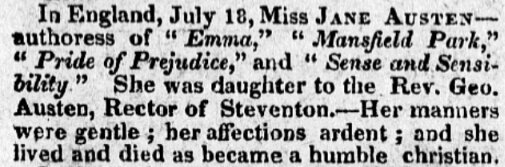
Shortly after Jane Austen’s death, notices were published in the newspapers and word reached America. The one below was posted in a Connecticut newspaper two months after her death.
With her books, Jane Austen left a legacy that has outlived her. Ads were posted in the newspapers for her books for years to come.
For example, an ad posted by Carey & Lea of New York in 1833 announced that they were selling Northanger Abbey. The book was written in 1803 and published 14 years later (on 20 December 1817), five months after the authoress died. The edition Carey and Lea were selling had a memoir prefixed to the book, presumably the brief biography discussed above.
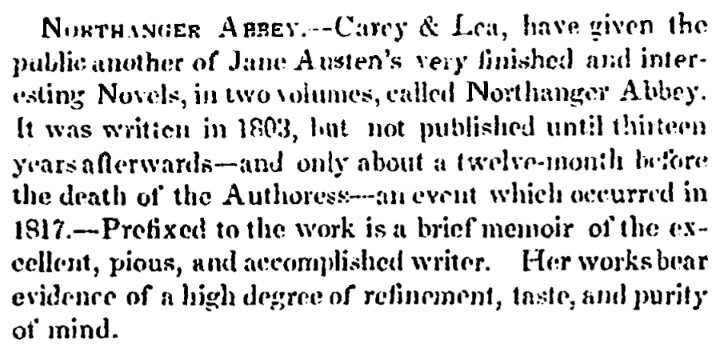
This ad reads:
Northanger Abbey. – Carey & Lea, have given the public another of Jane Austen’s very finished and interesting novels, in two volumes, called Northanger Abbey. It was written in 1803, but not published until [fourteen] years afterwards – [five months after] the death of the authoress – an event which occurred in 1817. Prefixed to the work is a brief memoir of the excellent, pious, and accomplished writer. Her works bear evidence of a high degree of refinement, taste, and purity of mind.
Jane Austen’s books are still sold in modern bookstores in paper or hardback. They are also available as eBooks and audiobooks.
I own a paperback copy of Pride and Prejudice. I would read it while waiting for the bus, which meant having to suddenly put it away when the bus approached. I can’t say how many times I was in the middle of reading Mrs. Bennett’s dialogue when that happened. Other Jane Austen books I listened to as audiobooks while riding public transit or doing chores. I’ve recently watched a few of the movie adaptations with my husband.
Jane Austen left a legacy through her books. That legacy lives on.
Create a free account at GenealogyBank for 7 days to start your journey and discover the stories your ancestors left behind.
Note on the header image: Jane Austen was a regular visitor to her brother Edward’s home, Godmersham Park in Kent, between 1798 and 1813. Credit: Adam Hincks / Godmersham Hall / CC BY-SA 2.0; Wikimedia Commons.
