
 October 23, 2026
Introduction: In this article – as Halloween approaches – Katie Rebecca Merkley concludes her two-part series about Edgar Allan Poe, the “Father of the Macabre.” Katie specializes in U.S. research for family history, enjoys writing and researching, and is developing curricula for teaching children genealogy. She has a website: krgarnergenealogy.com
Edgar Allan Poe, who died at the age of 40 under mysterious circumstances on 7 October 1849, was an American writer, editor and critic. He helped create the genres of detective fiction and science fiction. Most of all, he was known for his poetry and short stories, and is referred to as the “Father of the Macabre” for the Gothic horror in many of his poems and stories – such as “The Pit and the Pendulum” and “The Tell-Tale Heart.”
In Part 1 of this two-part series, we explored some stories by Edgar Allan Poe that were published in newspapers. With Part 2 today, the series concludes with articles posted about him and his works after his death.
An Infamous Obituary
Edgar Allan Poe died on 7 October 1849 in Baltimore. Below is the opening paragraph of a very long obituary, written by a man named “Ludwig,” that appeared the day after Poe was buried on Oct. 8.
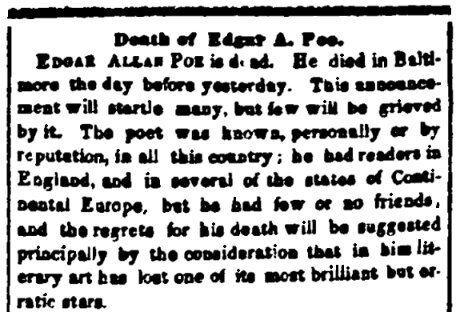
This opening paragraph reads:
Edgar Allan Poe is dead. He died in Baltimore the day before yesterday. This announcement will startle many, but few will be grieved by it. The poet was known, personally or by reputation, in all this country; he had readers in England, and in several of the states of Continental Europe, but he had few or no friends, and the regrets for his death will be suggested principally by the consideration that in him literary art has lost one of its most brilliant but erratic stars.
“Ludwig” turned out to be Poe’s literary rival Rufus Wilmot Griswold, and he wrote the obituary, filled with falsehoods, to harm Poe’s reputation.
The obituary describes his family as “one of the oldest and most respectable in Baltimore.” His grandfather, David Poe, served as a quartermaster-general during the Revolutionary War and was a friend of Lafayette.
His great-grandfather, John Poe, married Jane, the daughter of Admiral James McBride. McBride was noted in British naval history and was connected to “some of the most illustrious English families.”
Edgar Allan Poe’s father abandoned the family the year after Edgar was born, and his mother died of consumption the next year. John Allan, a wealthy gentleman of Richmond, Virginia, “took a fancy to him and persuaded Poe’s grandfather to [let] him adopt him.” Mr. Allan had no children of his own and regarded Edgar as a son – though he never formally adopted him. Edgar went to school in England from 1816 to 1822 and, in 1825, attended Jefferson University in Charlottesville, Virginia.
Poe left the country for Europe after college and returned home in 1829.
Meanwhile, Mr. Allan’s first wife died, and he remarried someone much younger.
Poe did not get along with the new wife, and they quarreled. Mr. Allan took his wife’s side, which led to angry letters. By the time Mr. Allan died, he’d had a child, who became his heir. Poe was left with nothing.
Poe began making his living by writing, publishing poems from his youth in 1827. The obituary then details his writing career. He was a brilliant writer, but his journal articles received little attention.
In 1831, Poe submitted articles for a writing contest held by the proprietor of the Baltimore Gazette. The committee was impressed with Poe’s work. Poe then became an editor of a recently established periodical, where he worked for a year and a half. He married during that time. He later went to Philadelphia to help edit a periodical, then to New York for another job.
His wife died in 1847, and Poe lived quietly off his writing income.
Griswold’s obituary of Poe includes this paragraph:
As a writer of tales it will be admitted generally, that he was scarcely surpassed in ingenuity of construction or effective painting. As a critic, he was more remarkable as a dissector of sentences than as a commenter upon ideas; he was little better than a carping grammarian. As a poet, he will retain a most honorable rank.
Cause of Death
We do not know what caused Poe’s death – it remains a mystery. This newspaper speculated that he, like other geniuses, died of intemperance.
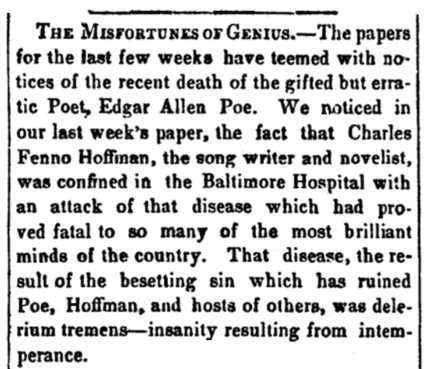
Decades later, the Philadelphia Inquirer published a very different story of how Edgar Allan Poe died.
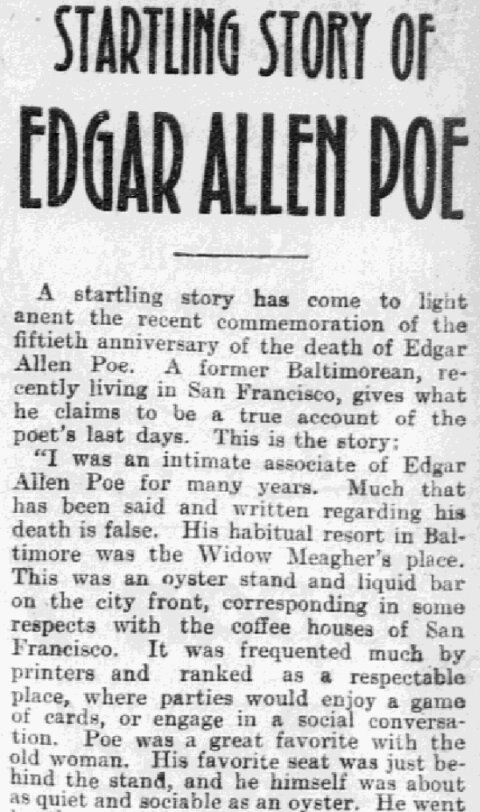
This article reports:
A former Baltimorean, recently living in San Francisco, gives what he claims to be a true account of the poet’s last days. This is the story:
“I was an intimate associate of Edgar Allan Poe for many years. Much that has been said and written regarding his death is false.
“…It was the night before election, and four of us, including Poe, started up town [in Baltimore]. We had not gone half a dozen squares when we were nabbed by a gang of men, who were on the lookout for voters to ‘coop.’
“It was a practice in those days to seize people, whether drunk or sober, lock them up until the polls were opened, and then march them around to every precinct, where they were made to vote the ticket of the party that controlled the coop. Our coop was in the rear of an engine house on Calvert Street. It was part of the game to stupefy the prisoners with drugged liquor. Well, the next day we were voted at thirty-one different places, and over and over, it being as much as a man’s life was worth to rebel. Poe was so badly drugged that after he was carried on two or three different rounds the gang said it was no use to vote a dead man any longer, so they shoved him into a cab and sent him into a hospital to get him out of the way.
“The commonly accepted story that Poe died from dissipation is bosh. He died from laudanum or some other poison that was forced upon him in the coop. He was in a dying condition while he was being voted around the city. The story by Griswold of Poe’s having been on a week’s spree, and being picked up on the street, is false. I saw him shoved into the cab myself and he told me he had just arrived in the city.”
Post-Mortem Book Publication
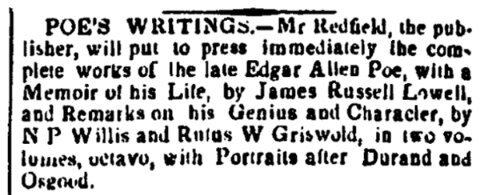
A publisher, Mr. Redfield, printed the complete works of Edgar Allan Poe, along with a memoir of his life, just weeks after Poe died.
Monument
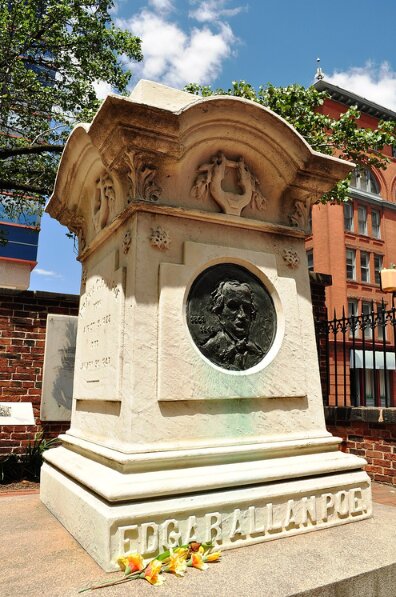
A monument to honor Edgar Allan Poe was erected on his grave in 1875 in Baltimore.
Celebrate Halloween by reading Edgar Allan Poe’s works. Some of his stories are macabre enough to give an edginess to your celebrations.
Create a free account at GenealogyBank for 7 days to start your journey and discover the stories your ancestors left behind.
Note on the header image: a drawing of Edgar Allan Poe made from the “Ultima Thule” daguerreotype by Mathew Benjamin Brady, before 1849. Credit: National Archives at College Park.
Related Articles:
