
 October 22, 2026
Introduction: In this article – as Halloween approaches – Katie Rebecca Merkley writes about Edgar Allan Poe, the “Father of the Macabre.” Katie specializes in U.S. research for family history, enjoys writing and researching, and is developing curricula for teaching children genealogy. She has a website: krgarnergenealogy.com
Edgar Allan Poe, who died at the age of 40 under mysterious circumstances on 7 October 1849, was an American writer, editor and critic. He helped create the genres of detective fiction and science fiction. Most of all, he was known for his poetry and short stories, and is referred to as the “Father of the Macabre” for the Gothic horror in many of his poems and stories – such as “The Pit and the Pendulum” and “The Tell-Tale Heart.”
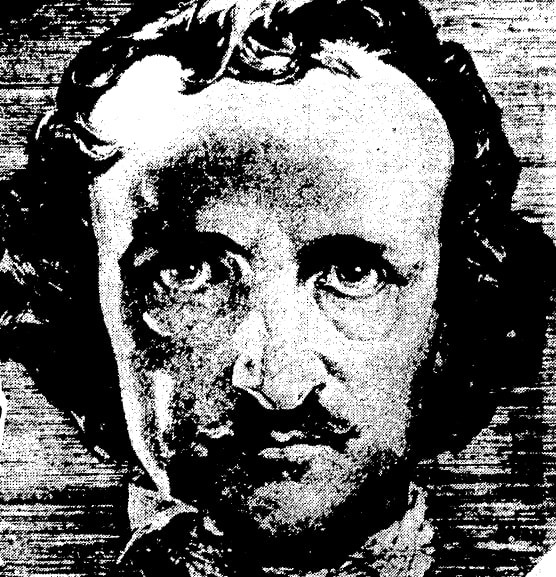
Many people celebrate Halloween by watching horror movies and reading horror stories. Edgar Allan Poe was well known for his creepy writings, so his works are perfect entertainment for Halloween. So are the newspaper articles written about him.
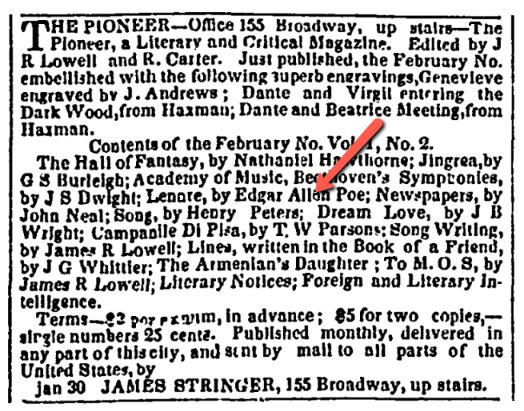
Advertisements
James Stringer, editor of the Pioneer magazine, advertised the newly released February 1843 issue in the newspaper. The ad listed contributors, including Edgar Allan Poe, author of the poem “Lenore.”
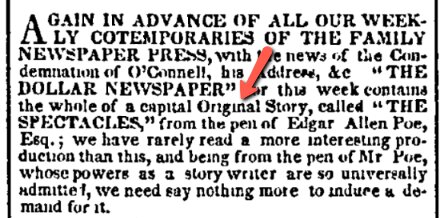
Another newspaper ran an advertisement announcing that it contained “the whole of a capital Original Story, called ‘The Spectacles,’ from the pen of Edgar Allan Poe, Esq.”
The advertisement sang Poe’s praises:
“We have rarely read a more interesting production than this, and being from the pen of Mr. Poe, whose powers as a story writer are so universally admitted, we need say nothing more to induce a demand for it.”
Stories
Some of Edgar Allan Poe’s stories were published in newspapers, such as “The Gold Bug; Or, The Treasures of Kidd,” in an 1849 newspaper.
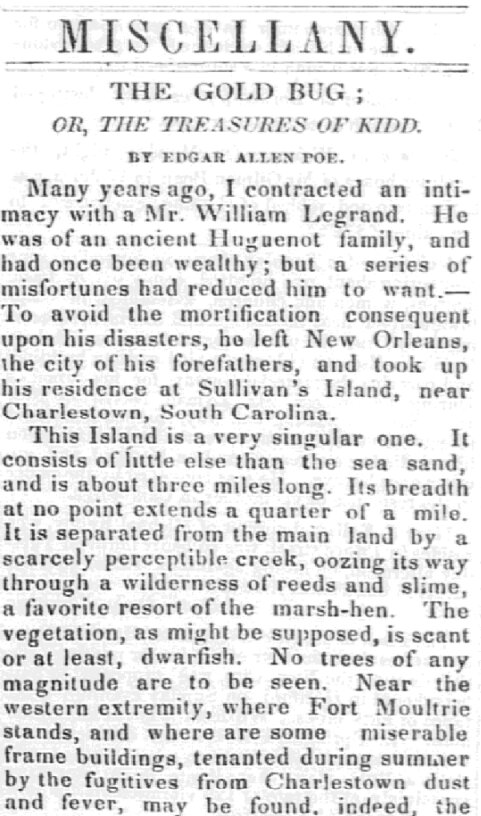
In this story, a Mr. William Legrand, from an old Huguenot family, had lost his wealth and moved from New Orleans to Sullivan’s Island near Charlestown, South Carolina, where he lived in a hut and befriended the narrator.
Another character, Jupiter, had been freed before the Legrand family lost its fortune but stayed with “Massa Will” on the island.
The story begins when the narrator visits Legrand. Legrand arrives with Jupiter, excited about a scarab beetle. Days later, Legrand sends Jupiter to bring the narrator back, persuading him to join an expedition with them and their dog.
The expedition enters a dense mainland forest, where Legrand sends Jupiter up an oak tree to drop the beetle through the eye of a skull nailed to a branch.
After measuring from where the beetle falls, they dig unsuccessfully, realize Jupiter used the wrong eye hole, remeasure, and uncover skeletons and treasure, which takes several trips to carry home.
Another story, called “The Business Man,” was published in an 1843 newspaper. In this story, the narrator is the main character, Peter Proffit. The story begins with an essay on method versus genius; Peter claims not to be a genius and disdains genius in general.
Here is an interesting passage in the story about his childhood:
“My notions upon this head might not have been so clear as they are, nor should I have been so well to do in the world as I am, but for a fortunate accident which happened to me when I was a very little boy. A good-hearted old Irish nurse (whom I shall not forget in my will) took me up one day by my heels, when I was making more noise than was necessary, and swinging me round two or three times… then knocked my head into a cocked hat against the bed-post. This, I say, decided my fate, and made my fortune. A tremendous bump got up at once on my [head], and turned out to be as pretty an organ of order as one shall see on a summer’s day. Hence that positive appetite for system and regularity which has made me the distinguished man of business that I am.”
At age 15, Peter’s father got him a job in the countinghouse of a hardware merchant, which the narrator called “a capital bit of fiddlestick!” A few days later, he had to be sent home to his “button-headed family” due to a fever. This sickness prevented him from continuing work with that employer.
Peter ran away from home at age 16, after overhearing his mother’s plans to set him up to work for a grocer. He determined to secure himself a decent occupation.
Peter ran a business as a Tailors’ Walking Advertisement, which involved going out wearing a suit made by the tailor and sending customers to that tailor. He left that employer over a price discrepancy of one or two pennies.
Peter’s next business was the Eye-Sore trade, which consisted of setting up shop near building projects and commissioning “an ornamental mud hovel right against it.” They could not afford to take these down, and the narrator thought being asked to do so was unreasonable. This business ended with his imprisonment.
The next business was the Assault and Battery business, “into which I was now forced to adventure for a livelihood.” Peter would antagonize people until they assaulted him, then consult his lawyer on how much to sue for. This wasn’t very profitable, and the narrator found it “too much for my delicate state of body.”
Peter’s next business was Mud-Dabbling, which he did with his dog. The dog, covered in mud, would get a dandy to pet him. The dandy, covered in mud, would look for someone to clean him up. This is where Peter came in with his blacking and brushes. He split the profits with his dog:
“I allowed him a third of the profits, but he was advised to insist upon half. This I couldn’t stand – so we quarreled and parted.”
The next business venture was Organ-Grinding, which he also eventually abandoned.
The next business venture was Sham Post, which consisted of writing fake letters from faraway places, delivering them to big houses, and collecting the postage. This gave him “serious scruples of conscience,” and people began cursing his fake names.
His final venture was in cats. The town, being overrun with cats, petitioned for relief. The Cat Act first took cat heads, then changed it to tails. So, Peter Proffit invested his whole estate in buying cats and kittens, and made an annual profit selling their tails to the government.
Stay tuned for more from Edgar Allan Poe!
Create a free account at GenealogyBank for 7 days to start your journey and discover the stories your ancestors left behind.
Note on the header image: Edgar Allan Poe, c. May-June 1849. Credit: Wikimedia Commons.
Related Article:
