
 September 21, 2026
Introduction: In this article – the third in a four-part series – Katie Rebecca Merkley continues the story of Mary Drapoe’s astonishing eight marriages! Katie specializes in U.S. research for family history, enjoys writing and researching, and is developing curricula for teaching children genealogy. She has a website: krgarnergenealogy.com
Genealogy is more than gathering names and dates. Sometimes newspaper articles provide juicy details about our ancestors that go far beyond the vital information and make our research more interesting. This was certainly the case when I researched Mary J. Drapoe.
The previous installments of this series (see links at the end) focused on marriage data and follow-up research into Mary’s eight marriages. I examined 10 different newspapers and correlated their data. The newspapers reveal more than just whom Mary married and when. They provide details about the drama and show us the kind of person she was.
Photo credit: https://depositphotos.com/home.html
More Drama
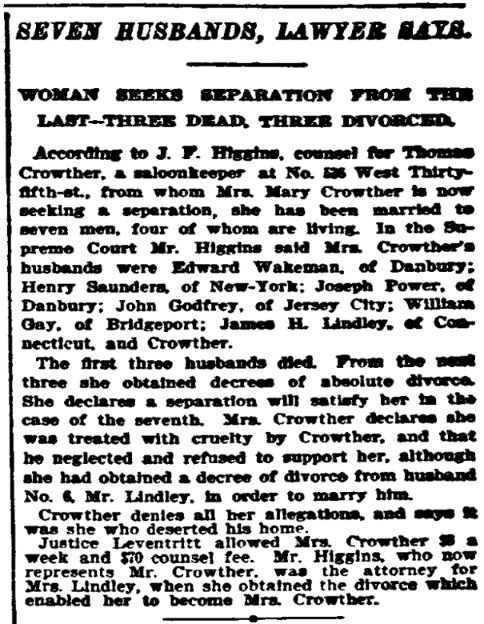
In the report by J. F. Higgins, Thomas Crowther’s divorce lawyer (Thomas was husband #7), Mrs. Crowther accused her husband of neglecting her and refusing to support her. Mr. Crowther denied all allegations and said she had abandoned him.
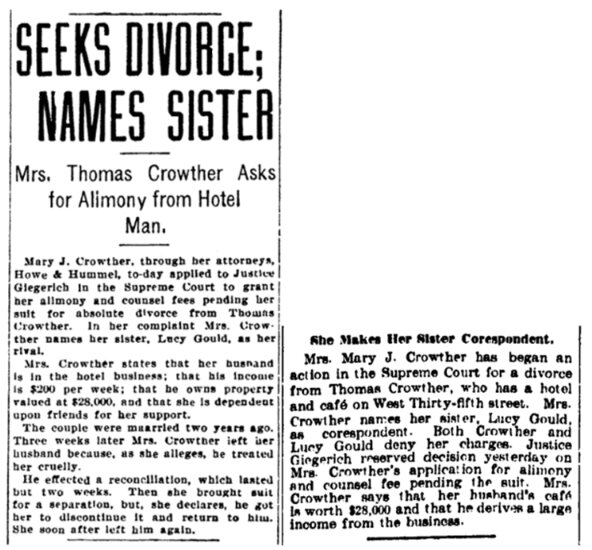
Another article about Mary’s appearance in court with her lawyers provides additional details about her marriage to Thomas Crowther. They had married two years earlier, and three weeks later she left him because he’d been cruel to her. He’d attempted reconciliation; she returned only to leave again. She also named her sister, Lucy Gould, as her rival.
In her article “What I Know About Husbands,” Mrs. Wakeman-Saunders-Powers-Godfrey-Gay-Lindley-Crowther discusses how she wooed so many husbands, referring to them as conquests. She says:
“It is the easiest thing in the world to get a husband if you only go about it in the right way.”
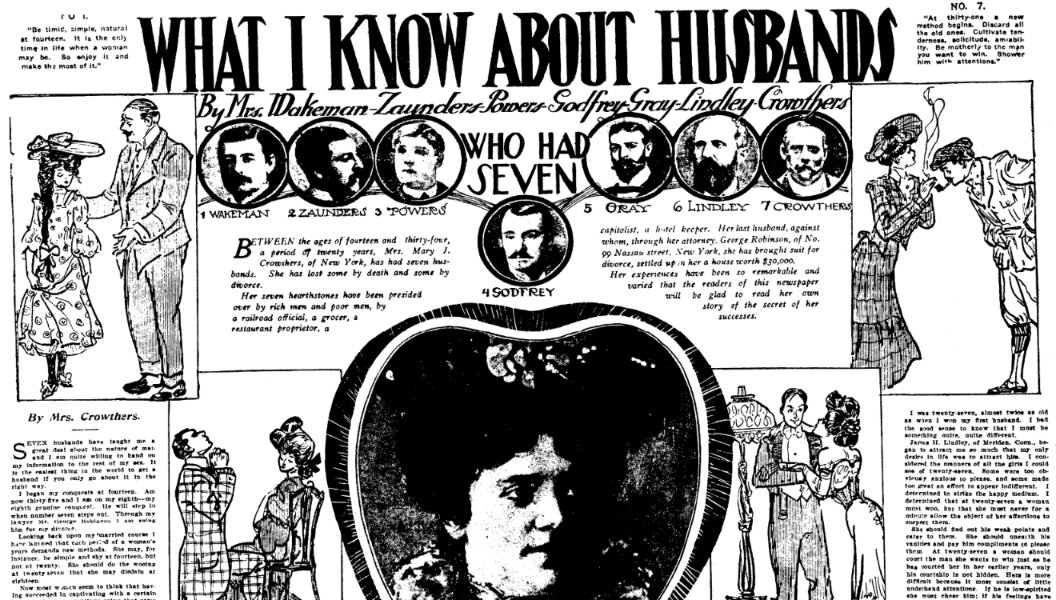
In this article, Mary goes into detail about her husband-catching behavior at each age. She calls it a fatal mistake for a woman to use the same manner of wooing “from girlhood to maturity.” She may, for instance, be simple and shy at 14, but not at 20. She should do the wooing at 27 that she may have disdained at 18.
After detailing the wooing behavior for each age, Mary goes on to describe each of her marriages. Of interest is the description of her second husband, Henry Saunders. He was a rich man who surrounded her with luxury. She was happy until his death. The articles about alimony suits involving Crowther mentioned his substantial income. It seems that Mary liked rich men.
When Mary picked out her third husband prospect at age 21, she discovered her earlier methods of wooing husbands did not work on him. So, she had to try another approach. This new method involved being proud and haughty, dominating and leading. No longer was she pretending to be innocent, but had decided what she wanted to be admired for: she determined that if a man thinks a girl can take care of herself, he can be certain she can take care of him.
In her discourse on wooing her 4th husband, Mary gives a physical description of herself: coal black hair and grey eyes. She considered herself slim and girlish at age 23.
The change in strategy between ages 21 and 23 was successful in wooing John Godfrey, husband #4. However, she quickly found she’d “drawn a very bad blank.” She was unhappy. She divorced him and thought she’d never love again. But she soon found another husband prospect and devised another method to catch him.
With the next few husbands, she’d pick out her man, figure out the best method to woo him, and succeed in doing so. But after each marriage she discovered it was a mistake, or was happy for only a short time, so she’d get another divorce.
Mary was 31 when she had decided to woo her seventh husband, Thomas Crowther, the husband she was divorcing at the time of writing her newspaper article. Her method when she had courted him involved making herself necessary for him and flattering him:
“I had wooed him by flattery of every sort, and I have found that from a woman of thirty a man can stand any amount of it. All that she must be careful about is to make it seem sincere.”
Mary had already set her sights on her eighth husband, and in her article she describes her planned methods for wooing him. It was successful.
The last few paragraphs of the article reveal Mary’s attitude about marriage. She had determined that the best way to “try a man” is by marriage. She had tried marriage seven times and was hopeful that the eighth time would be the charm. (It wasn’t.)
According to one of the articles posted while Mary was divorcing Thomas Crowther, she’d become engaged to marry William I. Post. (She actually broke off that engagement, and instead married William LePage as her next husband.) Note: the newspapers were having trouble keeping track of Mary’s many marriages. This article mistakenly says Thomas Crowther was her eighth husband, when he was her seventh.
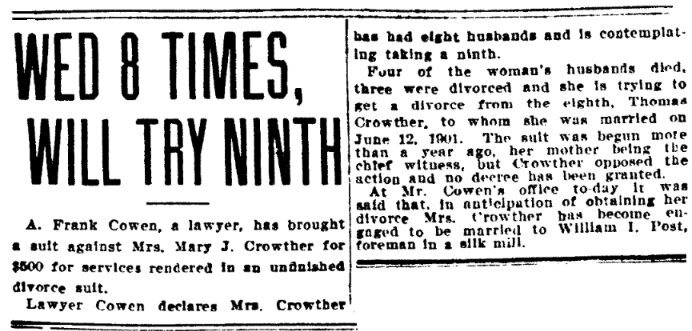
This next article correctly identifies William LePage as her eighth husband.
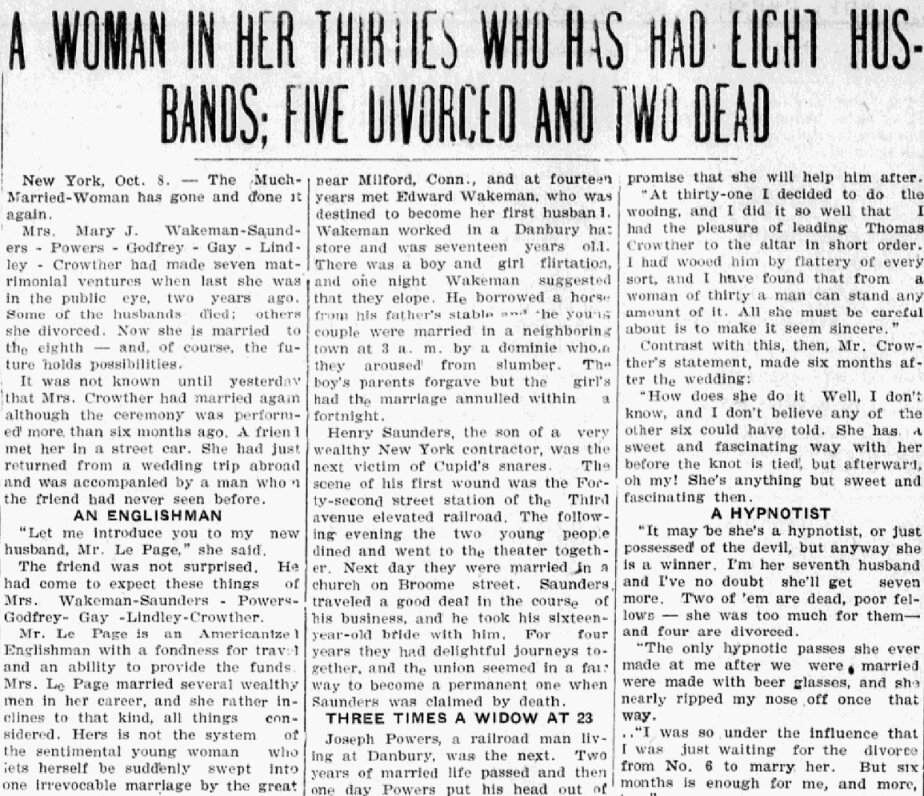
This article reports that Mr. LePage had a fondness for travel and “an ability to provide the funds.” The article acknowledges Mary’s preference for marrying rich men. It also points out that, at least twice, she remarried within 24 hours of divorcing!
Stay tuned to learn more drama from Mary J. Drapoe’s marriages and divorces in the fourth and concluding article in this series.
Create a free account at GenealogyBank for 7 days to start your journey and discover the stories your ancestors left behind.
Note on the header image: wedding cake and champagne glasses. Credit: https://depositphotos.com/home.html [061626]
Related Articles:
