
 October 21, 2026
Introduction: In this article, with Halloween approaching, Melissa Davenport Berry writes more about ghost hunter John Parker, focusing on a spooky house in Springfield, Massachusetts. Melissa is a genealogist who has a website, americana-archives.com, and a Facebook group, New England Family Genealogy and History.
Today I resume my series on John Cuthbert Parker (1904-1997), architect, artist, and famous paranormal investigator, who bewitched a whole generation of New Englanders with his tales of ghost hunting on some of the most infamous haunted historical properties.
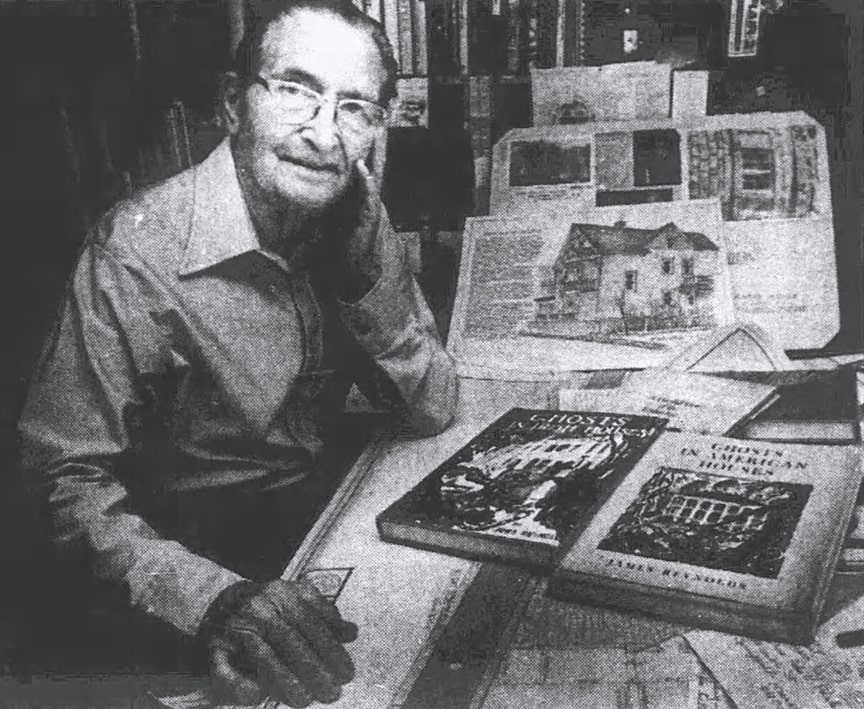
Parker’s lectures, known as “Ghost Houses of New England: Their Legends and Architecture,” were booked solid and included an illustrated slide show, his watercolor sketches of the homes he investigated, and pamphlets on ghost hunting with a full survey road map.
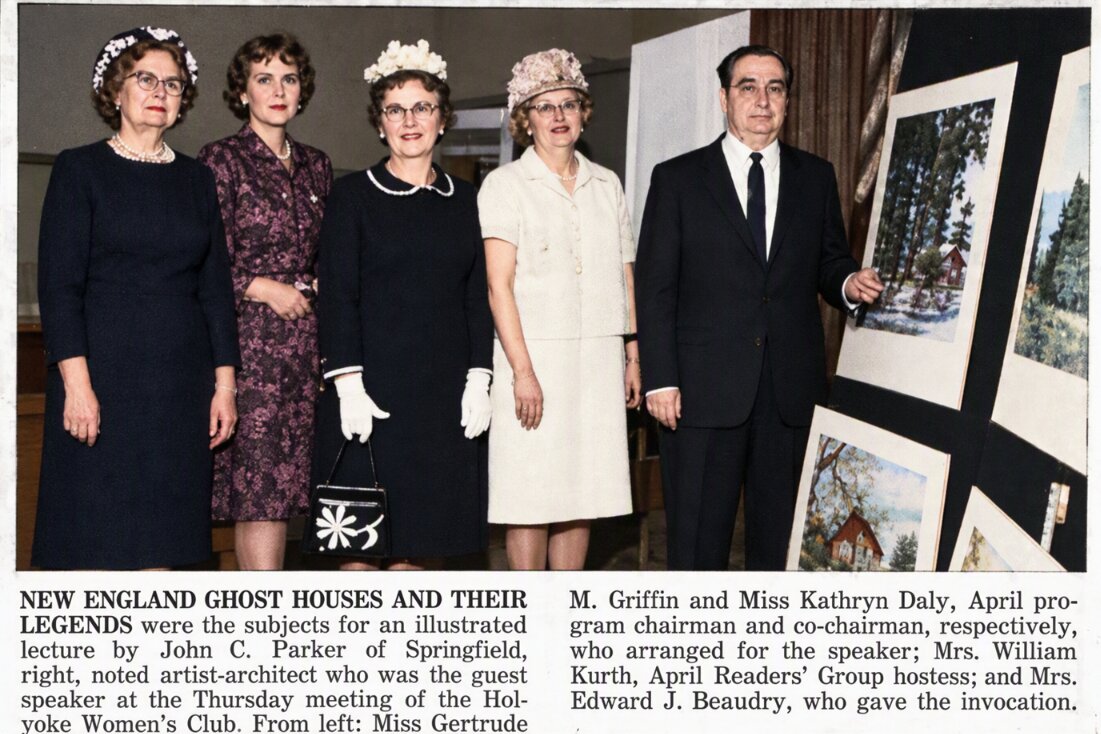
Below is a photo of Parker with members of the Holyoke Women’s Club, taken on 6 April 1968 after his lecture on New England ghost houses.
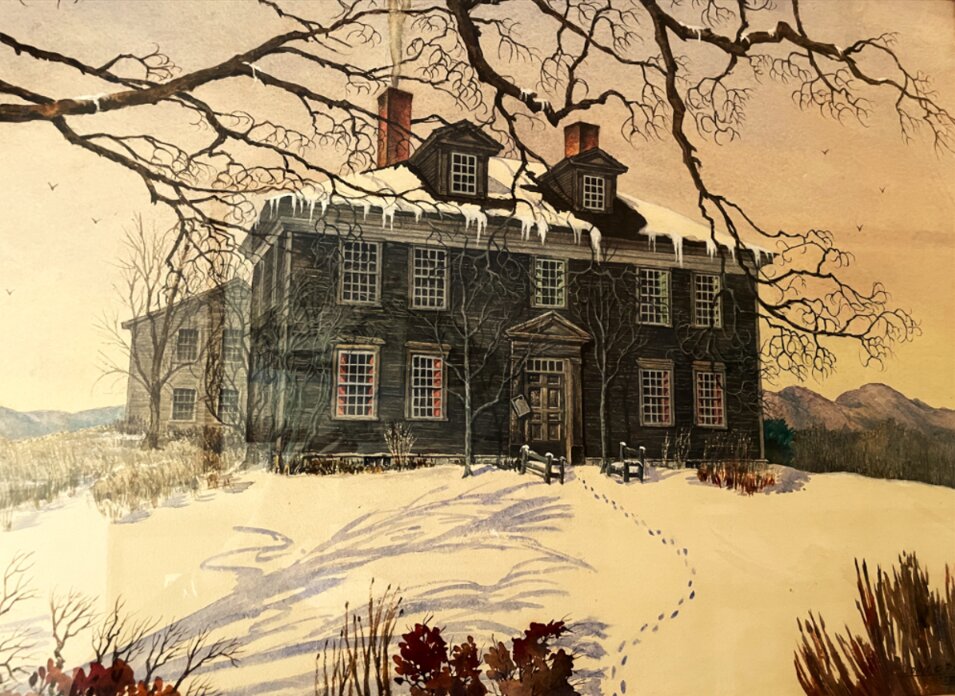
During his career Parker covered over 30 spook dens, which included Jonathan Moulton House in Hampton, New Hampshire, Green Mountain Tavern (aka the Second Bowker Tavern) in Savoy, Massachusetts, the Ocean-Born Mary House in Henniker, New Hampshire, and Porter-Phelps-Huntington House in Hadley, Massachusetts, where he became director and official historian.
Here is a news clip reporting on one of Parker’s lectures, presented to the Penelope Terry Abbey Chapter, Daughters of the American Revolution (DAR) at the Enfield, Connecticut, Congregational Church in 1960.
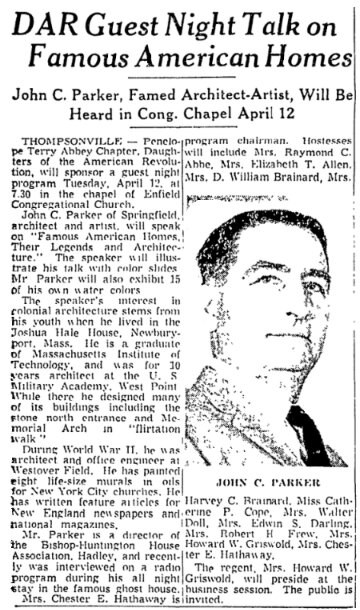
This article reports:
The speaker’s [Parker] interest in colonial architecture stems from his youth when he lived in the Joshual Hale House, Newburyport, Mass. [He had his first ghost encounter there.]
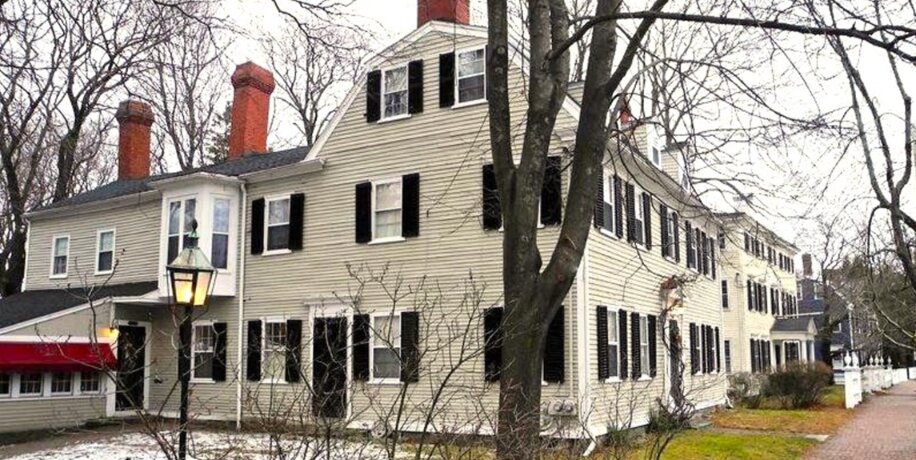
He is a graduate of Massachusetts Institute of Technology, and was for 10 years architect at the U.S. Military Academy, West Point. While there he designed many of its buildings including the stone north entrance and Memorial Arch in “flirtation walk.”
During World War II, he was architect and officer engineer at Westover Field [in Chicopee, Massachusetts.] He has painted eight life-size murals in oils for New York City churches. He has written feature articles for New England newspapers and national magazines.
Some of his most interesting experiences were investigating haunted houses. This Springfield Union article reports on a poltergeist (noisy ghost) investigation that started out with real promise – but ended up creating a situation that Parker called a real “Stinkeroo.”
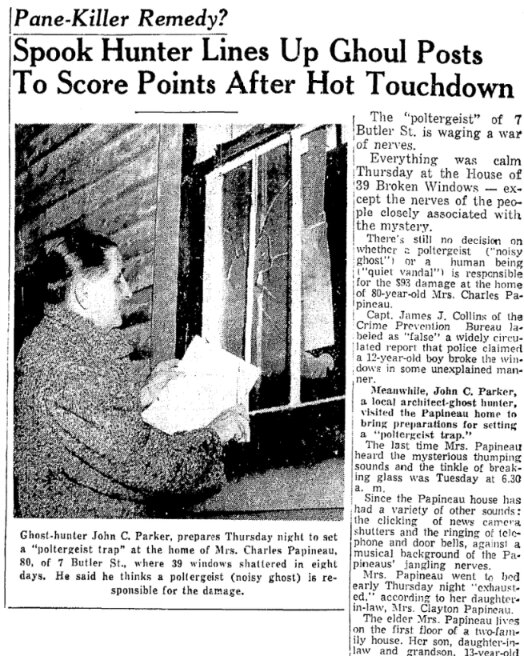
Parker was called to visit a home at 13 Butler Street in Springfield, Massachusetts, on 12 January 1959, where 39 windows were mysteriously blown out from the inside.
The owner, Mrs. Charles Papineau, was an 80-year-old widow who was scared and perplexed. Her home was under siege by an unexplainable phenomenon and a legion of reporters.
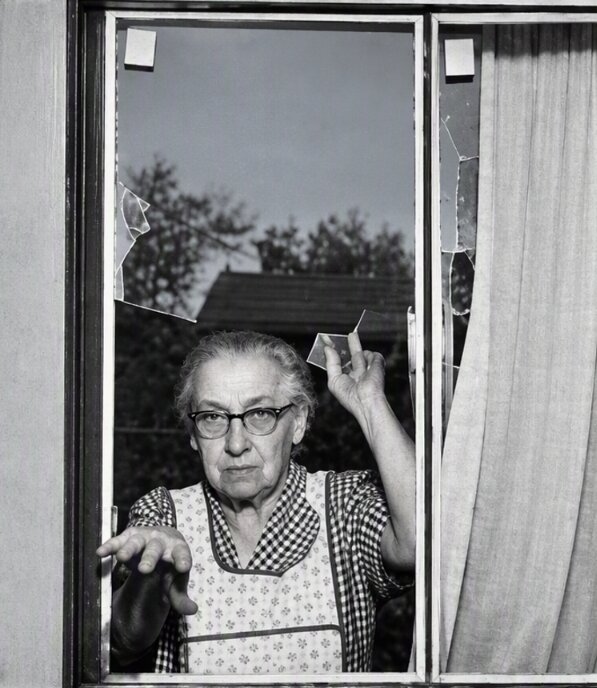
At first the woman thought vandals were responsible. Then a pane quivered and broke right before her eyes.
The mysterious window shattering began on January 6, and Captain James J. Collins of the Crime Prevention Bureau detected no criminal activity.
A team of expert engineers, meteorologists, and architects had no scientific explanation.
However, Parker was convinced that a demonic attack had caused the breakage and his solution was to prepare a “poltergeist trap.” He referenced a similar case in Seaforth, Long Island, where objects were exploding.
According to Parker’s daughter Wilma, who accompanied her father at the scene, the poltergeist was manifested by a mix of opposite energy forces. In the Papineau case, an older energy generating from Mrs. P. opposed a younger energy, which would be her 13-year-old grandson, Wayne, who lived on the 2nd floor of the house with his parents.
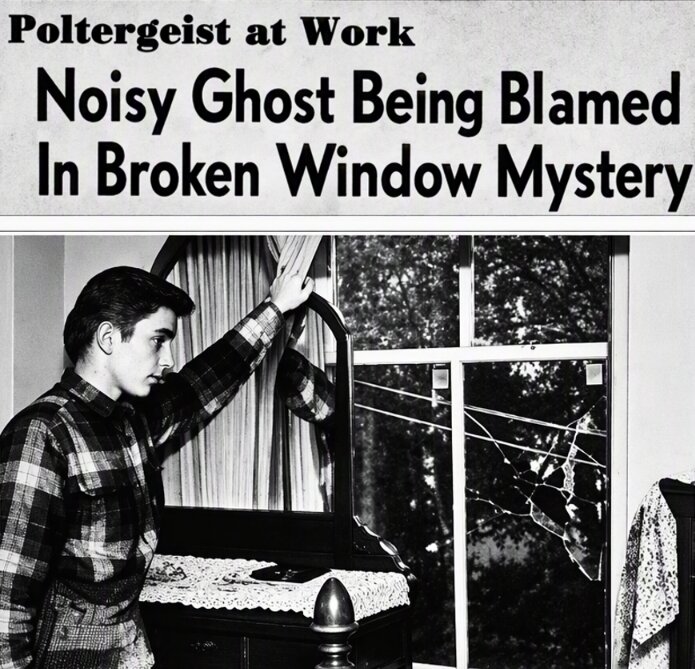
Wilma recalls her father also noted that animals can sense poltergeists and suspected that “Skippie,” the family dog, knew before a strike came.
Parker prepared for a full-scale psychic stakeout, as seen in the photograph published in the Springfield Union news clip shown above.
However, the local press turned spooky on Parker. A photo of him with a figure of a sheet-clad ghost superimposed into the picture appeared on the front page in another Springfield paper later that afternoon, in an obvious attempt to ridicule and embarrass Parker.
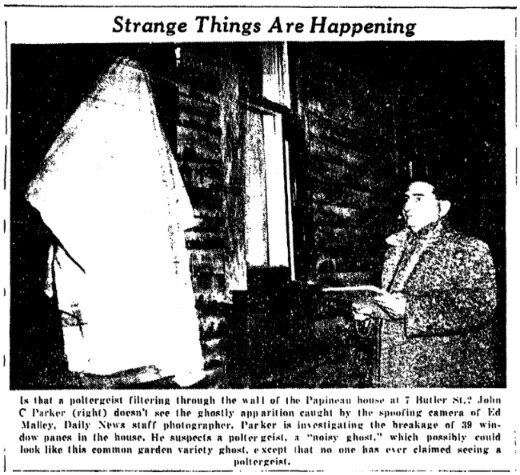
The following day Parker shared his thoughts with the press, telling the Springfield Union he was “dropping his investigation in disgust” and said the picture was “very unfair.”
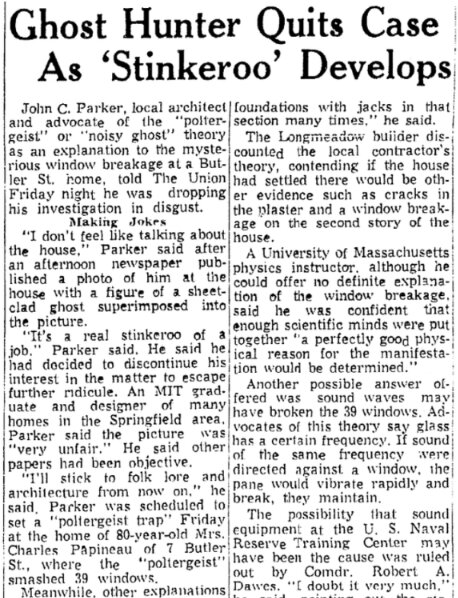
He called the Springfield Daily News picture a “real Stinkaroo of a job,” said other papers had been objective, and he decided to discontinue his interest in the matter to avoid further ridicule.
Wilma says her father stood by his theory of a poltergeist breaking the windows, but never publicly spoke of it again.
To this day the event remains a mystery.
Stay tuned for more on Parker, who explored spectral evidence on Shelter Island among other places.
Note: some of the graphics in this article have been AI enhanced.
Create a free account at GenealogyBank for 7 days to start your journey and discover the stories your ancestors left behind.
Note on the header image: John C. Parker and his daughter Wilma Parker outside his family home in Newburyport, Massachusetts. Credit: Wilma Parker.
Related Articles:
- It’s Haunted! The Ghosts at the Porter-Phelps-Huntington Mansion?
- Spooky Tales: The Ayers-Allen Haunted Tavern
- New England Ghost Hunter and His Haunted Houses (part 1)
- New England Ghost Hunter and His Haunted Houses (part 2)
- New England Ghost Hunter and His Haunted Houses (part 3)
- The Ghosts of Dent’s Palace in Maryland
- Writer Nathaniel Hawthorne’s Real-Life ‘Ghost Story’
- Ohio Specter Haunts Newlywed Cottage
- The Great Nantucket Bank Robbery & the Haunting of William Coffin
