
 December 15, 2025
Introduction: In this article – the first in a series of three – Katie Rebecca Merkley explores the legend of St. Nicholas/Santa Claus and other gift-giving Christmas figures. Katie specializes in U.S. research for family history, enjoys writing and researching, and is developing curricula for teaching children genealogy. She has a website: krgarnergenealogy.com
Every year, children leave cookies for Santa Claus before they go to bed on Christmas Eve, anticipating the gifts he will leave for them during his nocturnal visit from the North Pole. This three-part blog series will explore the lore behind Santa Claus and other related figures.
Some children debate whether or not Santa is real. Many may recognize that the mall Santas are “not the real Santa.” My cousin once bragged that the real Santa came to his school; he knew by pulling his beard. These debates have occurred between children since at least the 1890s. (1)
Yes, Virginia, There Is a Santa Claus
Eight-year-old Virginia O’Hanlon had such a debate with her classmates. She thought to resolve it by asking her father, who encouraged her to go to the newspapers.
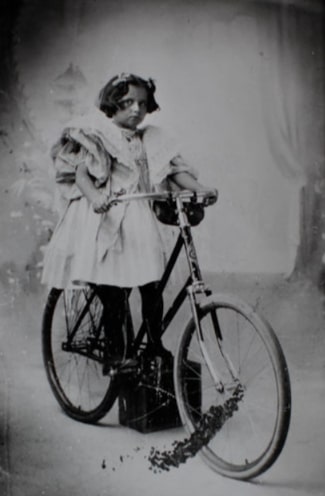
The New York Sun branded itself as a source of truth, and its subscribers believed what they read there. So Virginia’s father said, “If you see it in the Sun, it’s so.” Below is the letter Virginia wrote to the Sun’s editor in 1897, as reprinted in the Atlanta Journal.

This letter proved to be a challenge for the editors of the Sun, so her letter was passed around until it landed in the hands of a senior editor, Francis Pharcellus Church. He replied, writing what Wikipedia has called “the most reprinted newspaper editorial in the English language.”
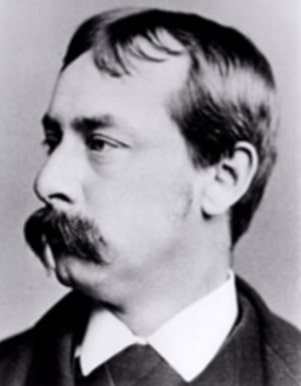
In his editorial, Church said that people have little minds and that real things in the world are those not seen. He argued that no one can see Santa Claus, but that doesn’t mean he isn’t real:
“The most real things in the world are those that neither children nor men can see… Nobody can conceive or imagine all the wonders there are unseen and unseeable in the world.”
Famously declaring “Yes, Virginia, there is a Santa Claus,” Church beautifully concluded his editorial with these words:
“You may tear apart the baby’s rattle and see what makes the noise inside, but there is a veil covering the unseen world which not the strongest man, nor even the united strength of all the strongest men that ever lived, could tear apart. Only faith, fancy, poetry, love, romance, can push aside that curtain and view and picture the supernal beauty and glory beyond. Is it all real? Ah, Virginia, in all this world there is nothing else real and abiding.“No Santa Claus! Thank God! he lives, and he lives forever. A thousand years from now, Virginia, nay, ten times ten thousand years from now, he will continue to make glad the heart of childhood.”
Virginia’s letter and the editor’s response have been reposted in newspapers ever since. In GenealogyBank’s Historical Newspaper Archives, the earliest printing of this letter is from 1897, the same year Virginia originally wrote her query, and a recent printing is from Christmas 2020.

I would add to the debate that Santa Claus is as real as any fictional character, like Luke Skywalker, Harry Potter, or Winnie the Pooh. The Santa Claus we know today was influenced by several 19th-century American men. But before they came along, there was St. Nicholas, his various helpers, and other magical gift bringers across Europe. Many of these have influenced the making of the modern Santa Claus.
Saint Nicholas
Saint Nicholas was a real person of whom very little is known. There are more legends about him than known historical facts. Nicholas was a bishop in Myra (now in Turkey) in the fourth century. He was the son of wealthy parents born in Patara, Lycia. He became archbishop of Myra in his early 20s. Some scholars believe he lived from 280 AD to 343 AD. (2)
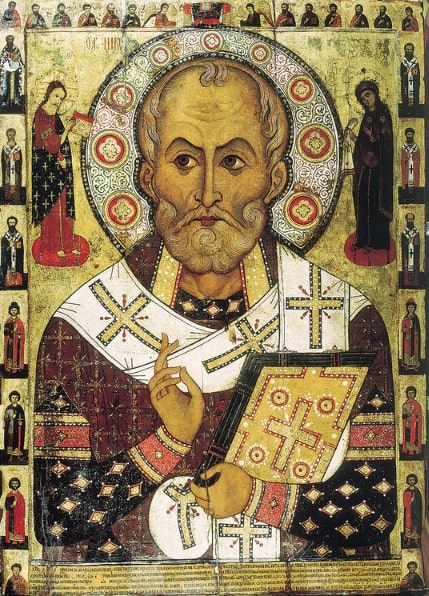
A popular legend about St. Nicholas is the story of the three maidens. Three sisters were so poor that they had no dowries to get married. Their father was about to sell them into prostitution. Young Nicholas anonymously delivered a bag of gold as a dowry to allow the oldest daughter to marry. Some versions of the tale say he dropped the gold down the chimney, and it happened to land in a stocking that was hung up to dry. Other versions say he threw it through the window. He repeated this twice so that all three daughters could marry. One version of the story says the father stayed awake for when Nicholas delivered the third bag of gold to thank him, and Nicholas asked him not to tell anyone. (3)
There are other legends of him saving people, including one about him reviving three children whom an evil butcher had brutally murdered.
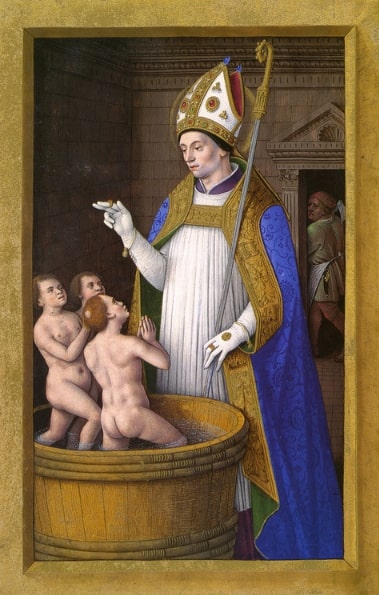
Many groups have claimed St. Nicholas as their patron saint: children, orphans, pawnbrokers, repentant thieves, seafarers, merchants, travelers, bankers, students, maidens. Russia and Greece claimed him as the patron saint of their nations. (4)
It is believed that St. Nicholas died on December 6, so that is St. Nicholas’ Day, celebrated with feasts and gifts. The night before, children leave offerings for St. Nicholas, such as straw for his steed. The next morning, they wake up to find the straw replaced with sweets or toys, which St. Nicholas had delivered during the night. (5) These traditions varied across several European countries. St. Nicholas Day is still celebrated in the Netherlands, with figures disguised as St. Nicholas and his assistant meeting the king and queen. (6)
In each country where St. Nicholas delivers gifts, he has a different assistant. In the Netherlands, this is Black Peter, or Zwarte Piet. Some legends say he was an orphan; others say he was a devil that St. Nicholas, or Sinterklaas, captured. Zwarte Piet would carry the presents for the good children and a switch for the naughty children. The very naughty children would be put into Zwarte Piet’s bag to be carried off to Spain, which is where the Dutch believed Sinterklaas and Zwarte Piet came from. (7)
According to Czechoslovakian tradition, St. Nicholas has two helpers: an angel and a demon. The demon is Cert. His job is to frighten naughty children by reminding them of the punishment in store if they don’t change their ways. (8)
In Germany, St. Nicholas’ helper is Knecht Ruprecht, which translates to “Knight Servant.” He is also known as Han Muff, Butz, Hans Trapp, Brampus, Blaubauf, Bullerklas, Pulterklas, and Schimmelreiter. In Austria, he is known as Krampus or Bartel. Like Cert and Zwarte Piet, his job is to punish naughty children. He is also known to accompany St. Peter, St. Martin, and Christkindl, who will be discussed in the next article in this series. He accompanies St. Nicholas, going down the chimneys to deliver treats to good children and birch rods to naughty children. (9)
Stay tuned to learn about other European gift bringers of Christmas.
Create a free account at GenealogyBank for 7 days to start your journey and discover the stories your ancestors left behind.
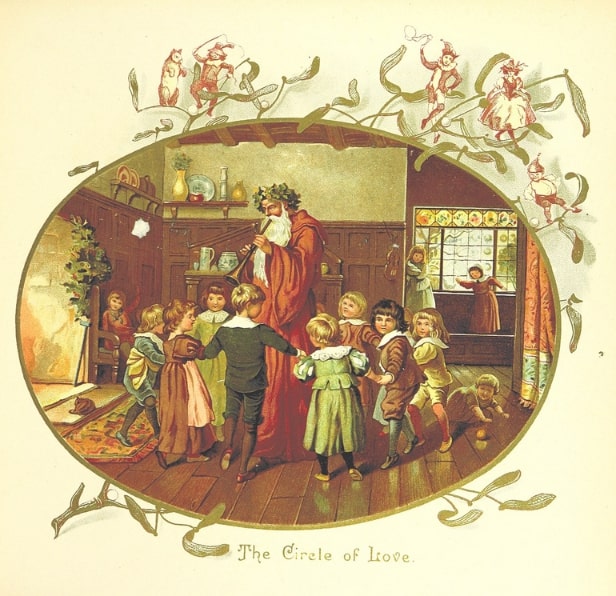
Note on the header image: frontispiece from “The Coming of Father Christmas” by Eliza F. Manning, 1894. Credit: The British Library; Wikimedia Commons.
______________
(1) Collins, A. (2003). Stories Behind the Great Traditions of Christmas (pp. 159-172), Zondervan.
(2) Bruce David Forbes. (2008). Christmas: A Candid History. University Of California Press, Chapter 4.
and;
Gulevich, T. (2000). Encyclopedia of Christmas, entry for St. Nicholas.
and;
Collins, A. (2003). Stories Behind the Great Traditions of Christmas (pp. 159-172), Zondervan.
(3) Ibid.
(4) Ibid.
and;
Sampsom, W. (1968). A Book of Christmas (pp. 100-103), McGraw-Hill Book Company.
(5) Collins, A. (2003). Stories Behind the Great Traditions of Christmas (pp. 159-172), Zondervan.
(6) Bruce David Forbes. (2008). Christmas: A Candid History. University Of California Press, Chapter 4.
(7) Ibid.
and;
Gulevich, T. (2000). Encyclopedia of Christmas, entry for Black Peter.
(8) Gulevich, T. (2000). Encyclopedia of Christmas, entry for Cert.
(9) Gulevich, T. (2000). Encyclopedia of Christmas, entry for Knecht Ruprecht.
