
 December 16, 2025
Introduction: In this article – the second in a series of three – Katie Rebecca Merkley explores the legend of St. Nicholas/Santa Claus and other gift-giving Christmas figures. Katie specializes in U.S. research for family history, enjoys writing and researching, and is developing curricula for teaching children genealogy. She has a website: krgarnergenealogy.com
In my last article (see: Part 1), we learned about Santa Claus/St. Nicholas. But he was not the only one delivering Christmas gifts in Europe.
The original gift-bringers were the wise men, or magi, mentioned in the Bible. The biblical account of them gives very little detail – only that they came from the East following a star and brought gifts of gold, frankincense, and myrrh. Like St. Nicholas, there have been many legends about them. (1)
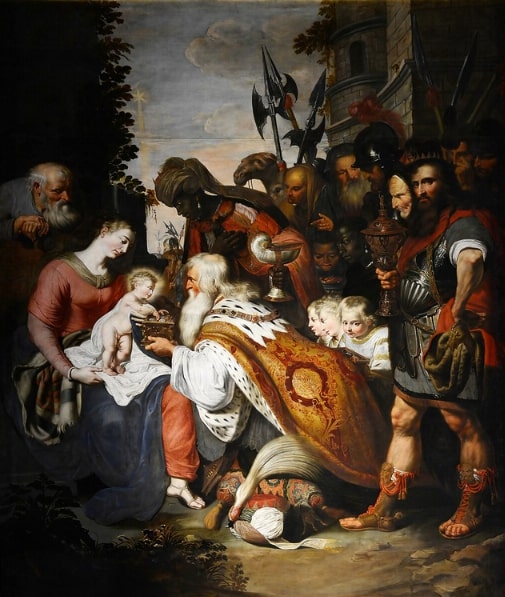
The Bible doesn’t say how many wise men there were. Eastern Christian tradition says there were twelve, and Western Christian tradition says there were three. Some traditions say their names were Balthazar, Caspar (Gaspar), and Melchior; other traditions say they were Galgalath, Magalath, and Tharath. Some traditions have said they were kings and assigned nationalities and ages to them. (2)
According to ancient historians, the magi were a class of scholar-priests originally from Medea and Persia. They were famous for their knowledge of astronomy, astrology, dream interpretation, philosophy and religious rituals. The magi practiced an ancient religion that believed in the coming of a savior born to a virgin mother. (3)
The celebration of Epiphany (also known as Three Kings’ Day) centers on the wise men. In Spain, children leave out shoes filled with straw for the donkeys, and the wise men leave gifts in the shoes. (4)
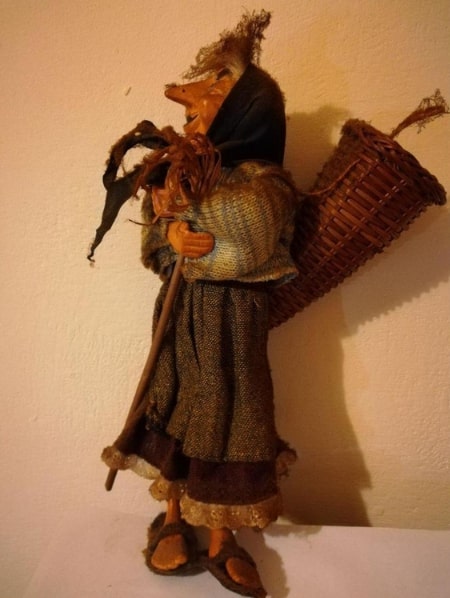
The wise men play a role in the legends of Babushka and Befana. Babushka is a gift-bringer in Russia and Befana in Italy. Their stories are very similar. An old, lonely lady kept herself busy with housework. One version of the legend says she had long ago lost her husband and child. In some versions of the legend, the wise men knocked on her door to ask directions to Bethlehem; in some, they invited her to join them on their journey. In other versions, the Holy Family asked her for directions to Egypt as they were fleeing from King Herod.
In all versions, she turned down the wise men or the Holy Family, only to later regret it. She then gathered trinkets from her home and went around trying to find the Christ Child, leaving gifts in every household she stopped at. The legends of Befana say she flies on a broom. (5)
Another gift-bringer in Russia is Grandfather Frost (“Ded Moroz,” or “Morozko”), and his granddaughter, the Snow Maiden. Grandfather Frost was the only gift-bringer allowed during the communist reign because the communist regime was anti-religion. He and his granddaughter bring gifts on New Year’s Eve. Grandfather Frost evolved from old Russian beliefs of the Spirit of the Frost. Country folk left him gifts so that he wouldn’t wither their crops. He gained a kindly reputation in the city, leaving gifts for good children and ignoring naughty ones. (6)
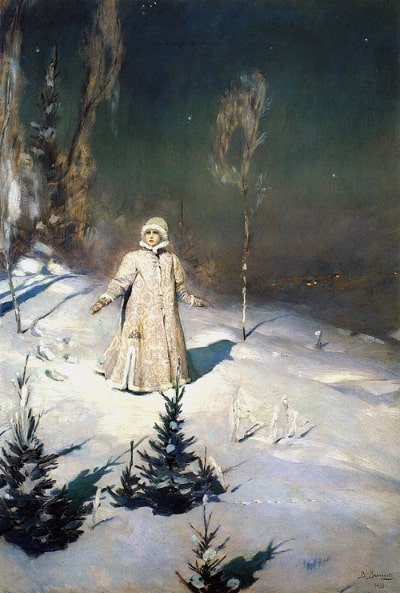
The Snow Maiden has a separate legend. A couple unable to have children built a snow girl who came to life and became their daughter. She melted away in the spring, breaking the couple’s hearts. But when winter came again, she returned with the first snow. The couple got to have their daughter every winter. Somehow, she became associated with Grandfather Frost and assisted him in delivering gifts. (7)
The Elves (fairies), Christmas Lads, and Jultomten are similar to each other. The gnome-like Jultomten of Scandinavia and the leprechaun-like Christmas Lads of Iceland both started out mischievously, stealing things and making messes. The Christmas Lads were known to try to steal naughty children. (8)
The Christmas Lads arrived one by one on the days leading up to Christmas and departed one by one on the days after Christmas. Legend says there are 13 of them, all sons of the troll Gryla. The Jultomten and the Elves were around year-round, but most active during the Christmas season. (9)
Elves and Jultomten could help or harm, depending on their mood. Elves would cause accidents, ruin crops, or steal children if they were provoked. However, if they felt benevolent, they’d leave gifts for good children. The Scandinavians would leave offerings of porridge or drinks to the Jultomten to appease them. Over time, the roles of Elves, Christmas Lads, and Jultomten shifted to that of gift-bringers. (10)
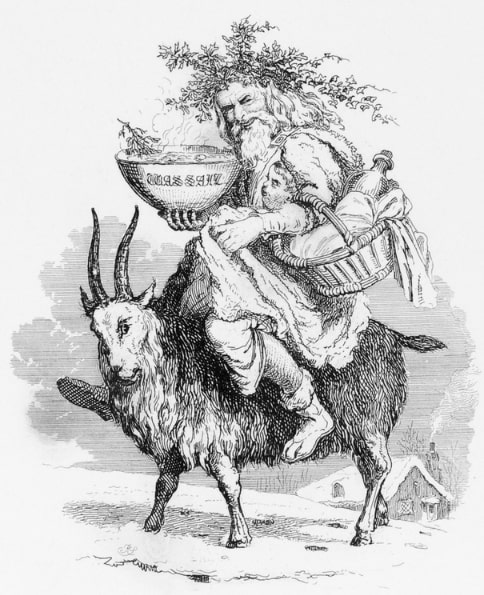
Another Scandinavian Christmas tradition is the Yule Goat. Straw goats are used as a Christmas decoration in Sweden. The Yule Goat is used as a mascot when caroling, with people dressing up as the goat. Before the Jultomten adopted the role of gift-givers, Scandinavians received their gifts from the Yule Goat. (11)
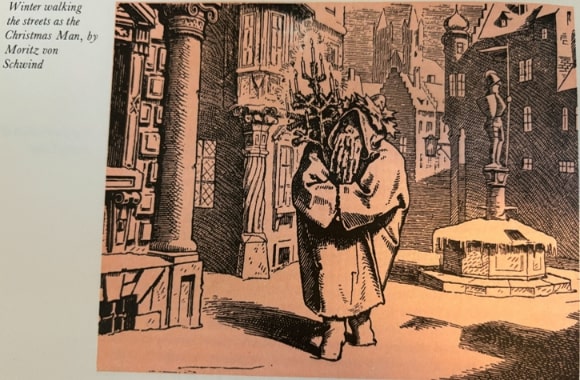
Some figures were impersonations of the Christmas season rather than gift-bringers. This includes Father Christmas in England (also known as Sir Christmas or King Christmas), or the Christmas Man (Weihnachtsmann) in Germany. Father Christmas is often portrayed wearing green or red robes lined with fur and a crown of holly, ivy, or mistletoe. He is sometimes portrayed as an old man with a long beard. The Christmas Man is portrayed as a tired old man carrying a Christmas tree. (12)
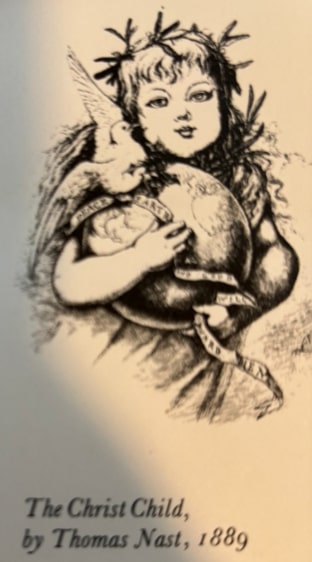
Protestants after the Reformation were opposed to the Catholic tradition of saint veneration. This included opposition to St. Nicholas. Germans did not want to give up their tradition of gift-giving on Christmas, so they came up with another gift bringer: the Christ Child, or Christkindl. Christkindl delivered gifts on Christmas Eve by going through the window. This was not the literal Christ Child but a representation of him, often depicted as a little girl. It didn’t take long for Christkindl to accompany St. Nicholas in gift delivery. (13)
When Europeans came to America, they brought their traditions, including their Christmas gift-bringers. In the third and final article in this series, we will explore how this influenced American Christmases.
Create a free account at GenealogyBank for 7 days to start your journey and discover the stories your ancestors left behind.
Note on the header image: frontispiece from “The Coming of Father Christmas” by Eliza F. Manning, 1894. Credit: The British Library; Wikimedia Commons.
Related Article:
______________
(1) Sampsom, W. (1968). A Book of Christmas (pp. 114-115), McGraw-Hill Book Company.
and;
Gulevich, T. (2000). Encyclopedia of Christmas, entry for Magi, wise men, three kings.
(2) Ibid.
(3) Ibid.
(4) Sampsom, W. (1968). A Book of Christmas (p. 106), McGraw-Hill Book Company.
and;
Gulevich, T. (2000). Encyclopedia of Christmas, entry for Magi, wise men, three kings.
(5) Gulevich, T. (2000). Encyclopedia of Christmas, entries for Befana and Babuskka.
(6) Gulevich, T. (2000). Encyclopedia of Christmas, entry for Grandfather Frost.
(7) Gulevich, T. (2000). Encyclopedia of Christmas, entry for Snow Maiden.
(8) Gulevich, T. (2000). Encyclopedia of Christmas, entries for Christmas Lads, Elves, Jultomten.
(9) Ibid.
(10) Ibid.
(11) Gulevich, T. (2000). Encyclopedia of Christmas, entry for Yule Goat.
(12) Gulevich, T. (2000). Encyclopedia of Christmas, entries for Father Christmas and Christmas Man.
(13) Sampsom, W. (1968). A Book of Christmas (p. 103), McGraw-Hill Book Company.
and;
Bruce David Forbes. (2008). Christmas: A Candid History (Chapter 4), University Of California Press.
