
 August 6, 2025
Introduction: In this article, Melissa Davenport Berry writes about the Stearns sisters, who had many ancestors accused – and some executed – for witchcraft during the 1692-93 Salem witch trials. Melissa is a genealogist who has a website, americana-archives.com, and a Facebook group, New England Family Genealogy and History.
Ruthie and Becky Stearns recently visited Old Salem Village (modern-day Danvers) in Massachusetts to further their understanding of their ancestors’ involvement in the events surrounding the 1692 Salem witch trials.
They have identified more than 30 relatives linked to the era commonly referred to as the “witch hysteria,” during which 19 individuals were executed by hanging, one individual was pressed to death, and numerous others were incarcerated.
Here is a collage of photos showing the Stearns sisters exploring their past in Old Salem Village.

In this collage we see: (top row, left to right) Becky Stearns on the left with her sister Ruthie Stearns meeting with historian Richard B. Trask; Peabody Institute Library in Danvers, Massachusetts, where head archivist and historian Richard B. Trask works; (middle row, left to right) Becky Stearns at Samuel Parris Archaeological Site in Danvers; Becky Stearns on the left with her sister Ruthie Stearns at Proctor’s Ledge Memorial, standing at the stone marker for their ancestor Sarah Wilds – who was executed for witchcraft on 19 July 1692; (bottom row, left to right) sign for the Rebecca Nurse homestead; Richard B. Trask at Salem Village Witchcraft Memorial site in Danvers; entrance marker for Proctor’s Ledge Memorial.
Some of the members of the Stearns family accused of witchcraft: John Proctor and Sarah Good, both of Salem Village; Mary (Ayer) Parker of Andover; Sarah (Averill) Wildes/Wilds of Topsfield; Susannah (North) Martin of Amesbury; and John Alden, a Boston mariner.
The Stearns also have ties to constables, jurors, accusers, and the village doctor, William Griggs, who attended to the “afflicted” girls and attributed their unusual behavior to witchcraft. A Stearns genealogy chart can be found here.
The Stearns sisters lived in Danvers in the 1960s. Their father, Rev. Howard Oliver Stearns, was the former pastor of Rev. Samuel Parris’ old church, now called the First Congregational Church of Danvers.
Rev. Parris’ home was a locale heavily involved in the drama behind the witch hysteria, and the site was discovered and excavated by historian Richard B. Trask in 1970. During their visit the Stearns sisters went to the Salem Village Parsonage site. You can view photos of the site at 1692 Salem.
Ruthie and Becky met with Richard B. Trask and the topic of the PBS mini-series “Three Sovereigns for Sarah” came into the conversation.
The series authentically portrays the Salem witch trials, using historical figures and original transcripts. The screenplay was written by Victor R. Pisano, who also created a teacher’s guide to the story.
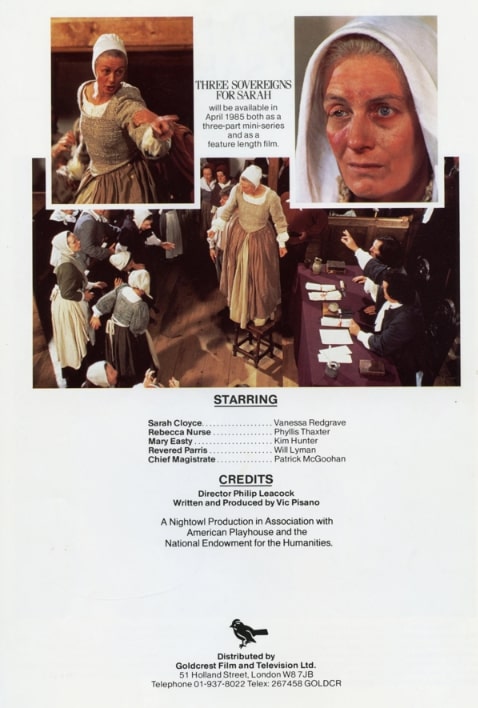
The story centers on Ruthie and Becky’s ancestors, the Towne sisters, who were accused of witchcraft. Mary (Towne) Esty and Rebecca (Towne) Nurse were executed, while Sarah (Towne) Cloyce survived. Sarah is portrayed by Vanessa Redgrave as the main character. The magistrates later grant Sarah three gold sovereigns as compensation for her ordeal and the execution of her two sisters.
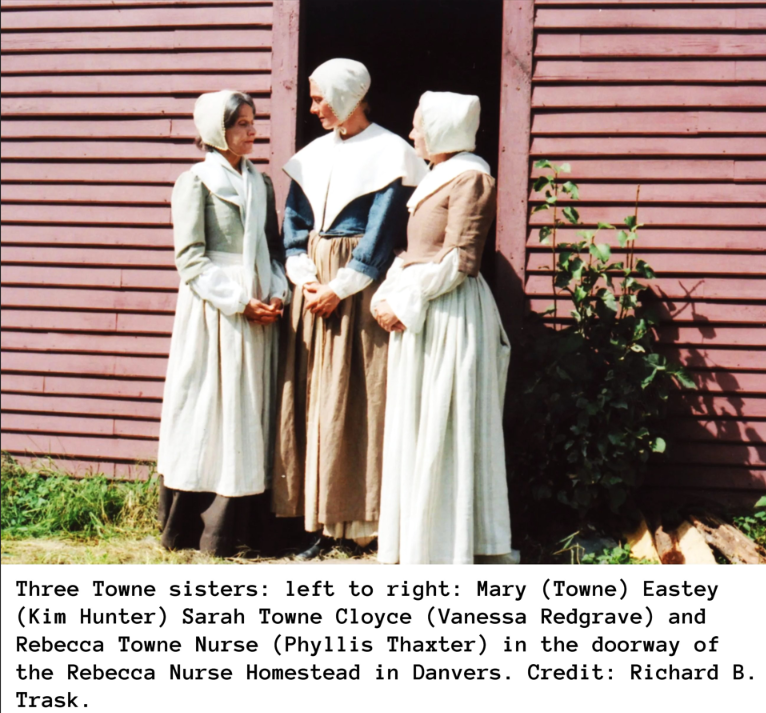
Trask was one of the official historians for the series and shared much knowledge to help the production. There are links at the end of this article to watch the series. I highly recommend this show to anyone who has ancestors associated with the witch trials.
‘Three Sovereigns for Sarah’
The pictures and material for this article are furnished by Trask, who has a plethora of records at the Danvers Archival Center including the article, “Historian on the Set: The Filming of Three Sovereigns for Sarah,” published in Americana Magazine in the May/June 1985 issue.
GenealogyBank’s Historical Newspaper Archives have quite a supply of intel on both the witchcraft era and on the production of the television series.
Here is one news clip entitled “Hysteria Paved the Road to the Salem Witch Trials.”

This article reports:
In 1692, a woman named Rebecca Nurse was arrested for witchcraft in her bedroom in Salem, Mass.
Nearly [300] years later, that same room was the site of the filming of the arrest of Rebecca Nurse.
Movies and TV shows often go “on location” to recreate an event for the cameras. “Three Sovereigns for Sarah” goes even further – some of the actual buildings connected to the infamous Salem Witch Trials are still standing, and the scenes that transpired in them centuries ago are recreated for this Public Broadcasting Service mini-series.
Among the buildings used are the 1683 Parson Capen House, Hoxie House in Sandwich, Rebecca Nurse Homestead, and Saugus Iron Works National Historic Site.
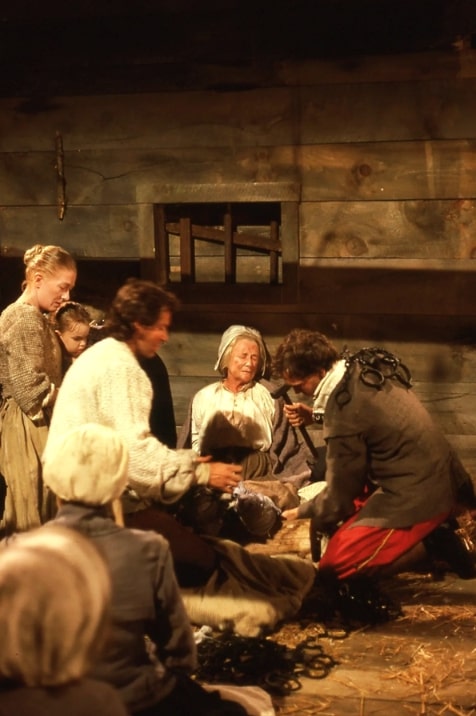
Here is a photo from the production of “Three Sovereigns for Sarah,” showing a scene being filmed at the Saugus Iron Works National Historic Site in Saugus, Massachusetts, near Boston.
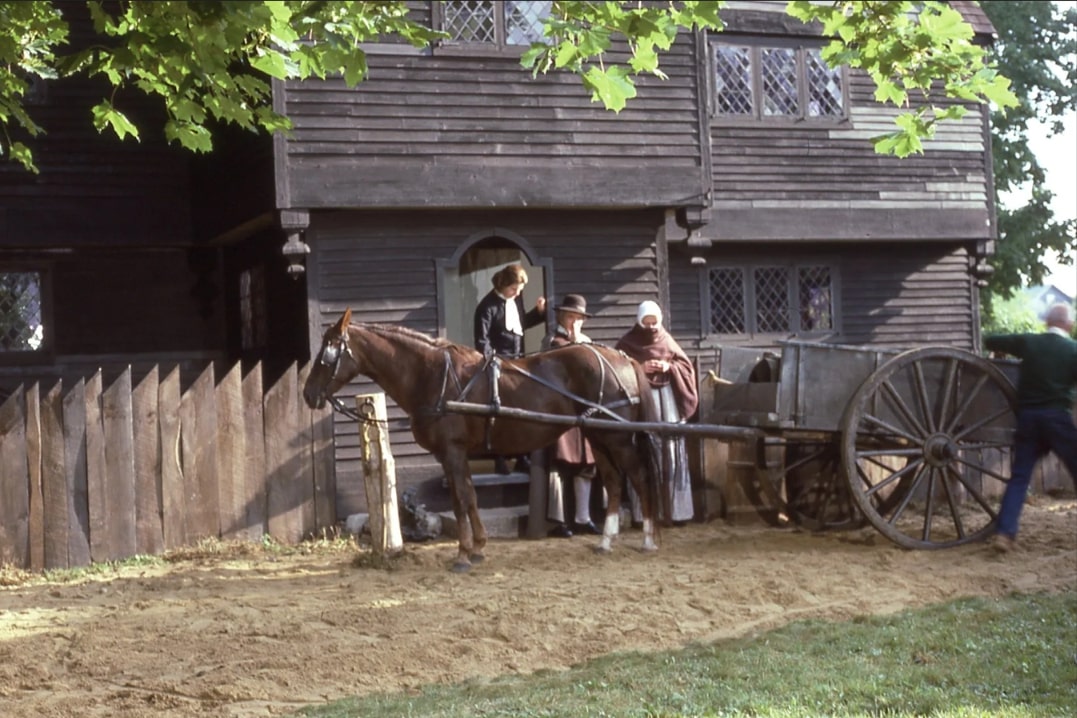
Here is a photo of the replica Old Salem Meeting House used in the PBS mini-series, the only replica of its kind created for “Three Sovereigns for Sarah.” The woman in the foreground is Sarah Cloyce (Vanessa Redgrave). After filming the structure was moved to the Rebecca Nurse Homestead lot.
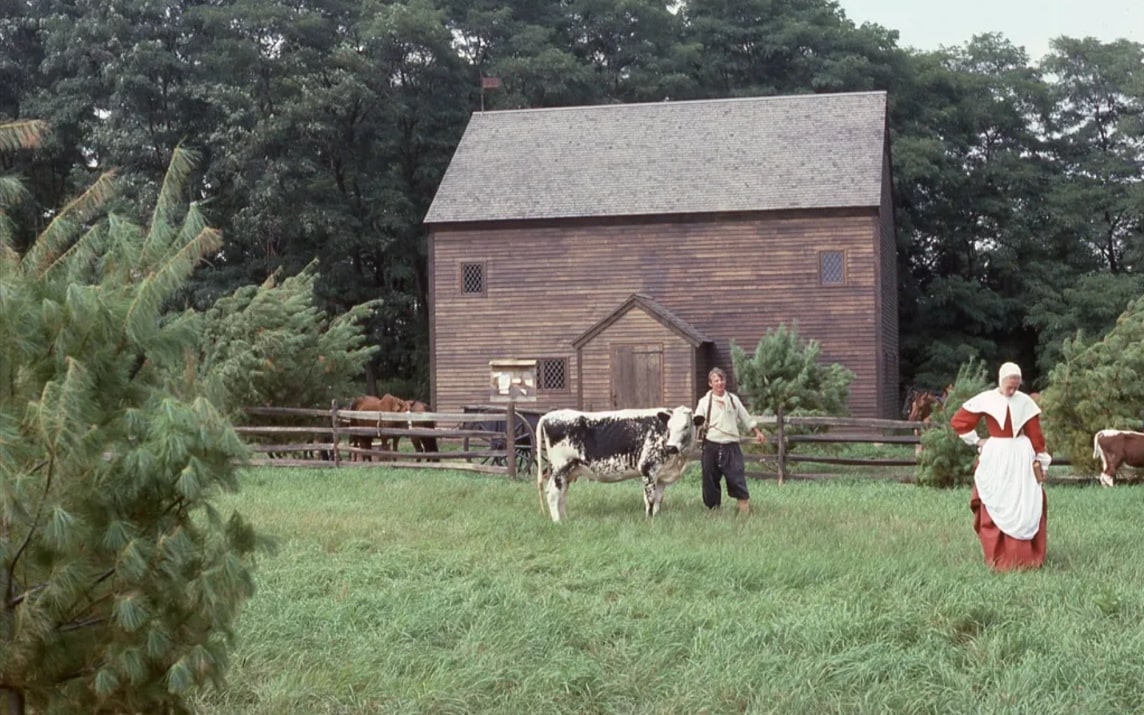
Trask made sure the meeting house constructed for “Three Sovereigns for Sarah” was an exact model. You can read all about the construction and history in Trask’s article, “The Meetinghouse at Salem Village.”
In May 1986 Trask, “the historic watch dog over production” gave an interview to the Danvers Herald and stated the following:
“The series is only 85 percent accurate because of two dramatic details shown at the beginning and end of the film. For Sarah Cloyce to tell her story, the screenplay called for three magistrates from England, who knew nothing about the situation, to listen to her tale. Nothing of the sort happened. The decision to include this was because I had to make decisions very fast – I was in Hollywood time. But nothing in history is clear-cut.
“However, all other aspects of the production were authentic, including the period furnishings and the jailor’s shackles utilized during filming. And the actual court documents from the original trials.
“For example, the 24 sets of legs and wrists manacles were forged in Rowley, Mass., by the Cassidy Brothers Forge, Inc., very skilled blacksmiths.”
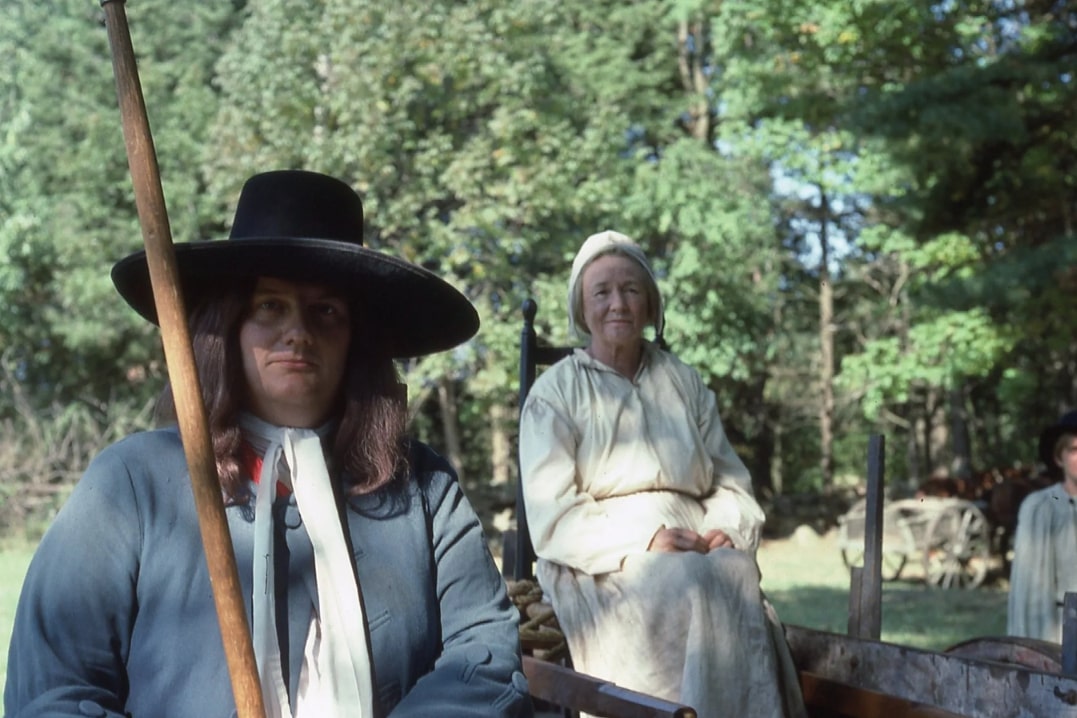
In this photo, Richard Trask poses as a guard while Rebecca Nurse (Phyllis Thaxter) sits in a cart awaiting execution.
Click here to watch “Three Sovereigns for Sarah.” It’s also available on Amazon.
More to come on the Stearns’ visit to Old Salem Village!
Explore your family history by creating your free account at GenealogyBank for 7 days, because every life deserves to be remembered, recorded, and rediscovered.
Note on the header image: witchcraft trial at Salem Village. The central figure in this 1876 illustration of the courtroom is usually identified as Mary Walcott. Credit: Wikimedia Commons.
Related Articles:
- Witchcraft: Salem Witch Trials
- Witchcraft: Salem Witch Trials (part 2)
- Salem Witchcraft (part 1)
- Salem Witchcraft (part 2)
- Relics of the Salem Witch Trials Era (part 1)
- Relics of the Salem Witch Trials Era (part 2)
- Relics of the Salem Witch Trials Era (part 3)
- Relics of the Salem Witch Trials Era (part 4)
- Relics of the Salem Witch Trials Era (part 5)
- Witch Lore in Old Salem Village: Ruthie Stearns’ Family Connections
- How the Accused Were Pinned for Witchcraft in Salem 1692
- Digging Up Witch Lore in Old Salem Village: The Rev. Samuel Parris Home
- Cache of Court Cases Reveals Puritan Sensibilities
- The Witchcraft Trial of Mary Perkins Bradbury
- With UVA’s Help, Salem Finally Discovers Where Its ‘Witches’ Were Executed
- A Season with the Witch: The Magic and Mayhem of Halloween in Salem, Massachusetts (J. W, Ocker)
- Cinema Salem: A Cinematic Guide to the Witch City (Peter Mac)

Incredible article! I’ll be watching the movie. Thank you, Melissa.