
 October 27, 2026
Introduction: In this article – as Halloween approaches – Katie Rebecca Merkley searches old newspapers to find ghost stories from the past. Katie specializes in U.S. research for family history, enjoys writing and researching, and is developing curricula for teaching children genealogy. She has a website: krgarnergenealogy.com
Halloween is the time for ghosts. Traditionally, All Hallow’s Eve was believed to be the night when the spirits of the dead could return. Now, people visit haunted houses and tell ghost stories, finding these activities entertaining whether or not they believe in ghosts.
Photo credit: https://depositphotos.com/home.html
Ghost stories are not new. A 1740 newspaper printed a song about a ghost. Before recorded music, lyrics to new songs circulated through newspapers. If you know the tune “Come and Listen to My Ditty,” you can sing this song. Here are the first four stanzas of this nine-stanza song.
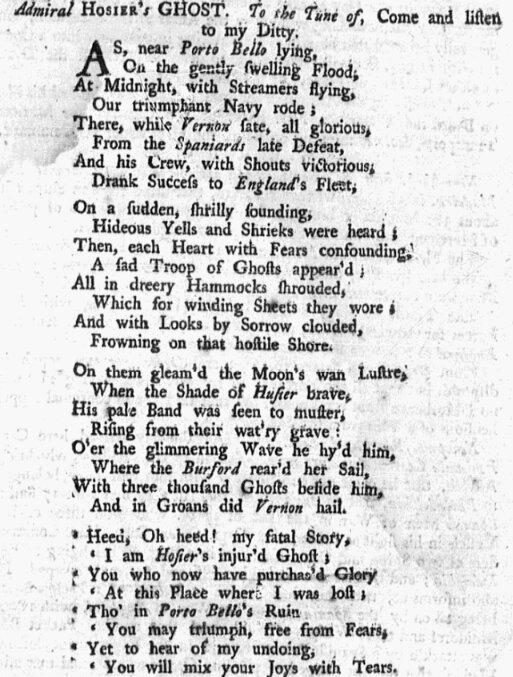
The song opens with the English Navy, led by Vice-Admiral Vernon, celebrating its victory against the Spanish at Porto Bello. But then:
“On a sudden, shrilly sounding,
Hideous yells and shrieks were heard;
Then, each heart with fears confounding,
A sad troop of ghosts appeared.”
Leading them was “Hosier’s injured ghost.”
The song continues with Hosier’s ghost telling his tragic tale. Admiral Hosier had previously taken 20 ships there against the Spanish town. Orders not to fight rendered Hosier’s mission a failure. The ghost laments that it would have been better to die fighting for his country than of a broken heart, bitter with disappointment at the lost chance at glory. At the end of the song, Hosier’s ghost urges Vernon to remember him on his return to England.
The song was based on historical events. In 1726, Admiral Hosier was sent with 20 ships to blockade Porto Bello. The intent was to prevent Spain from taking treasure home to fund its wars. Because England and Spain were not officially enemies, Hosier was forbidden to capture the port. He and his men died of tropical fever in 1727.
Vice-Admiral Vernon successfully took Porto Bello 12 years after Hosier’s failure. In response, and to preserve Hosier’s memory, the song above was written.*
Another ghostly anecdote comes from a 1762 newspaper report about a ghost supposedly revealing a murder. Sadly for genealogists, no names were named. But it’s quite a story!
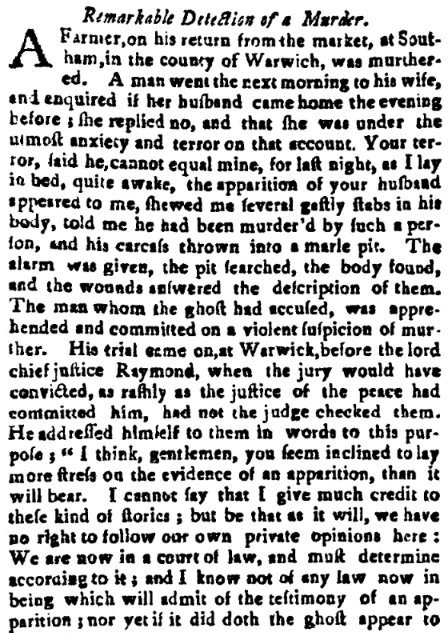
In the town of Southam in Warwickshire, England, a farmer was murdered on his return from the market. The next morning, a man asked the wife about her husband. She replied that he hadn’t come home last night and that she “was under the utmost anxiety and terror on that account.” The man then said that her husband’s ghost had appeared to him during the night and showed him “several ghastly stabs in his body,” and said he’d been murdered and his carcass thrown into a pit.
The article goes on to report:
The alarm was given, the pit searched, the body found, and the wounds answered the description of them. The man whom the ghost had accused, was apprehended and committed on a violent suspicion of murder.
During the trial, the jury was ready to convict the accused. The judge called out the jury for giving more weight to a ghost’s evidence than it should; no laws admitted the testimony of an apparition. The ghost was called but did not appear. The judge addressed the jury again:
“Gentlemen of the jury, the prisoner at the bar, as you have heard, by undeniable witnesses, is a man of a most unblemished character; nor hath it appeared, in the course of the examination, that there was any manner of quarrel or grudge between him and the party deceased… I do verily believe him to be perfectly innocent; and, as there is no evidence against him, either positive or circumstantial, he must be acquitted. But from many circumstances which have arose during the trial, I do strongly suspect that the gentleman who saw the apparition was himself the murderer; in which case, he might easily ascertain the pit, stabs, &c., without any supernatural assistance; and on such suspicion, I shall think myself justified in committing him to close custody, till the matter can be further enquired into.”
This was immediately done, and a warrant granted for searching his house, when such strong proofs of guilt appeared against him, that he confessed the murder, and was executed at the next [court of] assize.
In this case, the murderer’s purpose in spreading the ghost story is clear. However, his plan backfired because the judge saw through the scheme.
Some ghost stories, such as this one from 1767, circulated in newspapers for entertainment. It is uncertain if this story was fictitious or factual.
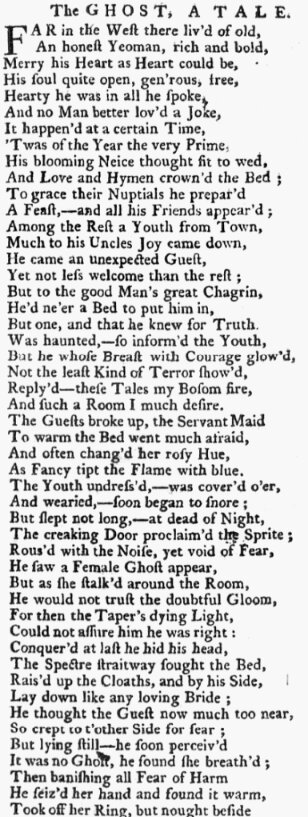
A yeoman’s niece was soon to wed, so guests arrived for the wedding. One guest was a young man, an unexpected yet welcome guest. The yeoman only had one bed available, but it was haunted. The young man agreed to sleep in it. During the night, a female ghost came into the room and lay on the bed. The young man noticed that she was breathing and felt that her hand was warm. He removed her ring. The young woman got up, walked about the room, and left.
The next morning, the other guests wanted to hear about the ghost. The young man asked if anyone was missing a ring. It belonged to the yeoman’s daughter; she had been the wandering ghost, for it turned out she was a sleepwalker:
No sooner did the morn appear,
Than all were met the youth to hear,
Expecting that he would recite,
The dreadful visions of the night.
The modest youth then bowing low,
Begged of the assembled fair to know,
Which of them all a ring had lost,
With diamonds set; a ring of cost;
The yeoman’s daughter glad to gain,
What she much valued once again
Replied ’tis mine, – then you my dear
Was the kind ghost that did appear;
The secret I’ll no longer keep;
But what you did, was done asleep.
Then told the story to them all,
And mirth and laughter shook the hall.
Not all ghost stories are easy to explain. Reports of a ghost scaring schoolchildren were published in a 1904 newspaper.
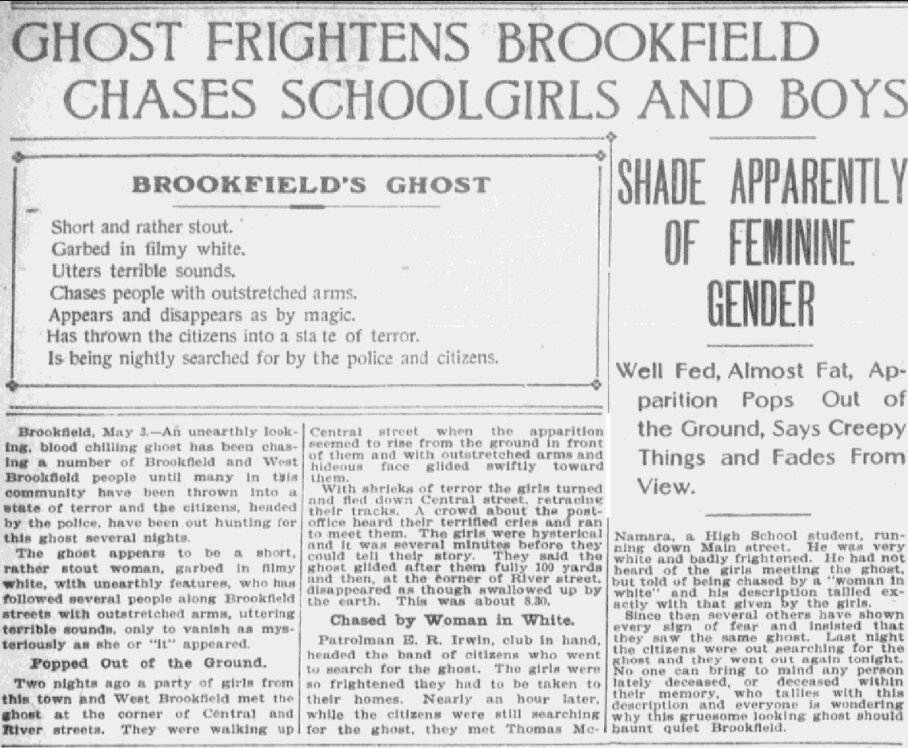
The ghost, apparently female, was known to chase people with outstretched arms, pop out of the ground, say creepy things, and fade from view. Brookfield and West Brookfield residents were terrified. The police and citizens had been searching for the ghost.
A party of girls met the ghost at the corner of Central and River Streets. They had been walking along Central Street when the ghost rose from the ground. The girls turned and ran, screaming. A group from the post office heard them and ran to meet them. The hysterical girls struggled to tell their story. They reported that the ghost had glided after them 100 yards before disappearing.
The frightened girls were taken home, and citizens went looking for the ghost. They found a high school student, Thomas McNamara, who had just been frightened. Unaware of the girls’ incident, he described the same ghost that had chased them. That same ghost had chased others, too.
Citizens continued their search. No one could remember any deceased person who matched the ghost’s description: a short, stout woman wearing filmy white, with a hideous face. No one knew why the ghost was haunting Brookfield. Was it a real ghost?
* Richard Lea, “Ranger’s House and Admiral Hosier’s Ghost,” English Heritage (https://www.english-heritage.org.uk/visit/places/rangers-house-the-wernher-collection/history-and-stories/admiral-hosiers-ghost/: accessed 6 October 2026).
Create a free account at GenealogyBank for 7 days to start your journey and discover the stories your ancestors left behind.
Note on the header image: representation of a ghost. Credit: https://depositphotos.com/home.html
