
 September 8, 2025
Introduction: In this article, Katie Rebecca Merkley explores a genealogy resource often overlooked: runaway ads for indentured servants and slaves. Katie specializes in U.S. research for family history, enjoys writing and researching, and is developing curricula for teaching children genealogy. She has a website: krgarnergenealogy.com
If your ancestor was an indentured servant or a slave who ran away from their master, they did you a favor. Their master probably published a newspaper ad to get their servant or slave back. These ads contain helpful information for modern genealogists, and you can find many of them in GenealogyBank’s Historical Newspaper Archives.

History
When early settlers were establishing farms and plantations in the American colonies, they needed laborers. Meanwhile, poor Europeans who couldn’t find work also couldn’t afford passage to America. The indentured servant system was a solution to both. (1)
A poor person could sign up to be an indentured servant, where they would serve four to seven years in exchange for passage to America and receive freedom dues at the end. Additionally, convicts were sent to labor in America as penance for their crimes. (2)
Africans were initially treated as indentured servants. However, the establishment of slavery in America in the mid-1600s stripped away the rights of African servants and left them in servitude for life. Eventually, landowners began to favor slavery over indentured servitude for their labor needs.
Those in servitude either worked on farms, plantations, or in forges. Indentured servants received land, food, and clothes at the end of their terms, depending on what their colony offered as freedom dues.
Working conditions were harsh, and some indentured servants did not survive their terms of servitude. If a servant ran away, the typical punishment was to extend their term. (3)
Indentured servants and slaves were considered property. Just as slaves could be bought or sold before the Civil War, indentured servants could be bought or sold during their terms.
What’s in a Runaway Ad?
The existence of runaway ads indicates that servants and slaves had tried to escape. Once slavery was enacted, running away may have seemed like an enslaved person’s only hope for freedom.
The owner of the runaway would have just lost a source of labor and would want them back. Many advertised in local newspapers. The purpose of these runaway ads was to help readers of the newspaper identify the fugitives and know where to return them. (No, these ads were not written for future genealogists.) As such, the ads would give a physical description of the runaway, name the owner, and where they lived.
For example, an enslaved man named George Trusty ran away from Risdon Bishop on 22 March 1790. Risdon Bishop lived near Duck Creek Cross Roads, Kent County, Delaware. The ad, posted in April and May, listed George’s age, height, and other descriptive details, including what he was wearing: a wool hat, a short white coat with light blue sleeves, a drab colored under jacket which had once been double-breasted, breeches to match his coat, homemade stockings, and a pair of old shoes run down at the heel. “He has a remarkable big foot.”
The ad concluded with instructions: anyone who could secure George Trusty would receive the reward, and all expenses incurred in bringing him home would be paid.

The ad gives this description of George Trusty:
About 23 years of age, 5 feet 10 or 11 inches high, very black, and when spoke to has a very down look; he is a very stout fellow.
In addition to physical traits, these records can sometimes offer clues about your last name origin.
In an ad that focuses so heavily on the physical description, what are the other genealogically valuable clues? The physical description often includes the age. George Trusty was about 23 in 1790, so he would have been born around 1767.
When researching enslaved African Americans, it is crucial to know who their enslavers were. Risdon Bishop enslaved George Trusty, so he would appear in the records of Risdon Bishop’s property. Duck Creek Cross Roads, Kent County, Delaware, is where the records were kept.
Further Research
I did further research to find more records of Risdon Bishop and/or George Trusty. Another slave, Stephen Miller/Gibbs, had run away from Risdon Bishop in 1789. Bishop published an ad for him, too.
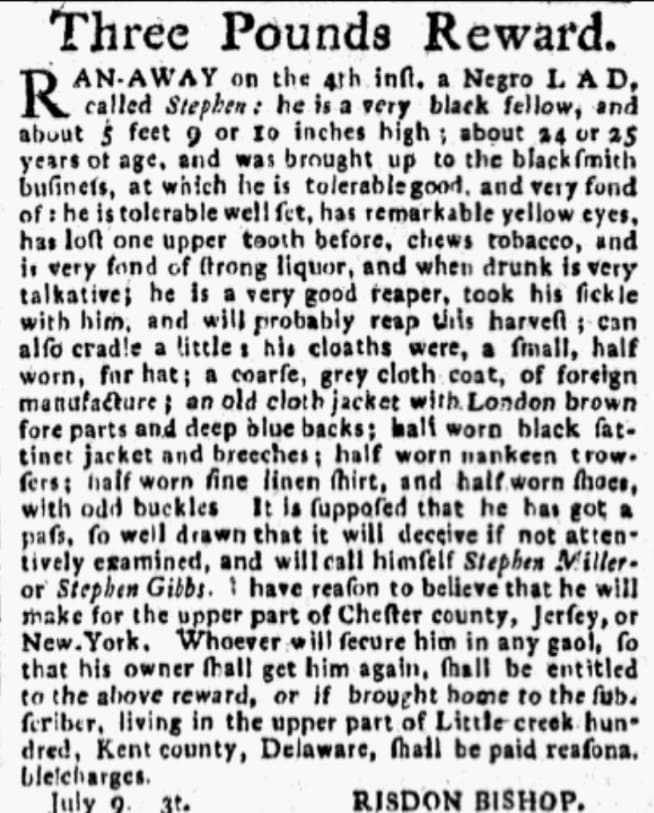
The 1790 census has been lost for Delaware, so Risdon Bishop would not be found in it. I found him in the 1800 census in Little Creek Hundred, Kent County, Delaware. The 1800 census counted the free white males and females by age, then had separate categories for colored people, which did not sort by age. Risdon Bishop had three people classified as “all other persons except Indians not taxed,” which could be free black people (likely servants) or white indentured servants. He had four slaves.

To identify the four slaves Risdon Bishop held in 1800, property records from that time must be examined. This is the only way to determine if George and Stephen were among the slaves he owned at that time. To determine the slaves Risdon Bishop held at the time of his death, his probate or estate papers need to be examined. Deeds also need to be checked for slave sales. Some of those records can be found online, and others need to be ordered from archives.
Did George and Stephen make it to freedom when they ran away from Risdon Bishop? Or did they get captured and sent back to him? The best way to determine that is to see if they appear as Risdon Bishop’s slaves after they ran away.
Was your ancestor a runaway servant? Search for them in Historical Newspaper Archives to find out. You’ll find some helpful genealogy clues and an interesting story.
Explore your family history by creating your free account at GenealogyBank for 7 days, because every life deserves to be remembered, recorded, and rediscovered.
Note on the header image: runaway ad for Betsey Cudney, Westchester Herald (Ossining, New York), 29 May 1832, page 3
Related Articles:
- Genealogy Tip: Indentured Servant Advertisements
- African American Genealogy Tip: Information Wanted Ads
________________________
(1) PBS. (n.d.). Indentured Servants in the U.S. – History Detectives. Retrieved 14 August 2025 from https://www.pbs.org/opb/historydetectives/feature/indentured-servants-in-the-us/
(2) National Park Service. (n.d.). Indentured Servants – Hampton National Historic Site. U.S. Department of the Interior. Retrieved 14 August 2025 from https://www.nps.gov/hamp/learn/historyculture/indentured-servants.htm
(3) National Park Service. (n.d.). Working Conditions – Hampton National Historic Site. U.S. Department of the Interior. Retrieved 14 August 2025 from https://www.nps.gov/hamp/learn/historyculture/working-conditions.htm
