
 July 17, 2025
Introduction: In this article, Melissa Davenport Berry continues her series on Mayflower descendants, again featuring the Hopkins family line with court drama over a contested will. Melissa is a genealogist who has a website, americana-archives.com, and a Facebook group, New England Family Genealogy and History.
Today I continue my series on “Mayflower Descendants: Who’s Who,” again featuring a group of California pioneer families.
To recap: In Part 2 and Part 3 I referred to “Diary of Young Girl Recalls Gilded Age,” describing life in Menlo Park, California, at the palatial mansion “Sherwood Hall” owned by Mrs. Mary Frances (Sherwood) Hopkins, aka “America’s Richest Widow,” who received millions from California railroad magnet Mark Hopkins’s estate.
Both Mark and Mary were direct descendants of Mayflower passengers William Bradford, Thomas Rogers, John Alden, and Priscilla Mullins.
Mary’s adopted son Timothy Hopkins married her niece Mary “May” Kellogg (Crittenden) Hopkins.

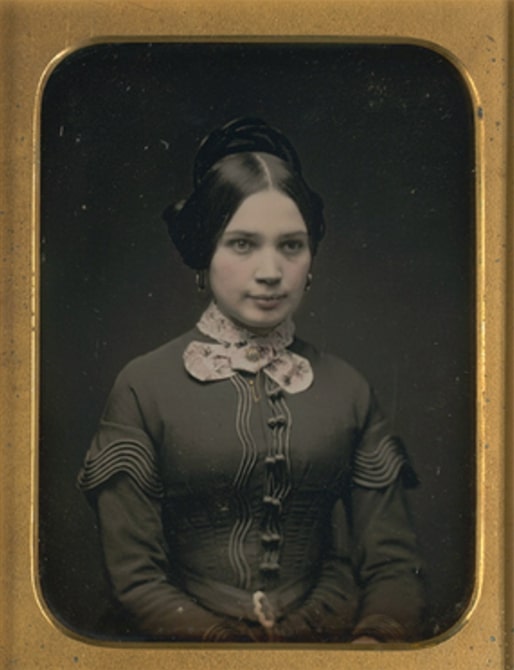
May was the daughter of Hiram and Lydia (Sherwood) Crittenden, a direct descendant of Mayflower passengers William Bradford, Stephen Hopkins, Thomas Rogers, John Alden, and Priscilla Mullins. Below is a photo of her mother Lydia, a direct descendant of Mayflower passengers William Bradford, Thomas Rogers, John Alden, and Priscilla Mullins.
Widow Hopkins Marries Decorator & Castle Builder
When Mary hired the New York firm Herter Brothers to remodel her California estates and other homes including Kellogg Terrace in Great Barrington, Massachusetts, she was introduced to Edward Searles, an interior and architectural designer from Methuen, Massachusetts.
The great dowager, 23 years his senior, shared a love for luxury and expensive furnishings. As Searles transformed her estates he became intimate with Mary, and they married on 8 November 1887 at Trinity Chapel in New York City.
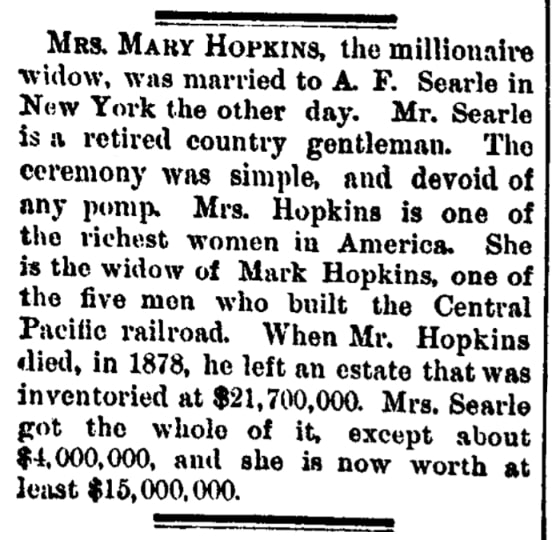
This article reports:
Mrs. Mary Hopkins, the millionaire widow, was married to [Edward Francis] Searle[s] in New York the other day. Mr. Searle[s] is a retired country gentleman. The ceremony was simple, and devoid of any pomp. Mrs. Hopkins is one of the richest women in America. She is the widow of Mark Hopkins, one of the five men who built the Central Pacific railroad. When Mr. Hopkins died in 1878, he left an estate that was inventoried at $21,700,000 [$697,655,000 today]. Mrs. Searle[s] got the whole of it, except about $4,000.000, and she is now worth at least $15,000,000.
The newlyweds took a six-month bridal tour around Europe and spent a fortune on furniture and art to bring back to the states.

When Edward returned, he was dubbed “Lord Methuen.” Apparently, while in England he purchased a tortoise shell, mother-of-pearl inlaid chest from a direct descendant of Lord Methuen, the namesake of his hometown.

With all the wealth bestowed upon him Edward became more eccentric and reclusive. He acquired a legion of servants and insisted he be addressed as “My Lord.”
Mary’s friends and family grew more suspicious of the relationship and Edward kept them at bay. Several of Mary’s relations, who were spread throughout the country, had been receiving generous monthly allowances from her – and communication with them ceased. She even cut off Timothy and May.
When Mary died in 1891 at their Methuen estate “Pine Lodge,” Searles was named as the sole heir of her massive fortune and all kin, including adopted son Timothy Hopkins, were left out in the cold.
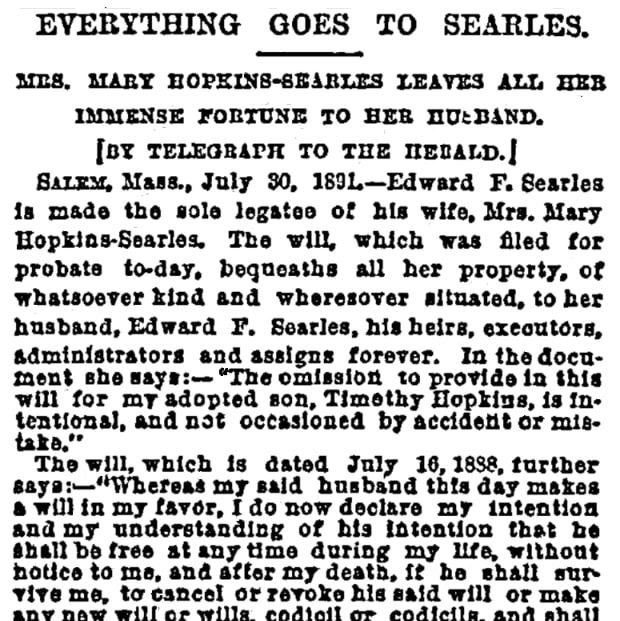
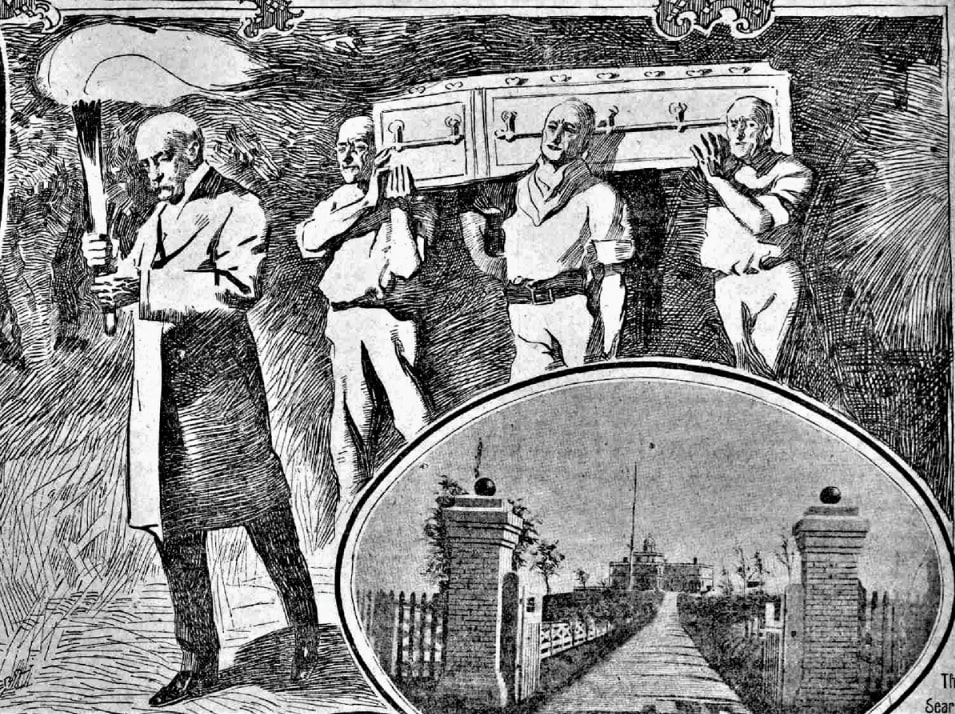
Her death occurred just a few years after their marriage, which was a hot topic of gossip because Mary was nearly a quarter-century his senior and many speculated that he only married her for the money. No one was allowed to attend the funeral.
Contested Will – Millions at Stake
Searles would not get his millions without a legal battle and a clothesline of dirty linen. Timothy Hopkins filed a suit to contest the will, which opened a Pandora’s box exposing Searles’s use of occultism to win the hand of Mary and control her coffers.
Hopkins and “Lord” Searles both lawyered up to commence battle. Edward’s council was top drawer: Col. Solomon Lincoln, William Allen, and three barristers from the Dodge dynasty – Fredrick, Butler, and Richard.
Timothy hired a string of powerful attorneys including Elbridge T. Burley and William Crowninshield Endicott.
Judge Rollin E. Harmon presided over the hearings which began on 22 September 1891 in Essex County Court in Salem, Massachusetts. There were 21 other claimants who joined forces with Hopkins. Most of them were first and second cousins to the late dowager.
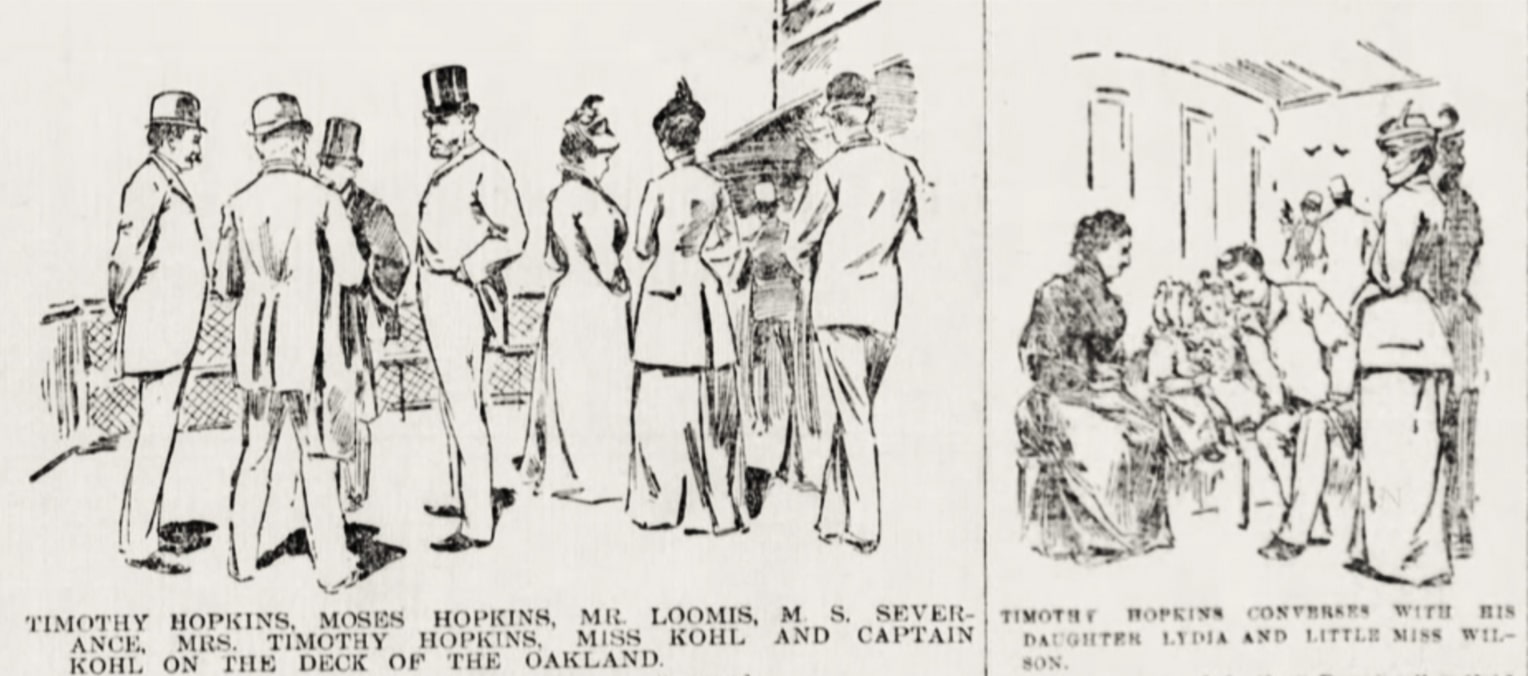
The press covered Timothy and his entourage of Mayflower scions traveling to Salem for the trial.
There were just a few who made the journey. The illustration on the left below shows Timothy Hopkins, Moses Hopkins (brother of Mark Hopkins), James Oscar Loomis, Mrs. Timothy Hopkins, her sister Anne Crittenden Severance with her husband Mark Sibley Severance, Captain William H. Kohl – co-founder of the Alaska Commercial Company – and his wife Sarah Hunter Kohl. The illustration on the right shows Timothy and May Hopkins with daughter Lydia Kellogg Hopkins.
Many came forward collaborating with the claim that Edward’s hold over Mary came from the spirit world.
Before Mary hooked up with Searles she was dabbling in the occult and kept a private medium on staff at all her palaces. Timothy’s wife May also was known to seek out sorcerers and the like.
An entry in the diary referenced above, which was written by Isabella Cass, reads:
Friday Dec. 26, 1884
I went with May [and Mrs. Rathbone] to the occultist and then different stores.
Stay tuned…
Create a free account at GenealogyBank for 7 days to start your journey and discover the stories your ancestors left behind.
Note on the header image: “Mayflower in Plymouth Harbor,” by William Halsall, 1882. Credit: Wikimedia Commons.
Related Articles:
- Fake Wills & Forged Bibles Lay Claim to Mark Hopkins’ Huge Estate
- The Gilded Age Palace: What Mark Hopkins Bankrolled
- Mad Scramble to Claim Mark Hopkins’ Riches: A ‘New Gold Rush’
- Pedigree, Pearls, and Pooches: The Hopkins Saga Continues
- The Mysterious Death of Heiress Lydia Kellogg Hopkins, Part I
- The Mysterious Death of Heiress Lydia Kellogg Hopkins, Part II
- America’s Richest Widow Restores Church and Cemetery of Great Barrington, MA
- Moss’ Hoax: A Scam for the Hopkins Fortune
- More Legal Battles over the Mark Hopkins Railroad Fortune
- Scams to Get the Hopkins Fortune: Seances, Table Tipping, and Slate Writing
- More Hopkins Saga: Minister’s Wife Battles Edward Searles
- Kin of America’s Richest Widow Battle Edward Searles in Probate Court
- Mayflower Descendants: Who’s Who, Part 48 (part 1)
- Mayflower Descendants: Who’s Who, Part 48 (part 2)
- Mayflower Descendants: Who’s Who, Part 48 (part 3)
