
 November 25, 2025
Introduction: In this article – the third and final in a series of three – Katie Rebecca Merkley writes about our ancestors celebrating Thanksgiving, in this case 100 years ago. Katie specializes in U.S. research for family history, enjoys writing and researching, and is developing curricula for teaching children genealogy. She has a website: krgarnergenealogy.com
Memes all over the internet make fun of the fact that black Friday is right after Thanksgiving, pointing out the irony that greed is encouraged right after celebrating gratitude. However, some find the discounts useful for Christmas shopping. Of course, it doesn’t start there – many stores begin selling Christmas merchandise before Thanksgiving.
Turns out this phenomenon occurred 100 years ago. A department store’s ad posted in an Albany, New York, newspaper in November 1925 incentivized customers to do their Christmas shopping with them early by offering free Thanksgiving turkeys. The ad promised a fresh turkey delivered the day before Thanksgiving to anyone who spent $15 or more.
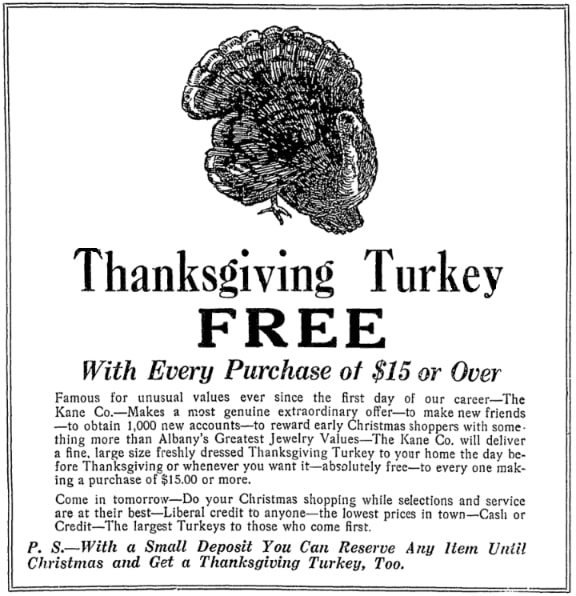
In 1925, turkeys usually cost around $4-$5 (25-41 cents per pound), so it was actually more expensive to spend $15 for a free turkey than it was to buy a turkey.* However, a company offering free products must do so without losing profits to stay in business. Many companies still use similar incentives to encourage consumers to spend.
A Pittsburgh, Pennsylvania, newspaper ran a Thanksgiving spread featuring a cartoon indicating a turkey is wise to stay thin this time of year, followed by a quote from poet Ella Wheeler Wilcox.
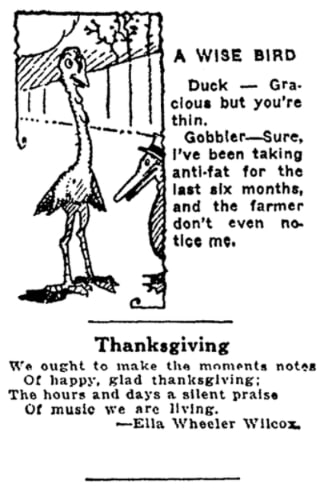
The quote is from Wilcox’s poem “Thanksgiving”:
We ought to make the moments notes
Of happy, glad Thanksgiving;
The hours and days a silent [phrase]
Of music we are living.
On that same page is an article about Thanksgiving in 1714, supposedly held in Danvers, Illinois – but I think the editors got some details wrong in this article.
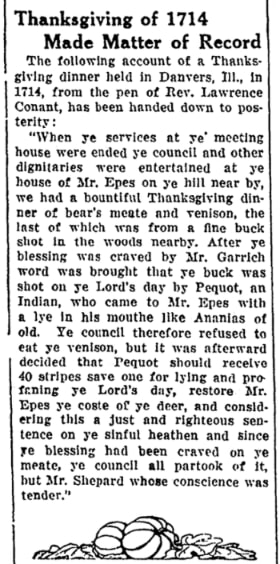
This article is immediately suspect, knowing that Illinois did not exist in the colonial period. The Pequot are from Connecticut, not Illinois. Where the account says “ye,” it should have said “the.” A letter known as the thorn no longer exists in the English language. In old documents, that would be represented with what looks like a Y but is pronounced as th.
The article discusses how the council held a Thanksgiving dinner at Mr. Epes’s house. The dinner consisted of bear’s meat and venison from “a fine buck shot in the woods nearby.” After the blessing, word was brought that a Pequot Indian had shot the buck on the Lord’s Day. The council refused to eat the venison until a punishment was agreed upon for the Pequot for hunting on the Lord’s Day.
It seems likely that the newspaper editor put in the wrong state by mistake. Illinois does have a Danvers, but so does Massachusetts. New England at that time was predominantly Puritan. The attitude expressed in the above story seems fitting for a Puritan council.
This newspaper’s Thanksgiving spread included an article about turkeys.
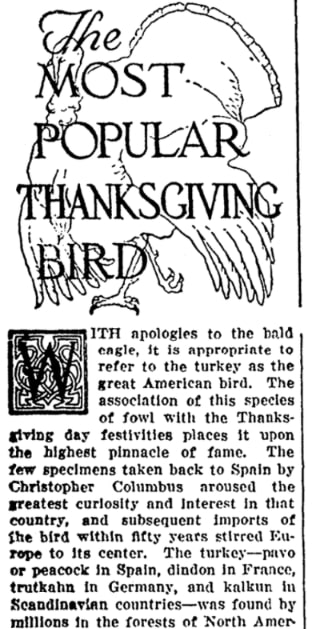
This article begins:
With apologies to the bald eagle, it is appropriate to refer to the turkey as the great American bird. The association of this species of fowl with the Thanksgiving day festivities places it upon the highest pinnacle of fame.
The article describes how Christopher Columbus found turkeys in the Americas and brought them back to Europe, where they became popular. When the Pilgrims settled in Plymouth, they learned the value of turkeys from the Wampanoags. Mayan hieroglyphs portrayed turkeys. Benjamin Franklin wanted turkeys to be the national bird, but they were outvoted in favor of bald eagles.
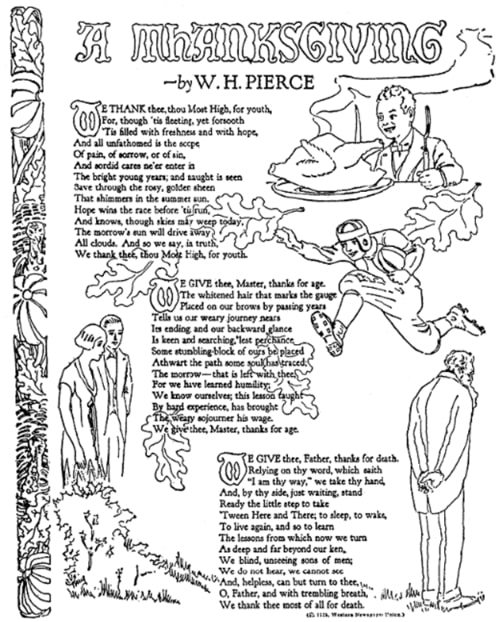
Other Thanksgiving articles found in 1925 include stories and poems, such as this poem titled “A Thanksgiving,” by W. H. Pierce. It expresses gratitude for youth, age, and death, giving poetic detail about each stage of a person’s life.
I’ll leave you with one final 1925 Thanksgiving newspaper article, this one titled “The Thanksgiving Myth,” by Jane Osborn.
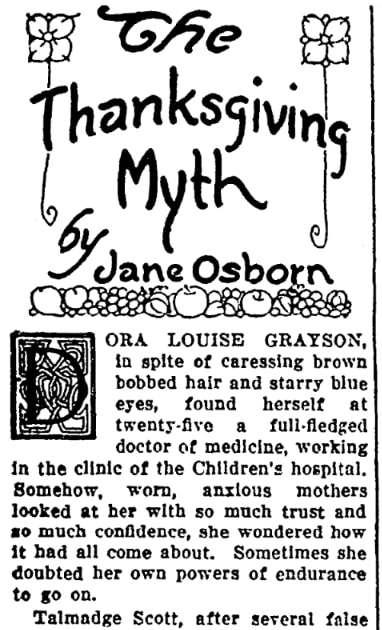
It is a love story about a couple coming together at Thanksgiving. Two doctors, Dora Louise Grayson and Talmadge Scott, worked at the same hospital. He had intended to invite her out to have Thanksgiving dinner with him, and she had intended to invite him over to cook a Thanksgiving dinner for him. Their answers to the initial probing on both ends gave the other the false impression that they didn’t care for Thanksgiving dinner. They went out for salad on Thanksgiving Day, then each secretly went out to have Thanksgiving turkey and found each other again. He asked her why she became a doctor instead of getting married, and she said she only wanted to marry a doctor. The story ends happily when he goes on to propose to her, and she says yes.
A century ago, newspapers at Thanksgiving time included heartwarming stories and poems, historical information, and advertisements for both Christmas and Thanksgiving.
Happy Thanksgiving everyone!
* Details of turkey pricing in 1925, report, Perplexity, Perplexity AI (https://www.perplexity.ai/search/how-much-did-a-thanksgiving-tu-Ah_CfeLpTWSxsSdtXpVB4A: generated 23 October 2025), 35-41 cents per pound meant a 10-12 pound turkey cost $4-$5; generated from query “how much did a thanksgiving turkey cost in 1925?”
Explore your family history by creating your free account at GenealogyBank for 7 days, because every life deserves to be remembered, recorded, and rediscovered.
Note on the header image: Happy Thanksgiving display. Photo credit: https://depositphotos.com/home.html
Related Articles:
