
 November 24, 2025
Introduction: In this article – the second in a series of three – Katie Rebecca Merkley writes about our ancestors celebrating Thanksgiving, in this case 200 years ago. Katie specializes in U.S. research for family history, enjoys writing and researching, and is developing curricula for teaching children genealogy. She has a website: krgarnergenealogy.com
Many people like to post on social media around holidays. In our ancestors’ time, those messages were newspaper posts. Newspapers from our ancestors’ day can reveal much of their lives, including how they celebrated Thanksgiving.
Thanksgiving two centuries ago was different from how we know it today.
One thing the newspapers of 1825 reflect about Thanksgiving is its irregularity. One example is this clipping from Salem, Massachusetts.
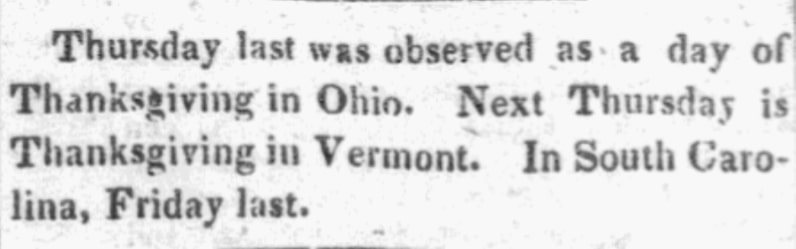
Each state listed in this clipping had Thanksgiving on a different day. Looking at an 1825 calendar shows that November 29, when this announcement was posted, was on a Tuesday. So “Thursday last” was November 24, “Next Thursday” was December 1, and “Friday last” was November 25. South Carolina held Thanksgiving on a Friday rather than a Thursday, and Vermont held it in December rather than in November.
Thanksgiving was not set to a specific day until 1863, when Abraham Lincoln designated the last Thursday of November as Thanksgiving. But that change was not permanent. A law in 1941 established Thanksgiving as the fourth Thursday in November, which we now celebrate today.* Before Abraham Lincoln, state governors decided if and when to celebrate Thanksgiving, and this varied by state – as shown by the above news clipping.
In most of New England and New York, Thanksgiving in 1825 was observed on November 24. An article posted in Maine that day mentioned that the governor had declared that date as a day of Thanksgiving, and that coincidentally, the governors of other states had also chosen that same day. A few years earlier, Thanksgiving was celebrated only in New England.

This article reminds its readers that Thanksgiving was a day to praise “him who rules the nations, and who is the giver of every good gift.” It also reminds the readers of the colonists’ deliverance from warfare with Native Americans in their early days.
In Massachusetts, newspapers announced on November 1 that Thanksgiving in that state would be on the 24th, as in other New England states. Governor Clinton had declared that day a day of public prayer and thanksgiving. “All servile labor and vain recreation, to use an old joke, seem in that state to be by law forgiven.” Additionally, the day after Thanksgiving was also a day of celebration in Massachusetts.
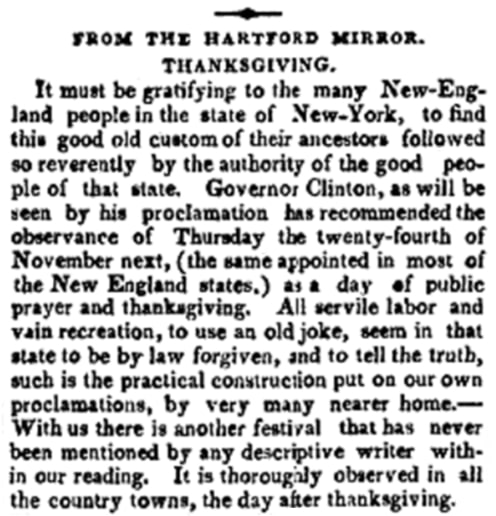
Details about the day after Thanksgiving were given in the following article. For many people nowadays, the day after Thanksgiving means shopping. I hear this is quite the nightmare for retail workers. (My retail days were at a grocery store, which is dead the day after Thanksgiving.) For some, the day after Thanksgiving marks the beginning of the Christmas season. For me, that is the day I begin playing Christmas music and put up all the Christmas decorations.
For people in Massachusetts two centuries ago, the day after Thanksgiving, while not an official holiday, was still an important festival day, especially in the country towns.
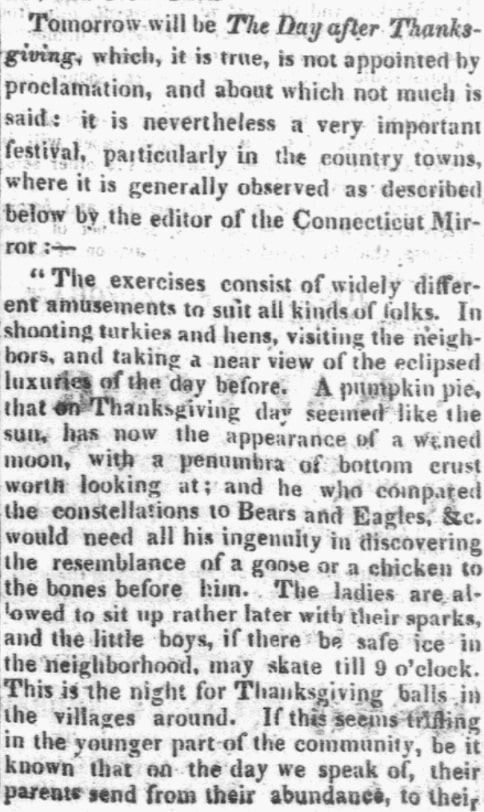
This article reports:
The exercises consist of widely different amusements to suit all kinds of folks.
This included shooting turkeys and hens, visiting neighbors, and skating “if there be safe ice in the neighborhood.” There were also Thanksgiving balls.
Meanwhile, those who were well off would send from their abundance to their poor neighbors: clothes, meat, wood, school books for the children, and other charities. Additionally, to thank the minister for his Thanksgiving sermon about their forefathers, “farmers vie with each other in getting [him] the best cord of walnut.” The richest squire would send the minister his fattest turkey. People also paid tribute to the minister’s wife with yarn and “other domestic comforts.”
A New York newspaper writer, whose state also celebrated Thanksgiving on November 24 in 1825, sang the Lord’s praises and offered thanks in the paper.
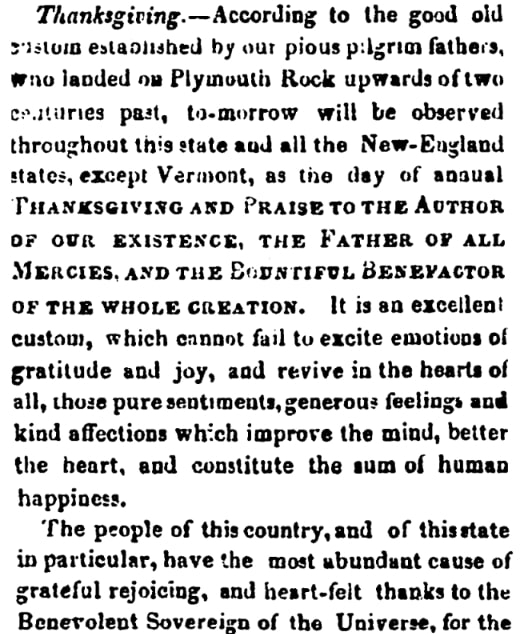
This article reads:
The people of this country, and of this state in particular, have the most abundant cause of grateful rejoicing, and heartfelt thanks to the Benevolent Sovereign of the Universe, for the continual blessings of the same Good Providence, which attended our fathers on the mighty deep when they fled from persecution to the new world – which protected them in the bleak and stormy winter of their landing…
The article goes on to praise the establishment of government, which laid the foundation for national freedom. It mentions the patriots of the American Revolution and the establishment of the United States.
The writer concludes:
While we remember with gratitude these general blessings, and offer the thanksgiving of the heart for the fruitful season and ample harvest which has filled “our basket and our store,” let us not be unmindful of individual suffering, and the claims of the poor and the afflicted.
Today, there is enough hustle and bustle around Thanksgiving for people to forget why they’re celebrating. However, some families will go around the table and state what they are grateful for. Other people post on social media what they’re thankful for. Our ancestors 200 years ago had such reminders in the newspapers, as seen above.
To be continued…
Happy Thanksgiving everyone!
* Laws that regulated Thanksgiving celebrations, report, Perplexity, Perplexity AI (https://www.perplexity.ai/search/when-was-thanksgiving-day-regu-cVtzmCC3R2Ot9O7R0yAQtA: generated 30 October 2025); generated from query “when was thanksgiving day regulated?”
Explore your family history by creating your free account at GenealogyBank for 7 days, because every life deserves to be remembered, recorded, and rediscovered.
Note on the header image: Happy Thanksgiving display. Photo credit: https://depositphotos.com/home.html
Related Article:
