
 October 2, 2026
Introduction: In this article, Melissa Davenport Berry explores a little-known aspect of Plymouth Colony Pilgrim history: the opening of their first trading post. Melissa is a genealogist who has a website, americana-archives.com, and a Facebook group, New England Family Genealogy and History.
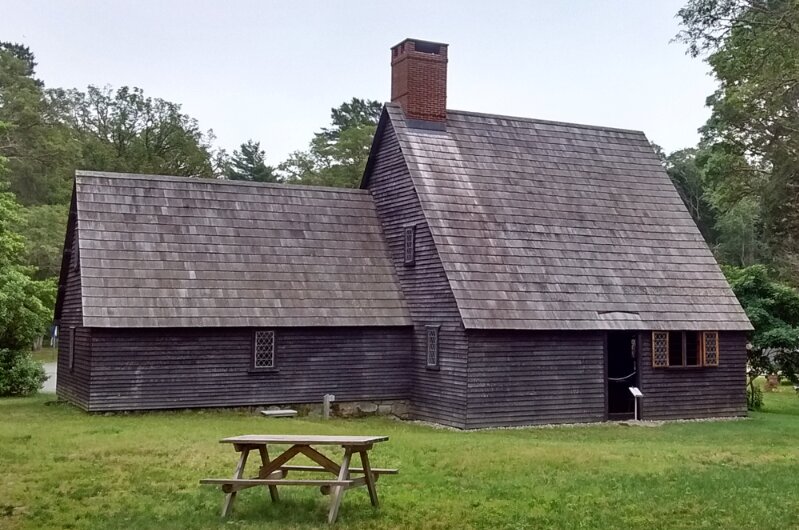
In September 1930, a dedication ceremony was held in Bourne, Massachusetts, for a newly built replica of the Pilgrims’ trading post known as the Aptucxet Trading Post.
The simple, historically accurate structure represents the early trade established in 1627 by Plymouth Colony Pilgrims on the Manomet River (now the Cape Cod Canal) to facilitate a three-way trading system with: the local Wampanoag people; Dutch traders from New Amsterdam (modern-day New York City); and the French.
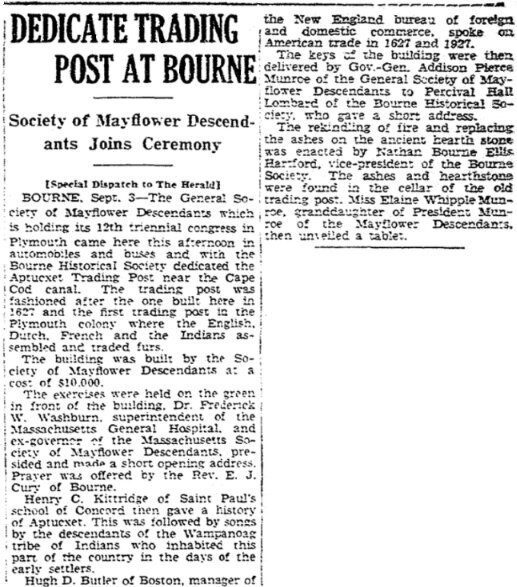
The Society of Mayflower Descendants funded a large portion of the building costs for the replica trading post, in conjunction with the Bourne Historical Society.
This newspaper clip on the dedication ceremony mentions the Society of Mayflower Descendants’ contribution of $10,000 for the building. Dr. Frederick Washburn, superintendent of the Massachusetts General Hospital and ex-governor of the Massachusetts Society of Mayflower Descendants, presided over the proceedings. My follow-up blog article will explain how the site was chosen and trace the project from excavation through construction.
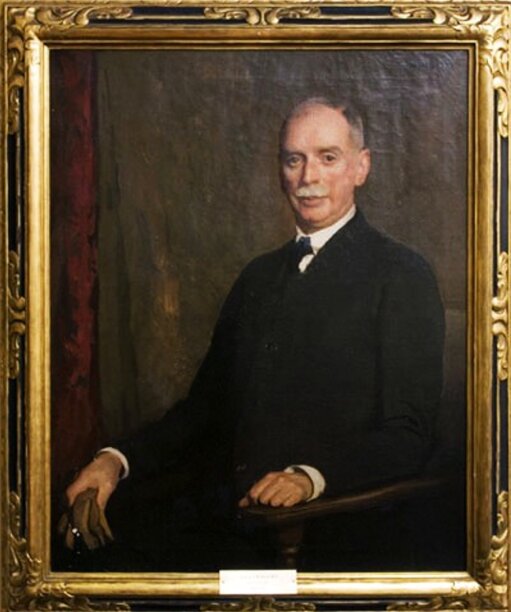
Here is a portrait of Dr. Frederick Washburn, who “presided and made a short opening address” at the dedication ceremony.
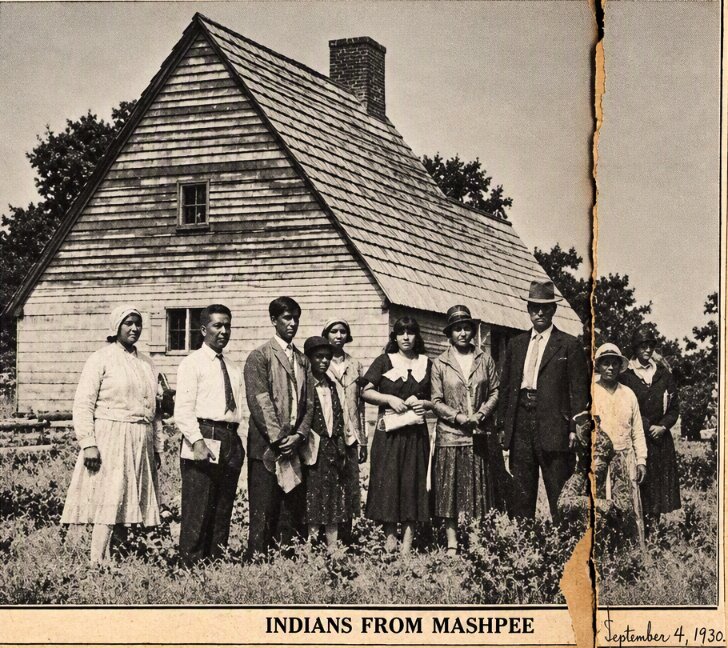
The Wampanoag descendants performed songs, and below is a photo of families from Mashpee Wampanoag Tribe members attending the 1930 dedication.
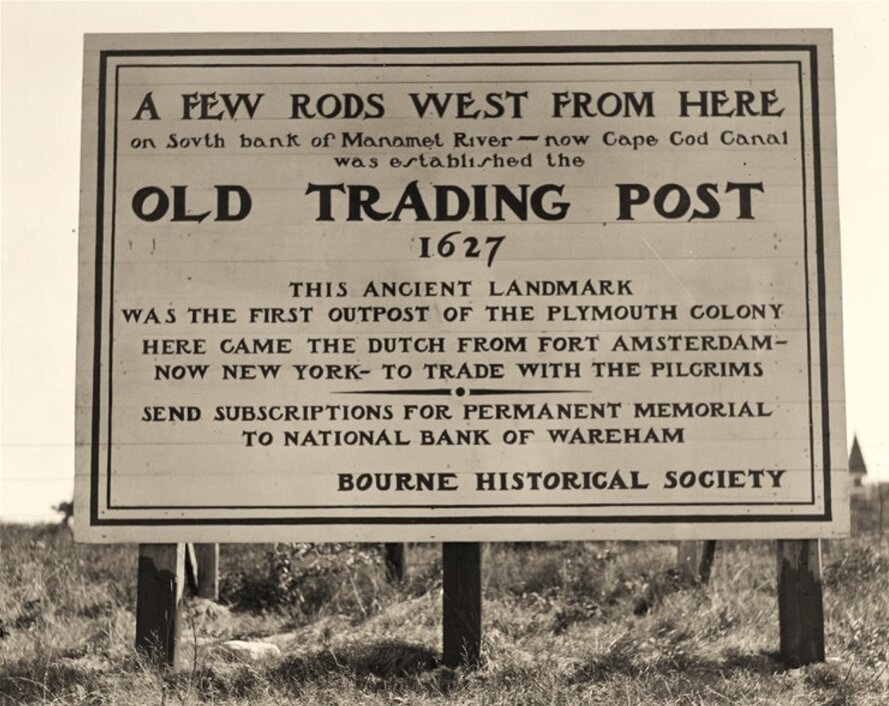
Here is a sign for the historic trading post site.
Some history of the first trading post is furnished in an article entitled, “Pilgrim Legacy: Example of Early Americana Graces Site of Cape Cod Canal,” published in the Providence Journal in 1986.
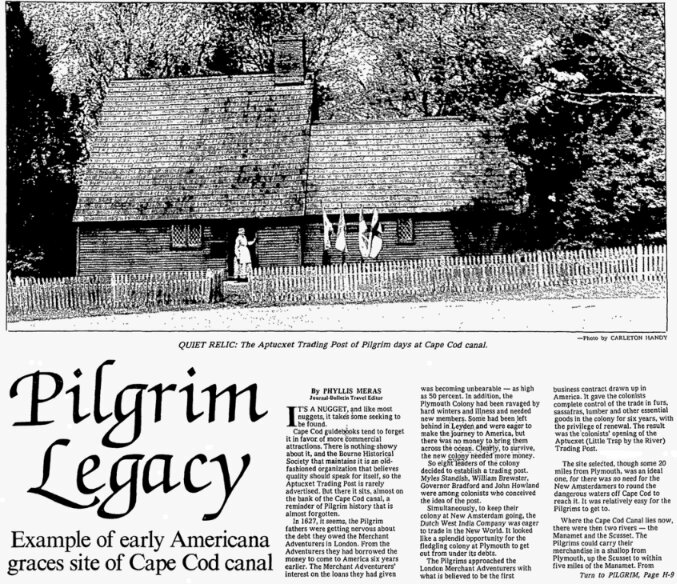
This article reports:
It’s a nugget, and like most nuggets, it takes some seeking to be found.
Cape Cod guidebooks tend to forget it in favor of more commercial attractions. There is nothing showy about it, and the Bourne Historical Society that maintains it is an old-fashioned organization that believes quality should speak for itself, so the Aptucxet Trading Post is rarely advertised. But there it sits, almost on the bank of the Cape Cod Canal, a reminder of Pilgrim history that is almost forgotten.
In 1627, it seems, the Pilgrim fathers were getting nervous about the debt they owed the Merchant Adventurers in London. From the Adventurers they had borrowed the money to come to America six years earlier [on the Mayflower]. The Merchant Adventurers’ interest on the loans they had given was becoming unbearable – as high as 50 percent. In addition, the Plymouth Colony had been ravaged by hard winters and illness and needed new members. Some had been left behind in Leyden [Leiden, Netherlands] and were eager to make the journey to America, but there was no money to bring them across the ocean. Clearly, to survive, the new colony needed more money.
So eight leaders of the colony decided to establish a trading post. Myles Standish, William Brewster, Governor Bradford, and John Howland were among colonists who conceived the idea of the post. [The others were Isaac Allerton, Edward Winslow, John Alden, and Thomas Prince.]
Simultaneously, to keep their colony at New Amsterdam going, the Dutch West India Company was eager to trade in the New World. It looked like a splendid opportunity for the fledging colony at Plymouth to get out from under its debts.
The Pilgrims approached the London Merchant Adventurers with what is believed to be the first business contract drawn up in America. It gave the colonists complete control of the trade in furs, sassafras, lumber and other essential goods in the colony for six years, with the privilege of renewal. The result was the colonists’ opening of Aptucxet (Little Trap by the River) Trading Post.
The site selected, though some 20 miles from Plymouth, was an ideal one, for there was no need for the New Amsterdamers to round the dangerous waters off Cape Cod to reach it. It was relatively easy for the Pilgrims to get to.
Where the Cape Cod Canal lies now, there were then two rivers – the Manamet and the Scusset. The Pilgrims could carry their merchandise in a shallop from Plymouth, up the Scusset to within five miles of the Manamet. From there, they could portage to the Manamet, which the Dutch could easily reach without rounding Cape Cod, because it emptied into Buzzards Bay.
There was a third party, too, that was to profit by the establishment of a trading post. The Wampanoag Indians could bring their deerskins and beaver furs to exchange for Dutch tobacco or brightly colored Plymouth beads.
In addition to tobacco, the Dutch came with linen and tools and wampum.
After establishing this trading post, Governor Bradford set up two more on the Kennebec River and the Connecticut River.
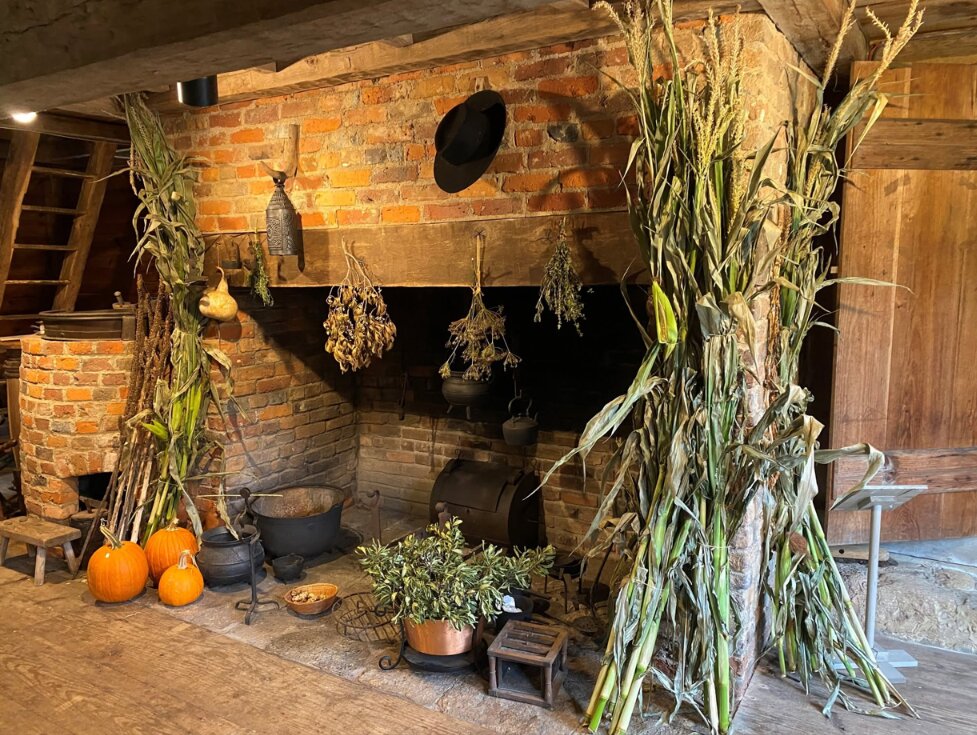
Below is a photo of the interior of the Aptucxet Trading Post Museum decorated for autumn.
From Governor Bradford on trade, recorded in his history:
This year (1627) the Dutch sent againe unto them from their plantation, both kind leterss, and also diverse comodities, as sugar, linen cloth, Holand finer and courser stufes, etc. They came up with their barke to Manamete, to their house ther, in which came their Secretarie Rasier; who was accompanied with a noyse of trumpets, and some other attendants; and desired that they would send a boat for him, for he could not travill so farr over land. So they sent a boat to Manonscussett, and brought him to the plantation, with the cheefe of his company. And after some few days entertainmente, he returned to his barke, and some of them wente with him, and bought sundry of his goods; after which begining thus made, they sente often times to the same place, and had entercourse togeather for diverce years; and amongst other comodities, they vended much tobaco for linen cloath, stuffs, etc., which was a good benefite to the people, till the Virginians found out their plantation. But that which turned most to their profite, in time, was an entrance into the trade of Wampampeake; for they now bought about 50 li. worth of it of them; and they tould them how vendable it was at their forte Orania (now Albany); and did perswade them they would find it so at Kenebeck; and so it came to pass in time, though at first it stuck, and it was 2 years before they could put of this small quantity, till the inland people knew of it; and afterwards they could scarce ever gett enough for them, for many years togeather.
More to come…
Note: some of the graphics in this article have been AI enhanced.
Explore your family history by creating your free account at GenealogyBank for 7 days, because every life deserves to be remembered, recorded, and rediscovered.
Note on the header image: “Mayflower in Plymouth Harbor,” by William Halsall, 1882. Credit: Wikimedia Commons.
