
 August 25, 2025
Introduction: In this article, Melissa Davenport Berry writes about the fateful encounter between Capt. Hart and his crew with pirates in the West Indies in 1829. Melissa is a genealogist who has a website, americana-archives.com, and a Facebook group, New England Family Genealogy and History.
Captain Charles Hart sailed out of Salem, Massachusetts, in the brig New Priscilla on 24 September 1828, never to return.
Capt. Hart and his crew fell prey to a beastly lot of pirates. The capture of the New Priscilla is one of the worst cases of piracy against an American vessel on record.
Most of the story is recalled in Francis B. C. Bradlee’s book Piracy in the West Indies and Its Suppression and in newspaper archives.

The New Priscilla (125 tons) was bound for Sumatra and the pepper coast when it cleared the Salem Custom House. Before making the long voyage to Sumatra, Capt. Hart would first make a few runs from Havana, Cuba, to Charleston, South Carolina, and back.
The funding needed for the trip and to pay for the pepper cargo was in Spanish currency, delivered in kegs and linen sacks from the Asiatic Bank on Essex Street in Salem down to the wharf prior to New Priscilla’s departure.
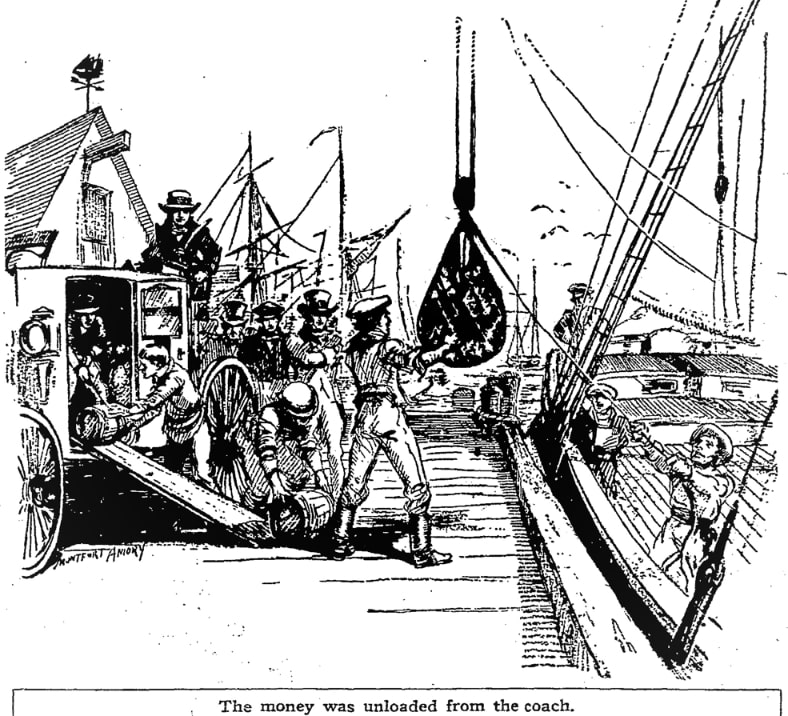
Capt. Hart’s recovered logbook records two completed runs from Cuba to South Carolina, and then a final departure from Charleston.
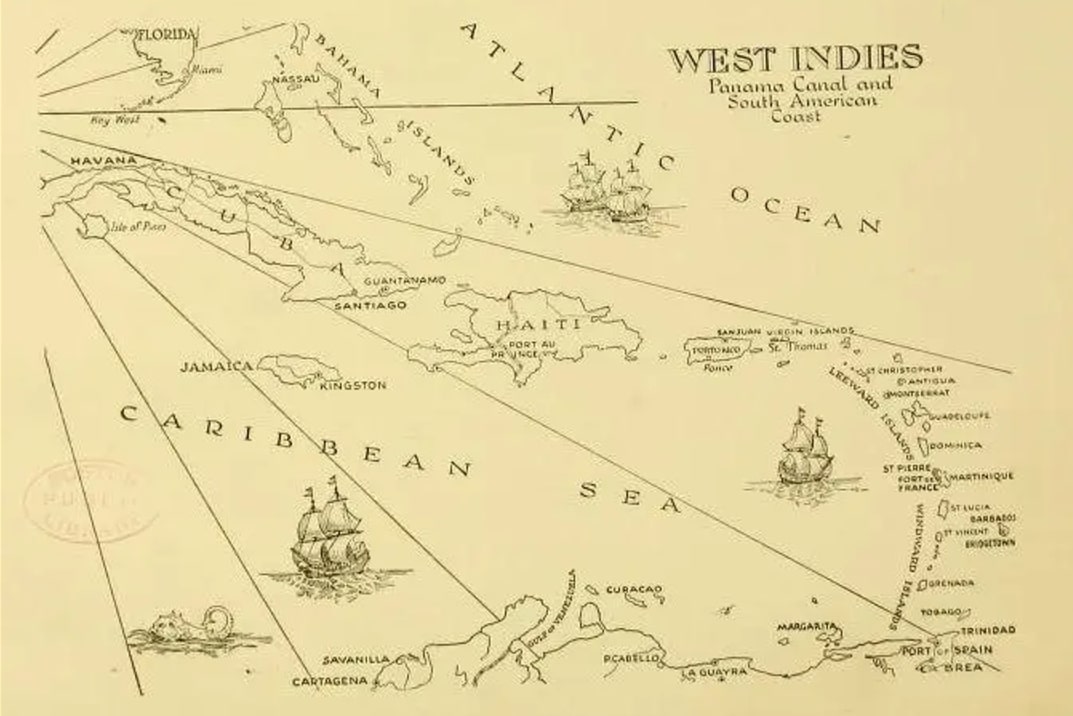
But then disaster struck.
The initial alarm was raised on 14 February 1829, when foul play was cited by Capt. Weston of the Mary Jane.
Weston’s report was confirmed by a report first published on March 14 by the Royal Gazette, reprinted by the Charleston Courier, then reprinted a month later by the Baltimore Patriot.
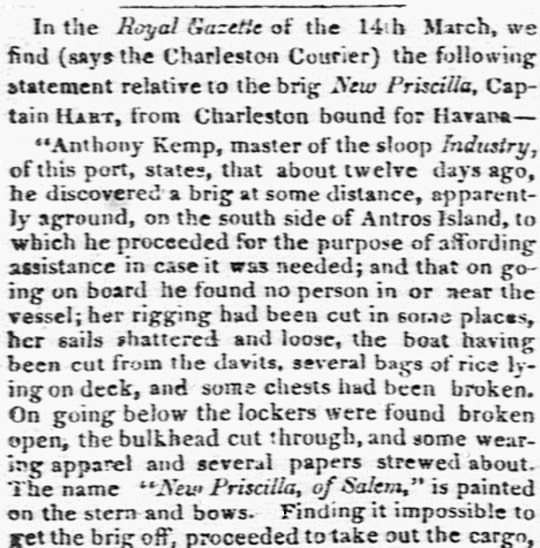
This article reports:
In the Royal Gazette of the 14th March, we find (says the Charleston Courier) the following statement relative to the brig New Priscilla, Captain Hart, from Charleston bound for Havana:
“Anthony Kemp, master of the sloop Industry, of this port, states, that about twelve days ago, he discovered a brig at some distance, apparently aground, on the south side of Antros [Andros] Island, to which he proceeded for the purpose of affording assistance in case it was needed; and that on going on board he found no person in or near the vessel; her rigging had been cut in some places, her sails shattered and loose, the [life]boat having been cut from the davits; several bags of rice lying on deck, and some chests had been broken. On going below the lockers were found broken open, the bulkhead cut through, and some wearing apparel and several papers strewed about. The name New Priscilla, of Salem is painted on the stern and bows. Finding it impossible to get the brig off, proceeded to take out the cargo, which consisted of rice in tierces and bags, which having effected with the assistance of another little vessel that came there on the following day, she floated, and was towed to a place of more security, where the remainder of the cargo was taken out and landed. A part of the cargo has arrived here, and other vessels have been sent to bring the whole to port. The papers, among which is said to be the logbook, are not yet brought from the wreck, but expected in a day or two.
An extract from Capt. Weston’s letter dated March 16 was printed in the Salem Register and then reprinted in the Portsmouth Journal and Rockingham Gazette.
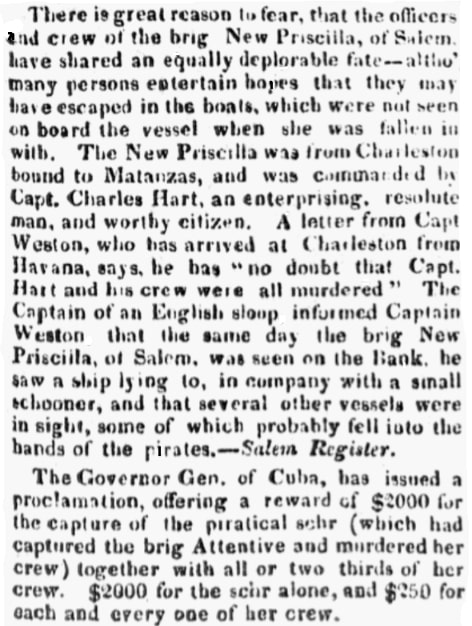
This article reports:
There is great reason to fear that the officers and crew of the brig New Priscilla, of Salem, have shared an equally deplorable fate – although many persons entertain hopes that they may have escaped in the boats, which were not seen on board the vessel when she was fallen in with. The New Priscilla was from Charleston bound to Matanzas, and was commanded by Capt. Charles Hart, an enterprising, resolute man and worthy citizen. A letter from Capt. Weston, who has arrived at Charleston from Havana, says he has “no doubt that Capt. Hart and his crew were all murdered.” The captain of an English sloop informed Capt. Weston that the same day the brig New Priscilla, of Salem, was seen on the Bank, he saw a ship lying to, in company with a small schooner, and that several other vessels were in sight, some of which probably fell into the hands of the pirates.
The Governor Gen. of Cuba has issued a proclamation offering a reward of $2000 for the capture of the piratical schooner (which had captured the brig Attentive and murdered her crew) together with all or two thirds of her crew. $2000 for the schooner alone, and $250 for each and every one of her crew.
Some possible hope was raised in an article published on June 10.
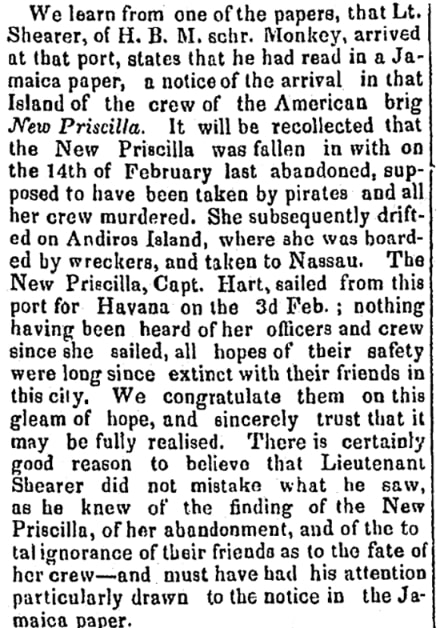
This article reports:
We learn from one of the papers that Lt. Shearer, of H.B.M. schooner Monkey, arrived at that port, states that he had read in a Jamaica paper, a notice of the arrival in that island of the crew of the American brig New Priscilla… The New Priscilla, Capt. Hart, sailed from this port for Havana on the 3d Feb.; nothing having been heard from her officers and crew since she sailed, all hopes of their safety were long since extinct with their friends in this city. We congratulate them on this gleam of hope, and sincerely trust that it may be fully realized.
But that “gleam of hope” proved to be false. Nothing more was ever seen or heard from Capt. Hart and his crew.
A few years before the capture of the New Pricilla, American vessels made an aggressive campaign to ferret out the pilfering menaces.
From 1824 until the capture of the New Priscilla, piracy spread to an alarming extent in the West Indies, and several defenseless merchantmen were captured at the very entrance of large ports such as Havana.
Merchants banded together at the Salem Marine Insurance office to form a committee to urge Congress to amend laws on the willful destruction of vessels upon the high seas and suppress pirates in the West Indies.
The tragic loss of the New Priscilla initiated a powerful change, and she would ultimately become a kind of sacrificial vessel to anchor a higher justice against piracy.
Capt. Hart would never know that the fate of his brig triggered powerful repercussions: an American armada cleaned out the villainous sea rovers to create a safer briny deep.
According to historian Francis B. C. Bradlee, one of the last acts of piracy was in September 1832 on the Salem brig the Mexican, commanded by Capt. John G. Butman.
Soon after that final attack, the reign of piracy in the West Indies ended.
Here’s a little lore: two sailors from the New Priscilla received divine intervention which came in the form of a howling black cat on the Charleston docks their last night in port, as they were hurrying to get on board.
The superstitious fellows decided they were not going to test the fates, so they didn’t join their shipmates and escaped their fateful encounter with the murderous pirates.
Sources say one lived to a ripe old age in Salem, and during several tavern crawls told the tale of how he escaped the grim reaper of the New Priscilla.
Here is a newsclip from 1930 retelling the tale of Capt. Hart and the New Priscilla.
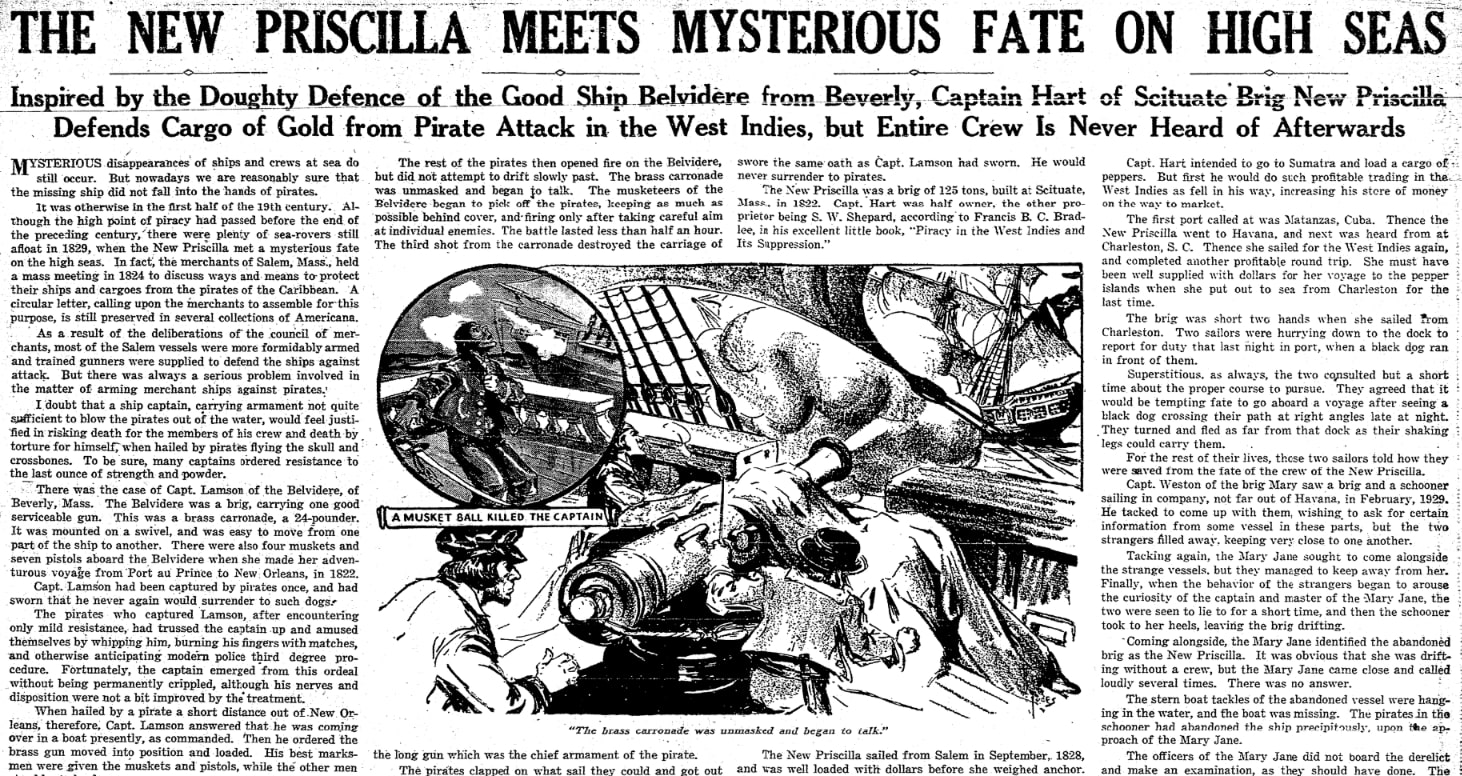
This article reports:
Coming alongside, the Mary Jane identified the abandoned brig as the New Priscilla. It was obvious that she was drifting without a crew, but the Mary Jane came close and called loudly several times. There was no answer.
The stern boat tackles of the abandoned vessel were hanging in the water, and the boat was missing. The pirates in the schooner had abandoned the ship precipitously, upon the approach of the Mary Jane.
The officers of the Mary Jane did not board the derelict and make an examination, as they should have done. The plain truth is that they were frightened by this eerie business on the high seas, and, after receiving no answer to their hails, sailed away. They reported the abandoned vessel to the proper authorities ashore.
Nothing more was ever seen or heard of the New Priscilla. It was concluded that the schooner was a pirate vessel, and that she had taken the New Priscilla after a fight and had murdered all of the captured crew. The pirates were probably sailing the prize with a skeleton crew when the Mary Jane hove in sight, and decided to abandon her and make their getaway when hailed.
Any seasoned ship master knew the answer to the knotty question of what went down with this brig. As the old saying goes, “the stuff that legends are made of.”
Create a free account at GenealogyBank for 7 days to start your journey and discover the stories your ancestors left behind.
Note on the header image: Illustration: Captain Charles Hart. Credit: Francis B. C. Bradlee.
