
 October 6, 2026
Introduction: In this article – to celebrate Family History Month in October – Gena Philibert-Ortega describes how she conducted a 4-generation audit. Gena is a genealogist and author of the book “From the Family Kitchen.”
Welcome to Week 1 of Family History Month and my 4 x 4 Plan. As a reminder, here’s what I wrote about this week in my introduction article.
Photo credit: https://depositphotos.com/home.html
Week 1: Conduct a 4-Generation Audit
Even those of us who have been researching for a long time have some mistakes and omissions in our family tree, including factual errors, missing documents, and records that need to be acquired. I’m going to look at my four generations and make sure that I have the documents and relevant facts that I should on my family tree.
For this week, I want to concentrate on basic records such as the U.S. Census, vital records, and newspapers. As I look at my family tree I’ll be asking:
- Have I found, documented, analyzed and attached my 4 generations in the U.S. Census? For my family, that would be the 1900-1950 censuses.
- Do I have everyone’s birth certificates or delayed birth certificates?
- Do I have everyone’s marriage certificates (if applicable)?
- Do I have death certificates for those who are deceased?
- Do I have everyone’s newspaper obituaries?
- Have I searched GenealogyBank for newspaper articles for my 4 generations?
My Genealogy Audit
I decided to start with the U.S. Census since that is the easiest to begin with (I’ve not included living names and those in the first three generations, which I’ve omitted for privacy). As a reminder, the U.S. Census is available on GenealogyBank.
Audit of the U.S. Census in My Family Tree
As I began my U.S. Census audit, I realized right away that I made a mistake thinking I needed to only focus on 20th-century census years. In fact, I have ancestors in my 4th generation that were found in the 1880 census (my ancestor who would have been in the 1860 and 1870 censuses had not immigrated to the U.S. yet). So, I need to look at the 1880-1950 censuses for my four generations.
2nd Generation
Mom and Dad: The only available census year they are found in is the 1950 census. I found them both as children in the 1950 U.S. Census when it was originally released.
Paternal 3rd Generation
Paternal Grandparents: Grandfather (1925-1994) and Grandmother (1927-1990). My paternal grandparents are found in the 1930, 1940, and 1950 censuses. I have those records for these grandparents.
Maternal 3rd Generation
Maternal Grandparents: Grandfather (1899-1957) and Grandmother (1905-1992). I have all of the censuses for my maternal grandfather, but I realized I do not have the 1910 census record for my grandmother. However, her family was not living in the United States during her childhood, which I think includes 1910. But I need to verify that.
Paternal 4th Generation
Paternal Great-Grandparents: Oscar J. Philibert (1899-1972) and Mary B. Chatham (1904-1988). I have the 1900-1950 census records for Oscar attached to my tree. I realized that I have not attached the 1950 record to Mary’s profile in my tree. I have that U.S. Census, but I need to attach it to her profile.
Maternal Great-Grandparents: Clifford J. Montgomery (1901-1977) and Jeltje M. Johnson (1905-1992). Clifford and Jeltje were divorced in the 1930s, which means that I need to find them separately in the 1940 and 1950 census years. In my family tree I am missing Clifford in the 1920 census. I’m missing Jeltje in the 1910, 1920, and 1940 censuses. I had no idea I was missing so many census years for her! Looks like I have some more research to do.
Maternal 4th Generation
Paternal Great-Grandparents: Frank L. Nikolaus (1856-1927) and Mary E. Laxton (1870-1916). Frank didn’t immigrate to the U.S. until 1879. So, I would expect to see him in the 1880, 1900, 1910, and 1920 census years. Of those, I’m only missing 1880. Mary was born in the United States, and I would expect to find her in 1880, 1900, and 1910 (she born in October 1870, too late to be counted for that year’s census). It looks like I’m missing her in 1880.
Maternal Great-Grandparents: Benjamin McNeil (1881-1956) and Edith Petersen (1884-1947). I’m missing the years 1900, 1910, and 1950 for Benjamin. Benjamin and Edith were living outside of the country and that might account for the missing years 1900 and 1910.
U.S. Census Conclusion
Wow! I didn’t realize how much I was missing from those four generations. It’s embarrassing. It’s a good reminder that I have done something I warn others about: skipping generations. My only defense is that I did change where I keep my family tree and it’s possible I forgot to move some of those over. But either way, this week I’ll go back and find those U.S. Census records and attach them.
Vital Records
I looked over each person in these four generations and realized that I was missing some birth records in the fourth generation (my 16 great-grandparents). I need to verify that birth registration was applicable to their birth year and place because it might be that there was no vital record registration. But even so, I need to add that to my family tree notes, so I know (and those who inherit my research know) that I at least checked.
Newspaper Obituaries
I have been working on adding historical obituaries, when they exist, to my family tree. But not all my family had obituaries. For example, my paternal grandparents do not. But once again I need to note that in my tree, so I remember that they don’t and there’s no reason to look for them.
Newspaper Articles
This is probably the one research area I have done a good job keeping up with: searching for family in historical newspapers. It’s important to know that GenealogyBank is always adding to their historical newspaper collection, so check back often.
Since I have recently searched for many of these ancestors I decided to focus on a few of my maternal ancestors – and I was glad I did. Although I have found many newspaper articles for that side of the family, I wanted to see if I could find anything new.
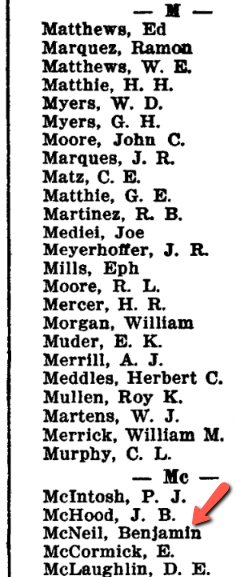
In the past, I’ve found many newspaper articles for my great-grandfather, Benjamin McNeil, and this time I did find something new: I found him in a grand jury list. This was new to me, and I appreciated the information at the beginning of the newspaper article explaining who was exempt from the grand jury.
Week 1 Conclusion
This exercise took longer than I originally thought but it yielded so much information. I need to concentrate on filling out information for the first four generations and make sure that I’m not missing anything or making assumptions. I’m so glad I decided to concentrate on these four generations. None of us is immune to mistakes and one of mine has been verifying all the U.S. Census years for my more recent ancestors.
Did you take the Week 1 challenge? What did you learn about your research? Let’s all learn from each other. Add your takeaways in the comments below.
Create a free account at GenealogyBank for 7 days to start your journey and discover the stories your ancestors left behind.
Note on the header image: Family History Month graphic. Credit: https://depositphotos.com/home.html
Related Article:

Worth adding to any 4-generation audit: the record you can’t find is itself a finding. The classic trap is the 1931 England & Wales census. People assume they’re searching wrong. The returns don’t exist. They burned at the Office of Works store at Hayes on 19 Dec 1942, and the GRO’s own report on it says it was not enemy action. Scotland’s 1931 returns were stored separately in Edinburgh and survive. So the honest audit line is ‘record gone, reason known,’ not ‘not found.’
Great point Chio! Thanks for that addition. I appreciate it.
Thanks Gena. One more for the audit body: when a database returns nothing, check its coverage before you conclude the record is gone. “No result” in a database usually means “not in this database,” not “never existed.” Those two get blamed on each other constantly.