
 September 26, 2025
Introduction: In this article, Melissa Davenport Berry starts her series about 17th century arrivals in New England, beginning with the Bradstreet family. Melissa is a genealogist who has a website, americana-archives.com, and a Facebook group, New England Family Genealogy and History.
During the “Great Migration” to colonial New England in the 17th century, Puritans and others arrived in Massachusetts Bay Colony (1628-1691) north of Plymouth Colony, and settled in places like Newbury and Agawam, later known as Ipswich.
The accounts in this article are drawn from archival materials and descendant testimony. Also check out American Ancestors’ website New England’s Great Migration.
Humphrey Bradstreet
The ship Elizabeth left Ipswich, England, in April 1634. Among the names on the passenger list arriving in Massachusetts Bay Colony was Humphrey Bradstreet. He came with his wife Bridget and children. He was the second cousin of Governor Simon Bradstreet (1603-1697).
Tracing the Bradstreet last name through colonial records reveals fascinating connections between passengers who arrived on the same ships and later became neighbors in the Massachusetts Bay Colony.
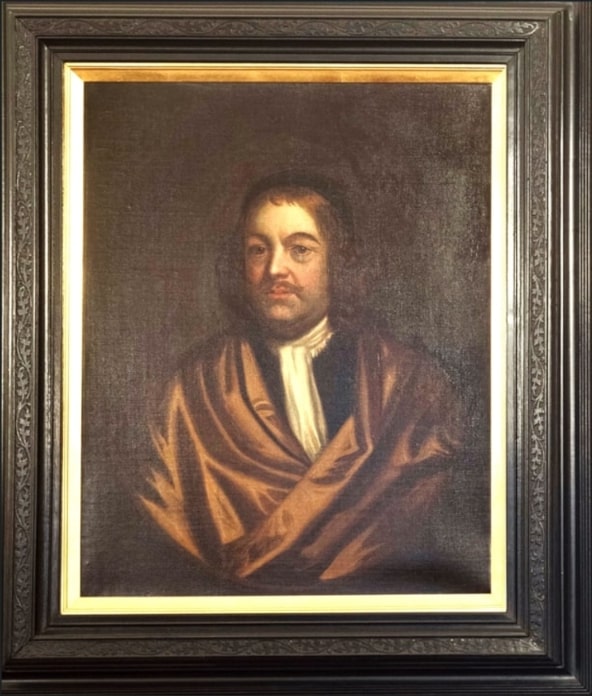
Humphrey was appointed the deputy for Ipswich to Massachusetts Bay General Court and was included on a committee to consider Mr. Endicott’s defacing of the colors. You can read more on that subject: “The Story Behind an Ancestor’s Unusual Name: Truecross Davenport.”

While he served on a few juries, other court records show Humphrey was entangled in some drama with neighbors and kin including John Cross, also a passenger on the ship Elizabeth, whose farm bordered Humphrey’s property.
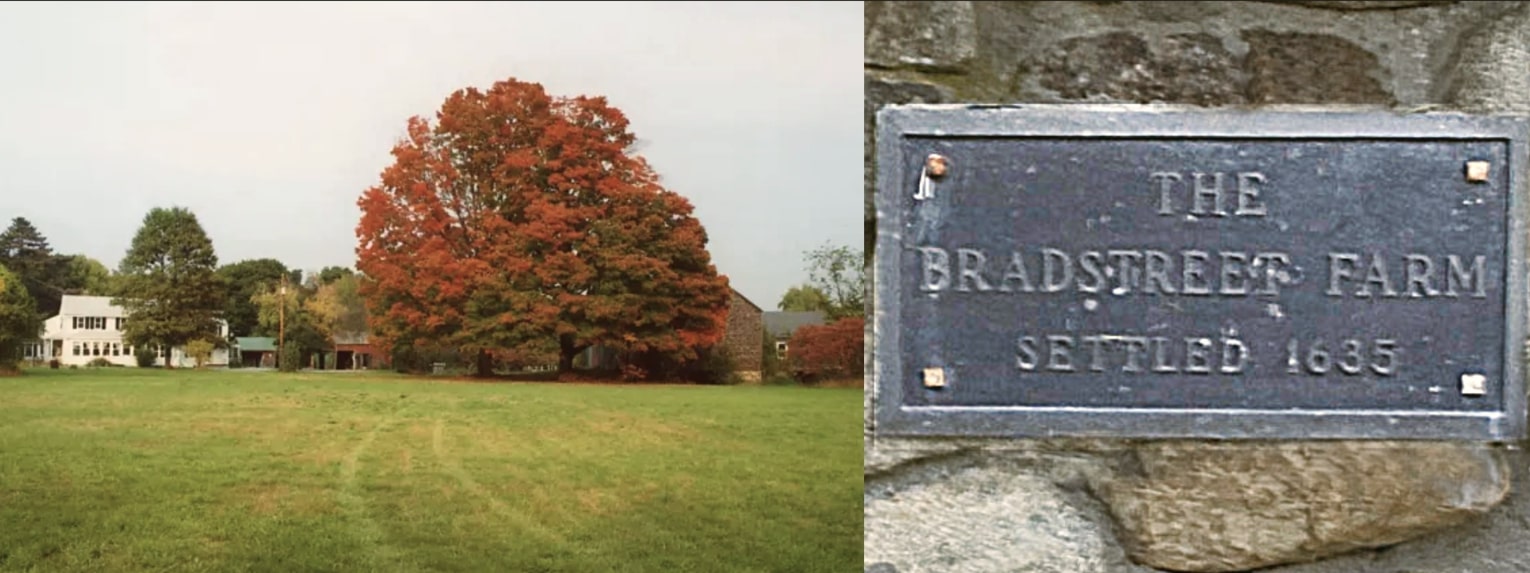
The Bradstreet Farm
The family farm, a 130-acre parcel originally granted to Humphrey Bradstreet by King Charles I in 1635, was inherited by his son Captain Moses Bradstreet, who married Elizabeth Harris, daughter of John and Bridget (Angier) Harris.
Most of the land on this property was originally in Ipswich. A lane crossed through the property called “Way to Newbury.”
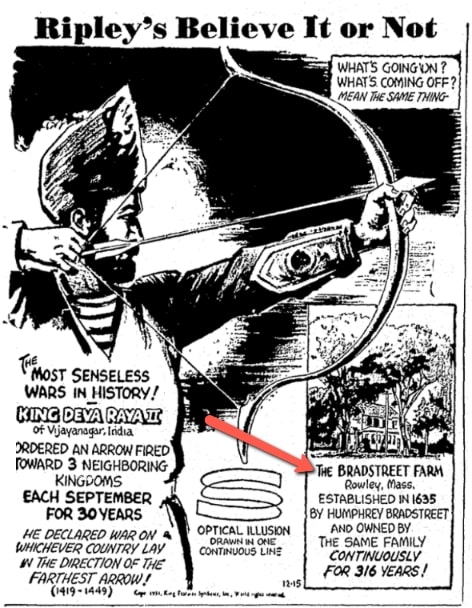
The property remained with the family through multiple generations until 2007. In 1951 “Ripley’s Believe It or Not” noted that the Bradstreet Farm, established by Humphrey Bradstreet in 1635, had been owned by the same family for 316 years!
A 1935 newspaper article says the Bradstreet Farm may be the oldest farm in the country.
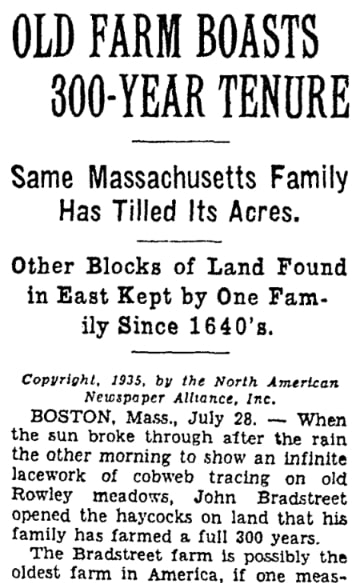
This article reports:
When the sun broke through after the rain the other morning to show an infinite lacework of cobweb tracing on old Rowley meadows, John Bradstreet opened the haycocks on land that his family has farmed a full 300 years.
The Bradstreet farm is possibly the oldest farm in America, if one measures the age of a farm by the continuous relations of one family to the same land. None but a Bradstreet has ever farmed these acres since Humphrey Bradstreet had his grant from Ipswich in 1635.
It is the oldest by a season or two of a number of ancient farms that lie within sight of the sea between Ipswich, Mass., and Newburyport…
Neighboring Newbury, celebrating this summer her three hundredth anniversary, claims several farms that share with the Bradstreet farm the tradition of continuous tillage through nine generations by descendants of the original settlers.
Sons now in college are counted on to continue the heritage of farm management that has passed down from father to son from the first settlers. The connection with the land is a conscious tradition and stoutly held. “Never any but a Moody has had this land,” is a Newbury boast. “None but an Isley has ever farmed here.” “Never any but a Little has ever lived on this place.”
Bradstreets of Rowley and Littles of Newbury have sailed the seas and settled in the West, have prepared for the pulpit and have apprenticed for a trade – but always to come back to keep up the farm before the old folks were through.
Only the other day a grizzled farmer in old Newbury said to a lad home from seeing the world with the marines:
“I’d like you to come back to the farm some time, son.”
“Don’t you worry, dad,” replied the son of a 300-year link with the land.
When Silas Little held his grandson on his knee before the fireplace in the great old brick-ended Little farmhouse this summer, Mrs. Little remarked, “That’s the tenth generation to sit before those andirons.”
The andirons were brought from England in 1640 by George Little, who cleared and farmed the Little grant in Newbury. Silas Little keeps the original grant intact as he keeps the andirons that were first set upon a hearth in America.
“Some time back a man from Boston drove into the yard and offered me his automobile for those andirons,” Silas Little says. “I didn’t have a car then, either. But, Mister, I didn’t trade. I’ve got some youngsters coming after me.”
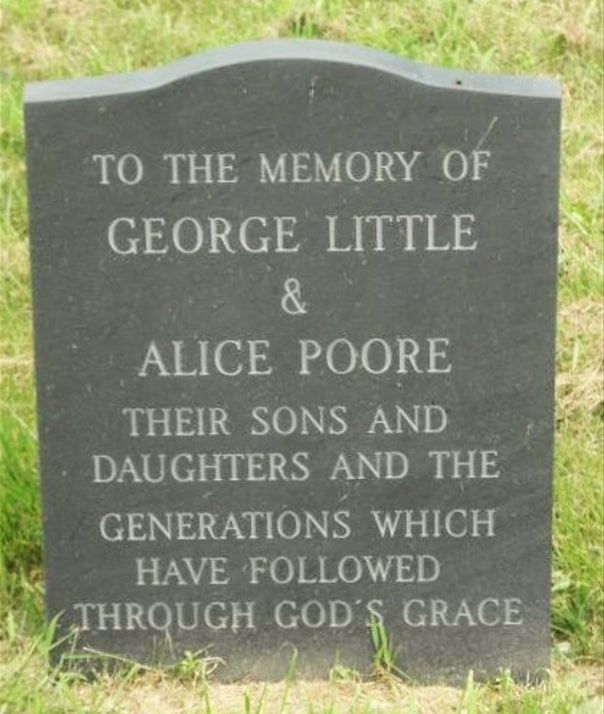
Below is a memorial grave marker for George Little and his wife Alice (Poore) Little, who emigrated from Southampton, England, in May 1638 and sailed to Massachusetts on the ship Bevis.
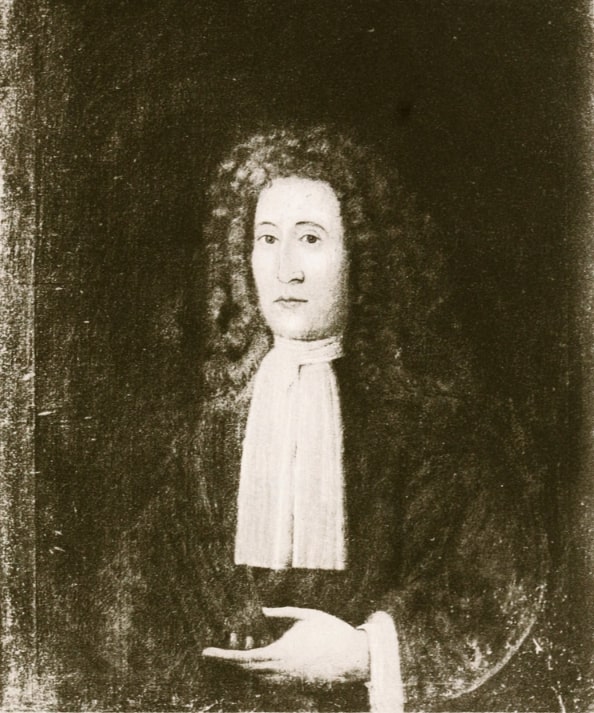
Sources say the Littles’ passage was paid for by Rev. John Woodbridge, who sailed on the ship Mary and John. Rev. Woodbridge married Mercy Dudley, daughter of Governor Thomas Dudley and sister of Anne Bradstreet.
To be continued…
Create a free account at GenealogyBank for 7 days to start your journey and discover the stories your ancestors left behind.
Note on the header image: this replica of Arbella was built in 1930 for the 300th anniversary of the Winthrop Fleet’s arrival at Salem on 12 June 1630. Credit: the Tichnor Brothers Collection, Boston Public Library, Print Department.
Related Reading:
- The Devil Went Down to Newbury (part 1)
- The Devil Went Down to Newbury (part 2)
- Stephen Hale: ‘The Old Sage of Newbury,’ Part I
- Stephen Hale: ‘The Old Sage of Newbury,’ Part II
- 300th Anniversary Celebration of New England’s ‘Winthrop Fleet’
- The descendants of George Little, who came to Newbury, Massachusetts, in 1640
