
 October 21, 2025
Introduction: In this article, James Pylant concludes a true-crime story that has a Halloween connection, showing that some family history has a dark side. James is an editor at GenealogyMagazine.com and author for JacobusBooks.com, is an award-winning historical true-crime writer, and authorized celebrity biographer.
The shocking murders of Maggie Snow, her son Bernie Connally, and mother Samantha Olds by Maggie’s husband F. M. Snow brought hordes of curiosity seekers to the crime scene, many hoping to collect macabre souvenirs: bones from the fireplace and ash piles.

As Part 1 explained:
No one knew the victims very well. They were new to the community. “I never felt he had much chance,” said a Waco resident of Bernie. Still, Bernie was better known than his mother and grandmother. “Them women was awful close-mouthed,” said a neighbor. And for a good reason. They didn’t want anyone to know about their past.
That’s because this blood-drenched saga began long before the 1925 triple crime.
Suspicious Background of Samantha Olds and Maggie Snow
Born on 31 October 1855 in Rusk County, Texas, Samantha Jones was described as petite, beautiful, and vivacious. She became a very young bride with her Christmas Eve marriage to Amos Smith in 1867 in Bosque County.
The Smiths had two daughters, Lizzie and Molly; another daughter died young. Amos, a gambler with an arrest record, reportedly killed a man, though no indictment records survive. Violence would claim his life on 26 July 1875.
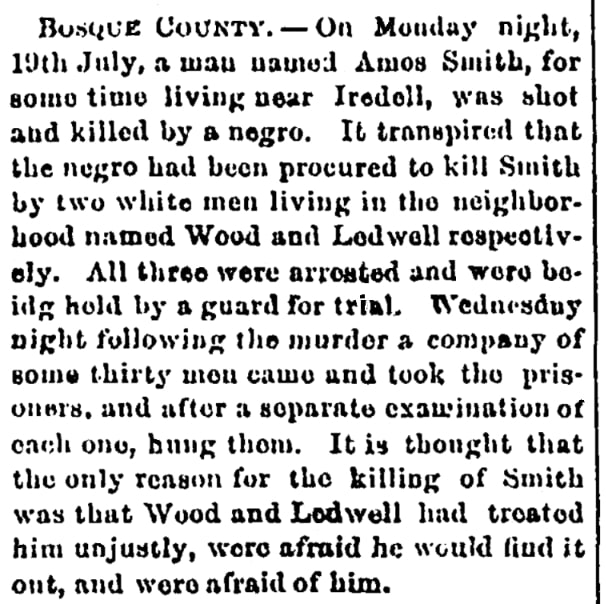
This article reports:
On Monday night, 19th July, a man named Amos Smith, for some time living near Iredell, was shot and killed by a negro. It transpired that the negro had been procured to kill Smith by two white men living in the neighborhood named Wood and Ledwell respectively. All three were arrested and were being held by a guard for trial. Wednesday night following the murder a company of some thirty men came and took the prisoners, and after a separate examination of each one, hung them. It is thought that the only reason for the killing of Smith was that Wood and Ledwell had treated him unjustly, were afraid he would find it out, and were afraid of him.
Yet the next day, a snippet from another newspaper gave the story a different slant.
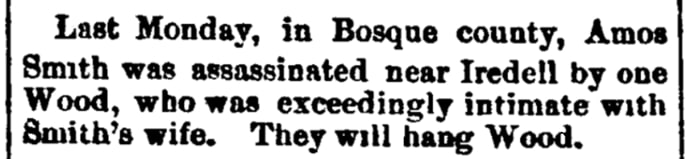
Amos’ wife Samantha was never indicted for her husband’s murder.
The young widow married William C. “Bill” Olds by 1876. They lived in Bosque County, where Bill had been arrested over the years for various offenses – theft, forgery, and murder – though never convicted.
As he grew older and became less of a physical threat, Samantha forced him from their home at gunpoint. She and her children soon relocated to Waco.
“That old lady could shoot better than any man I know,” said a long-time Wacoan. “She lived down by the wagon yards and used to shoot up the place right regular – just for the hell of it.”
Maggie, one of Samantha and Bill’s four children, was born in 1883. At 17, she married Robert G. Harris in Comanche County in 1900. The couple had one child, a son who died suddenly as an infant. Soon after, Robert disappeared. According to Maggie’s niece, Helen Luper, he “just left and failed to return.”
In 1906, Maggie married Sam L. Connally in Somervell County. Their son, Bernie, was born in 1907, and in 1915 they had a daughter, Wayne, who died at age seven. The Connallys may have lived in Hill County at the time of their children’s births. It was there, perhaps, where Maggie cultivated a curious 20-year association with a prominent attorney, William Spell, who represented the Missouri, Kansas, and Texas Railway, which employed Sam. Spell would later call Maggie his “charity client.”
Both the Spells and Connallys moved to Waco in the 1910s.
In 1921, 46 years after Samantha had been accused of complicity in her husband’s murder plot (though not indicted), Maggie’s own husband Sam was gunned down. Again, with three men implicated.
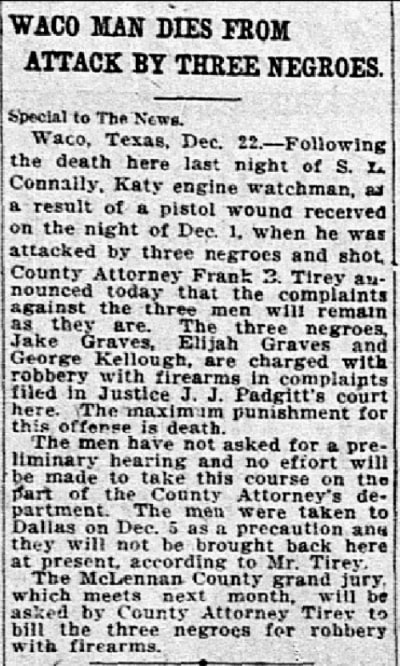
Eight months after Sam’s murder, his widow married Wiley McGregor on August 22. Within a month, Maggie left McGregor and filed for divorce, claiming he threatened to kill her. The divorce was finalized in February 1923.
On 20 May 1924, Maggie married 68-year-old peddler William H. Polston, a widower. The Polston marriage lasted one month, with the bride claiming abandonment after he unsuccessfully tried to persuade her into prostitution.
Mrs. Polston filed for divorce in August – but later that month, she made a motion to dismiss the suit: her estranged husband was dead.
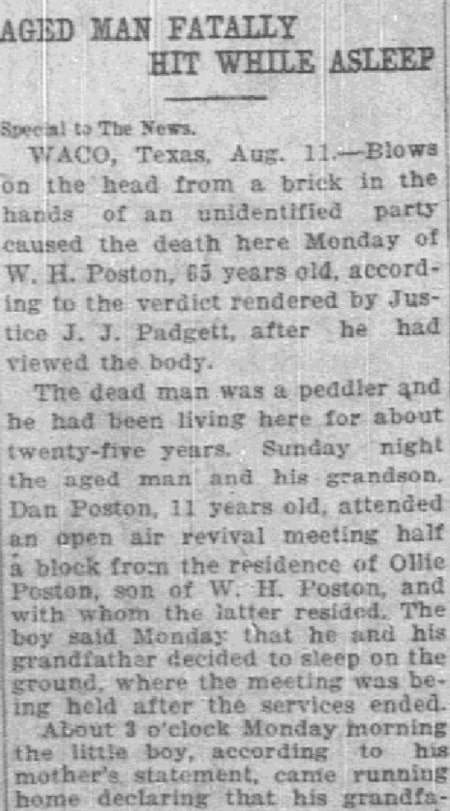
The murder was never solved.
Maggie was estranged from her sister’s family in Waco. Incredibly, even though they lived in the same neighborhood, they knew nothing about her McGregor and Polston marriages.
In her divorce petition, she claimed Polston’s abandonment left her “without any means to live on.” Yet less than a year later, she was said to possess “a considerable sum of money.” Attorney William Spell encouraged Maggie to move to Oklahoma and buy a ranch. En route she, along with her mother and son, stopped in Duffau, in Erath County, to visit her half-sister, Molly.
Instead of continuing to Oklahoma, they stayed in the county. Maggie first moved her family into a Stephenville home, where she rented rooms to college students. Soon, Bernie met Buck Hill, who lived nine miles away in Selden. “We do not know what happened, but they moved down to Selden with the Hills,” said Maggie’s niece, Helen Luper. There, the family toiled in the Hills’ cotton fields.
Perhaps cash-flush Maggie’s true motivation was the neighborhood’s underground economy: the federally prohibited manufacture of whisky. Her employers were moonshiners.
Conclusion to F. M. Snow’s Story
In the cotton fields, Maggie met her fifth and final husband, Francis Marion Snow, a recent graduate of Huntsville State Prison. Other than Samantha and Bernie, her relatives knew nothing about this marriage. Mr. Snow’s newlywed life turned tumultuous, echoing the chaos of Maggie’s McGregor and Polston marriages.
Snow visited his wife’s former employers, the Hills, alone.
“Mrs. Snow never came over to see me, and I never went to see her,” said Mrs. Hill. Snow’s family said Maggie and Samantha constantly antagonized him and called him stupid.
After committing the murders, Snow gave different versions of the triple slaughter of his wife, stepson and mother-in-law. To a minister, he claimed he had beaten Maggie to death with a small piece of lumber. He told reporter Boyce House that he crept behind Samantha as she sat by the fireplace and struck her with an axe, nearly severing her head.
F. M. Snow’s trial for the murder of Bernie Connally began on 22 January 1926, with newspaper reports detailing what supposedly led to the triple crime.
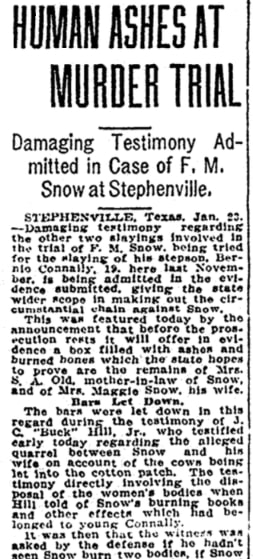
This article reports:
Damaging testimony regarding the other two slayings involved in the trial of F. M. Snow, being tried for the slaying of his stepson, Bernie Connally, 19, here last November, is being admitted in the evidence submitted, giving the state wider scope in making out the circumstantial chain against Snow.
This was featured today by the announcement that before the prosecution rests it will offer in evidence a box filled with ashes and burned bones which the state hopes to prove are the remains of Mrs. S. A. Old, mother-in-law of Snow, and of Mrs. Maggie Snow, his wife.
…By a number of other witnesses, the state made an effort to show that Snow had been in the habit of permitting his cow and horses to feed at will in one or the other of his cotton patches. The import of this testimony lay in the fact that Snow, in his confessions, said that the trouble leading up to the killings started from disagreements between him and his wife [about the cow and the cotton patch].
Six days later, on January 28, the jury returned a verdict.
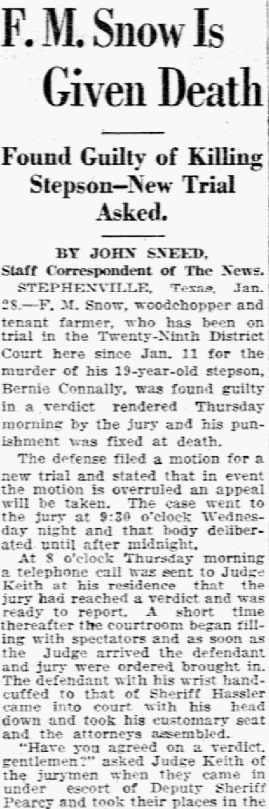
This article reports:
F. M. Snow, woodchopper and tenant farmer, who has been on trial in the Twenty-Ninth District Court here since Jan. 11 for the murder of his 19-year-old stepson, Bernie Connally, was found guilty in a verdict rendered Thursday morning by the jury and his punishment was fixed at death.
Snow never stood trial for the murders of his wife and mother-in-law.
An appeal for commutation was filed in July 1927, based on affidavits that the condemned man had the “mentality of less than a 12-year-old” and physicians’ opinions that “Snow is in such physical state that he cannot expect to live more than five years.”
The governor denied the appeal.
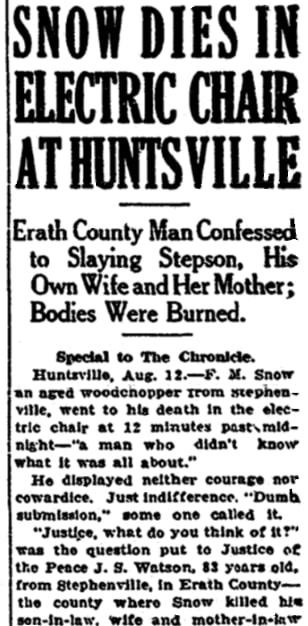
F. M. Snow’s execution came on 12 August 1927, bringing to an end this bizarre story of marriages and murders.
Create a free account at GenealogyBank for 7 days to start your journey and discover the stories your ancestors left behind.
Note on the header image: an AI-generated image depicting (left to right) F. M. Snow, Bernie Connally, Maggie Snow, and Samantha Olds. Credit: James Pylant.
Related Article:
Editor’s Note: This story is adapted from James Pylant’s book, Blood Legacy: The True Story of the Snow Axe Murders (Stephenville, TX: Jacobus Books, 2008).

