
 September 25, 2026
Introduction: In this article, Melissa Davenport Berry shares some old photos she found in a scrapbook about Hopi chiefs visiting the East Coast in 1929. Melissa is a genealogist who has a website, americana-archives.com, and a Facebook group, New England Family Genealogy and History.
The Hopi people are descendants of the Hisatsinom, ancient people who occupied the Colorado Plateau and many other regions, including what is now southern Arizona, New Mexico, Mexico, Utah, and beyond.
According to the Hopi Tribe Official Website:
The Hopi Tribe is a sovereign nation located in northeastern Arizona. The reservation occupies part of Coconino and Navajo counties, encompasses more than 1.5 million acres, and is made up of 12 villages on three mesas.
In 1929 a prominent group of Hopi traditionalists from Second Mesa in Arizona embarked on an important political and cultural tour of the eastern United States. Here are stories and photos of that tour from the archives and GenealogyBank; some are AI enhanced.
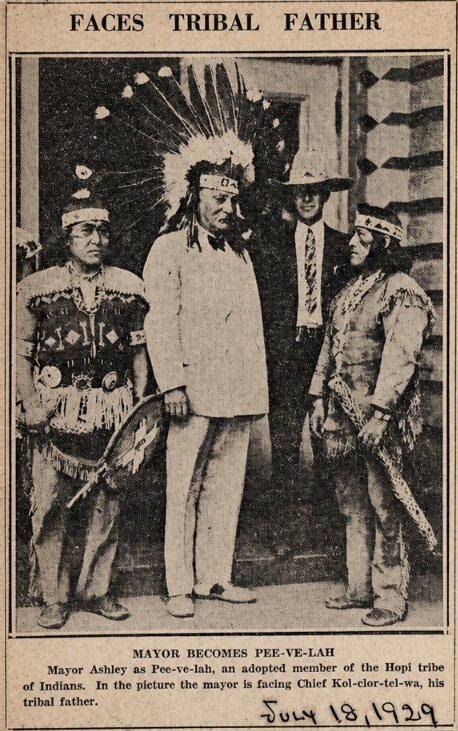
Charles Sumner Ashley Sr. (1858-1941) was the mayor of New Bedford, Massachusetts, for over 25 terms, serving various years from 1890 to 1936. During July of 1929 during the Hopi tour, Mayor Ashley was adopted into the Hopi Tribe and named Chief Pee-ve-lah, meaning “Builder of Fires.”
Below is a photo of the mayor after he received his adopted name, facing his tribal father Chief Kol-clor-tel-wa, a Hopi leader whose name translates to “Rope Out of a Bear Hide.” Also in the photo are: (in the background) M. W. Billings, head of the Chamber of Commerce, translator, custodian and adopted member of the Hopi Tribe; and Chief Soheik (left of Mayor Ashley).
Back in 1890, Charles Ashley had opened copper mines in the Ajo area, in Pima County, Arizona, leading the Hopi people to regard him as the town’s founder. The population grew to 2,000, and Hopi community members benefited from the jobs and opportunities the mines created.
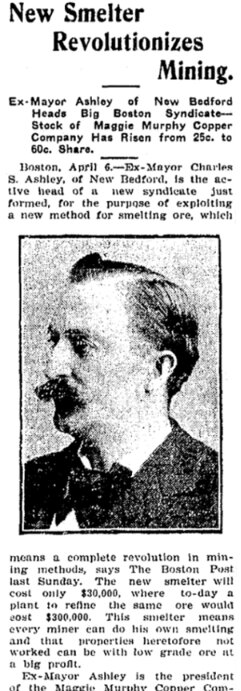
Ashley was also the president of Maggie Murphy Copper Company, which was organized in August 1904 at a mill site in Horseshoe Canyon, in the Laramie Peak district, Albany County, Wyoming.
I found this newsclip about Ashley’s mining ventures.
This article reports:
Boston, April 6. – Ex-Mayor Charles S. Ashley, of New Bedford, is the active head of a new syndicate just formed for the purpose of exploiting a new method for smelting ore, which means a complete revolution in mining methods, says the Boston Post last Sunday. The new smelter will cost only $30,000, where today a plant to refine the same ore would cost $300,000. This smelter means every miner can do his own smelting and that properties heretofore not worked can be with low grade ore at a big profit.
Ex-Mayor Ashley is the president of the Maggie Murphy Copper Company, one of the largest copper properties in Wyoming. Those who bought stock at 25c. have reaped a profit of 130 per cent., as the market price has gone to 60c., and will advance still higher before long. The remarkable story of how Ex-Mayor Ashley secured control of the Maggie Murphy mine, and the big copper strike, will be sent to anyone. Address: Maggie Murphy Copper Co., 16 State St., Boston.
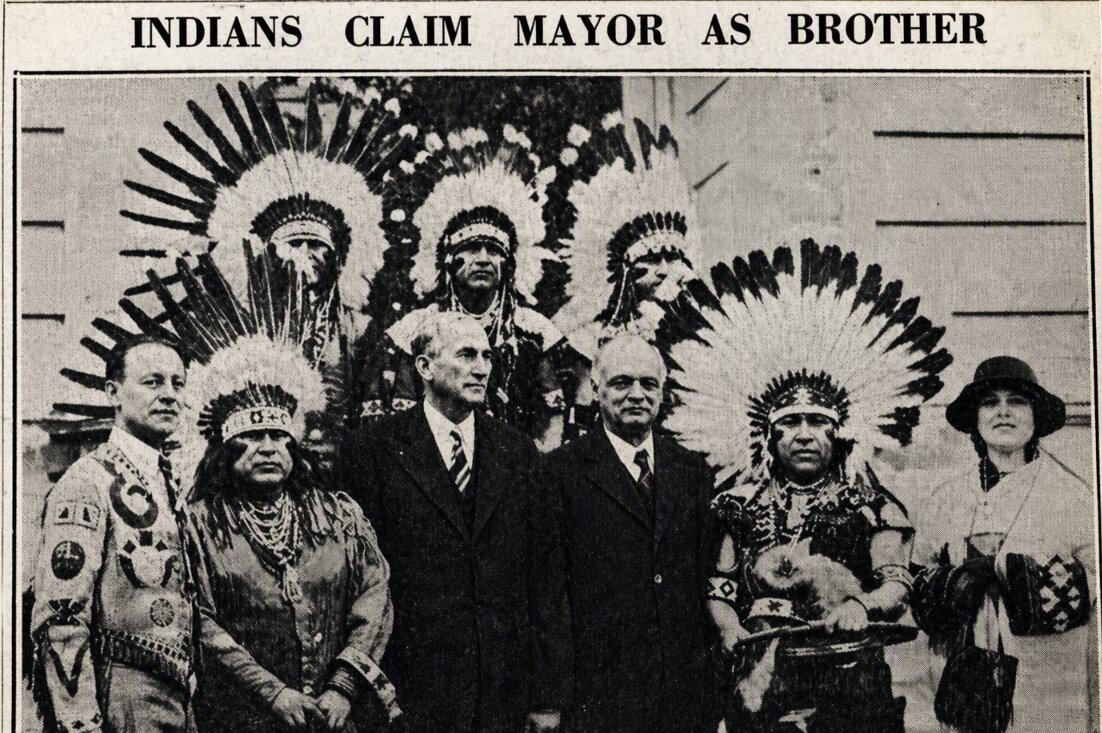
Here is another photo of the mayor with M. W. Billings and the Hopi delegation.
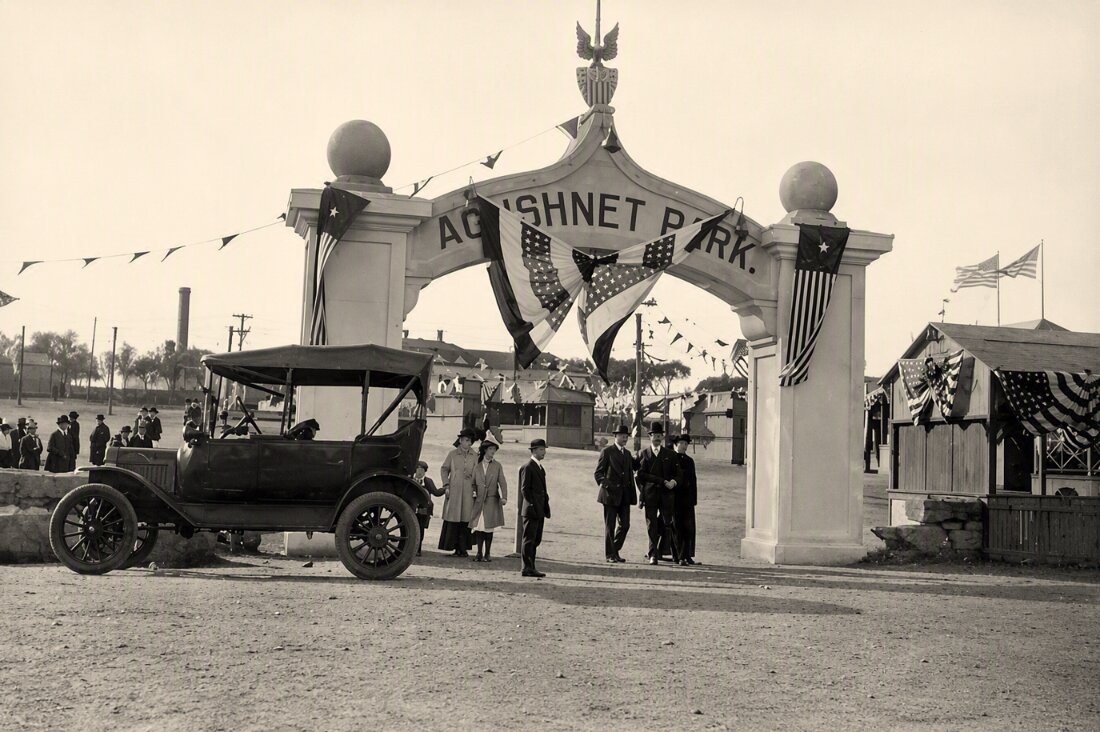
According to the New Bedford Evening Standard newspaper, five big chiefs of the Hopi Tribe came to Acushnet Park in New Bedford for an industrial exhibit.
A week later, Boston Mayor Malcolm Edwin Nichols (1876-1951) received a visit from the Hopi delegation.
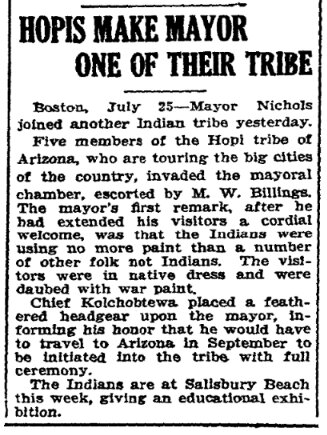
This article reports:
Boston, July 25 – Mayor Nichols joined another Indian tribe yesterday.
Five members of the Hopi Tribe of Arizona, who are touring the big cities of the country, invaded the mayoral chamber, escorted by M. W. Billings. The mayor’s first remark, after he had extended his visitors a cordial welcome, was that the Indians were using no more paint than a number of other folk not Indians. The visitors were in native dress and were daubed with war paint.
Chief Kolchobtewa placed a feathered headgear upon the mayor, informing his honor that he would have to travel to Arizona in September to be initiated into the tribe with full ceremony.
The Indians are at Salisbury Beach this week, giving an educational exhibition.
Below is a photo of Mayor Nichols and members of the Hopi Tribe from a scrapbook collection. From (left to right): Chief Solofacte, Chief Kashwazra, Mayor Nichols, Chief Maquoima, and Chief Sohiek.

This photo caption reads:
The Hopi Indian chiefs of Arizona are shown with Mayor Nichols after they made him one of their tribe yesterday at City Hall.
Many others received visits from the Hopi Tribe that year including the Shriners in Philadelphia.
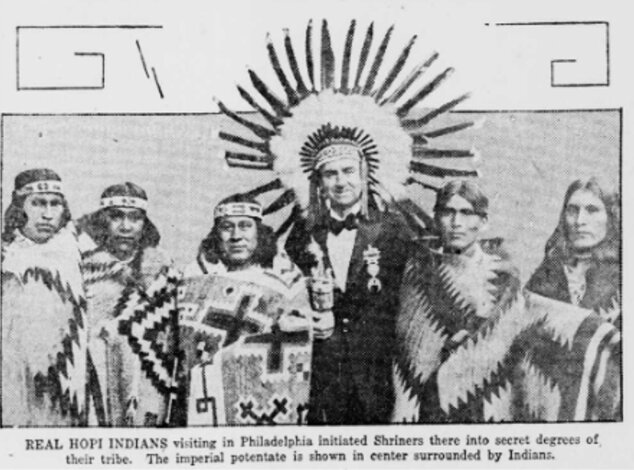
This photo caption reads:
Real Hopi Indians visiting in Philadelphia initiated Shriners there into secret degrees of their tribe. The imperial potentate is shown in center surrounded by Indians.
In August the Hopi chiefs traveled to Rhode Island.
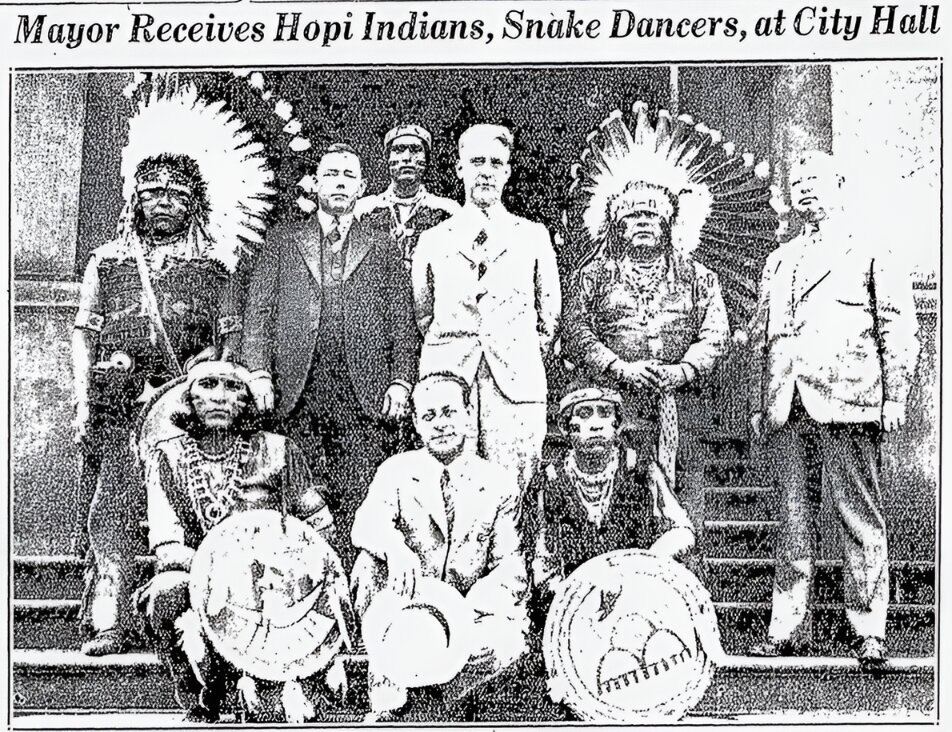
This photo caption reads:
Left to right, front row: Kashwazra, “the fleet one”; M. W. Billings, representing the Mesa, Arizona, Chamber of Commerce, sponsoring the Eastern trip [of] the Indians, who are appearing this week at a Rhode Island amusement park; and Sohuh, the designer. Second row, left to right: Chief Solofacte; Thomas J. Cashman, manager of the park; Mayor James E. Dunne; Chief Kolchovtewah; and William J. Brown, secretary to the mayor. Standing, in rear, is Naquoima.
Charles Curtis (1860-1936), the 31st vice president of the United States from 1929 to 1933 under President Herbert Hoover, was honored by the Hopi Tribe.
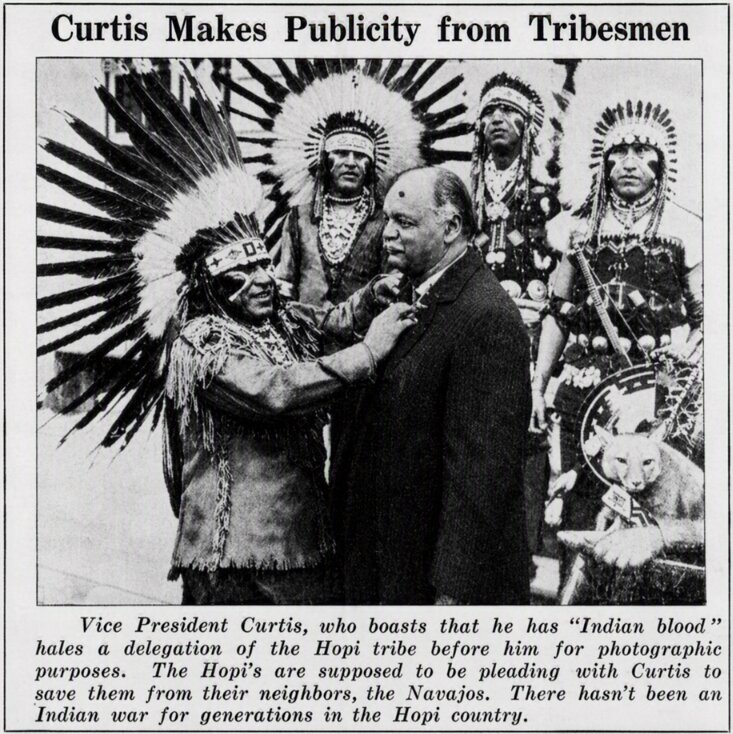
This photo caption reads:
Vice President Curtis, who boasts that he has “Indian blood,” hales a delegation of the Hopi Tribe before him for photographic purposes. The Hopis are supposed to be pleading with Curtis to save them from their neighbors, the Navajos. There hasn’t been an Indian war for generations in the Hopi country.
Explore your family history by creating your free account at GenealogyBank for 7 days, because every life deserves to be remembered, recorded, and rediscovered.
Note on the header image: Hopi polychrome ceramic water canteen, ca. 1870. Credit: Cleveland Museum of Art; Wikimedia Commons.
