
 October 13, 2026
Introduction: In the author’s own words, “With Halloween approaching, I thought you might appreciate a seasonally darker story.” In this article, James Pylant describes the Bender family, serial killers who ran a tavern in Kansas in the 1870s. James is an editor at GenealogyMagazine.com and author for JacobusBooks.com, is an award-winning historical true-crime writer, and authorized celebrity biographer.
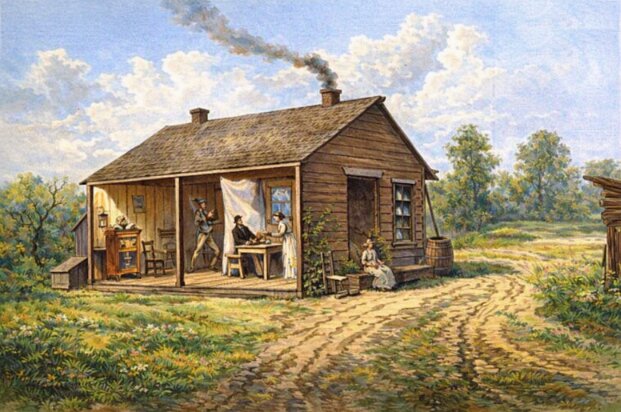
In October 1937, bestselling author Laura Ingalls Wilder gave a speech at Hudson’s Book Fair in Detroit, Michigan, with the release of her fourth book, On the Banks of Plumb Creek. She explained that while the stories in her books were true, one compelling episode had been excluded from the “Little House” series. It concerned another little house – or rather a tavern – belonging to the Bender family near Cherryvale, Kansas.
Wilder said:
“We stopped there, on our way into the Little House, while Pa watered the horses and brought us all a drink from the well near the door of the house. I saw Kate Bender standing in the doorway. We did not go in because we could not afford to stop at a tavern.”
Wilder didn’t describe Kate – if she caught more than a glimpse of her. Others did, and those portraits varied wildly, from “buxom, good-looking” and “slender but most voluptuously molded” to “an infernal hag” who was “repulsive” and “dirty-looking.” (1)
Who Were the Benders?
Early reporting was chaotic. The Weekly Kansas Chief (15 May 1873) published a garbled story describing the Benders as two brothers, William and Thomas, and their wives. One of the Bender women – a supposed Spiritualist – was called a “she-devil” by neighbors:
She was forty-two, with iron-gray hair, ragged at the ends and thin over the temples. Her eyes were steel-gray and hard. The light that came from them was sinister and forbidding. She had not a single prepossessing feature. Her form, angular and tall, seemed to lift itself up when the Spiritual influences took possession of it, and to become not only gigantic in height, but supernatural as well…
However, clairvoyant Kate was not a gray-haired woman in her 40s; she was a teenager. Also, the family of four was not two brothers and their wives, but a husband and wife – John and Maria – and their two children, John Jr. and Kate.
Chroniclers portrayed the family as grotesque. “The old man was a repulsive, hideous-looking brute,” wrote Col. Frank Triplett. “His wife was a dirty old Dutch crone.” John Jr., Kate’s brother, was “a rather good-natured dolt” when smiling, but when excited “the greenish glare of the eyes and the fierce lines about the treacherous mouth recalled the grave-robbing hyena.” He and Kate supposedly had an incestuous relationship. (2)
The York Mystery
Kansans first became aware of the Benders in early May 1873, when stories of the strange family began appearing in newspapers across the state. Word spread nationwide, and the Benders morphed into legend almost overnight. As Deputy Sheriff John R. Brunt of Neosho County, Kansas, remarked, “much has been written about the Benders, four-fifths of which is pure fiction.” (3)
Their downfall began in late March 1873 when Senator A. M. York of Independence, Missouri, organized a search party for his missing brother, Dr. William H. York. By his own account, Civil War veteran Leroy Dick suggested that they investigate the Benders, “one very unpopular family in our midst.” (4)
At first, the Benders denied knowing Dr. York, but Kate admitted she remembered him stopping at their tavern. She served him dinner, and then “he had gone on his way.” (5)
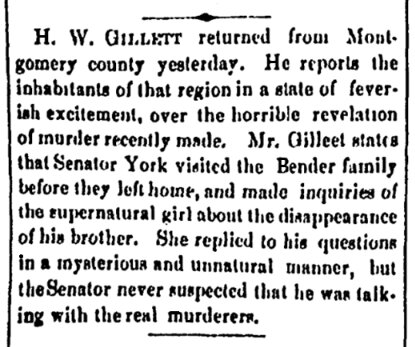
According to one newspaper’s account, Kate answered Senator York’s questions:
“in a mysterious and unnatural manner, but the Senator never suspected that he was talking with the real murderers.”
That meeting occurred on May 2. Finding no evidence of foul play, Senator York dismissed the Benders as suspects. (6) Yet on June 5, the senator returned after hearing that the Bender home had been found abandoned. Neighbors were already scouring the home and grounds when the York party arrived. (7)
Then the body of Dr. William H. York was found buried in a field near the tavern, and other corpses were found buried nearby.
“Yesterday the veil of mystery was drawn aside, and the sad fate of a long-lost citizen fully settled,” reported the Emporia News.
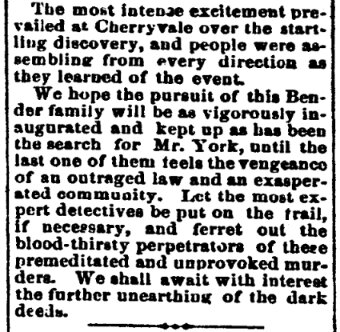
This article concludes:
The most intense excitement prevailed at Cherryvale over the startling discovery, and people were assembling from every direction as they learned of the event.
We hope the pursuit of this Bender family will be as vigorously inaugurated and kept up as has been the search for Mr. York, until the last one of them feels the vengeance of an outraged law and an exasperated community. Let the most expert detectives be put on the trail, if necessary, and ferret out the blood-thirsty perpetrators of these premeditated and unprovoked murders. We shall await with interest the further unearthing of the dark deeds.
Other newspapers published similar stories on the same date.
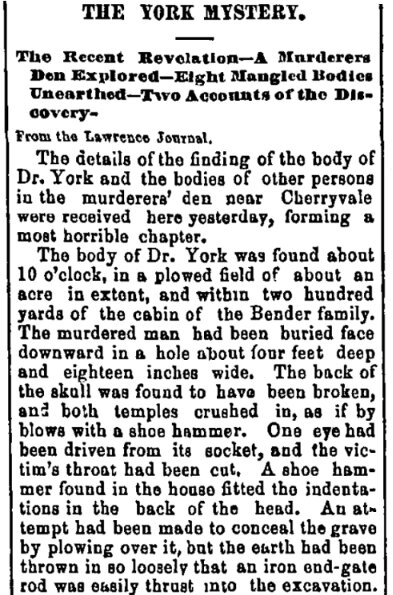
More grisly details surfaced days later.
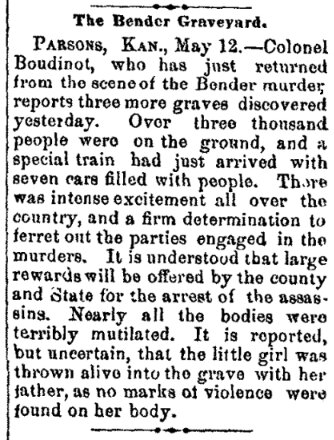
Scene of the Crime
The Bender tavern was described as a one-story dwelling divided into two sections. Meals were served in the large front room. In the back was a sleeping room with two beds and “scant additional furniture.”
As the investigation continued, authorities were able to reconstruct the method of execution.
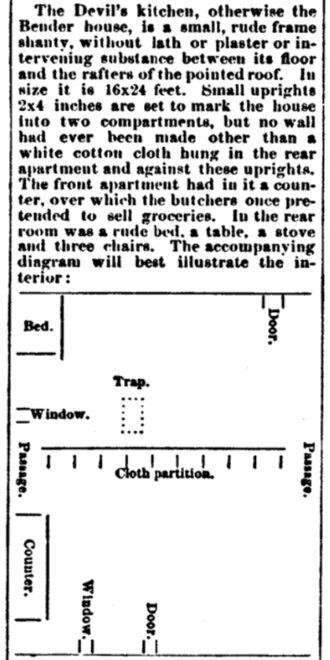
This article reports:
The table, to which the guests of the fiends were seated, was placed directly over the trap door, so that the guest’s back was to and against the white curtain. In this position it was an easy thing for the male villains in the front apartment to strike the form clearly lined and resting against the white cloth, and when the blows of the sledge and the hammer had knocked the victim, with a crushed and broken skull, senseless and helpless to the floor, for the female fiends in the back room to cut the throat [then drop the body through the trap door, so the blood didn’t soak the tavern’s floor]. The execution was as simple as it was dreadful, but, though it would seem resistance to such well planned murder of the trusting and unsuspecting was impossible, the walls gave silent evidence that some of the murdered ones had not been sent to their doom without an effort to defend their lives. No less than a dozen bullet holes in the sides and roof of the house attest that armed men, when struck down so relentlessly, had attempted to shoot their murderers, but, unfortunately, the aims had been wild, and the murderers are reserved for the hempen halter.
The Victims
The article went on to identify eight victims of the bloody Benders.
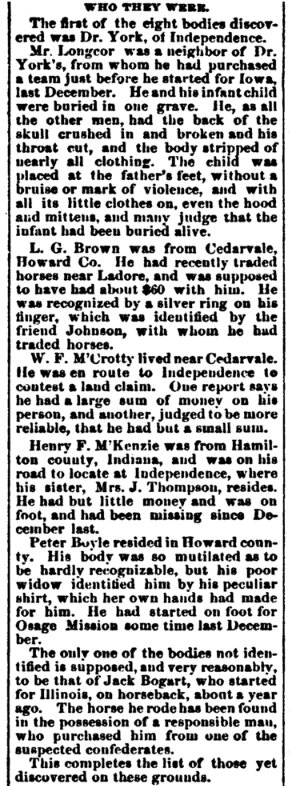
Aftermath
What became of the murderous family? Many theories emerged, but no one knows the Benders’ fate following their escape. The most authoritative source on the subject is Lee Ralph’s Hell Comes to Play, published in 2023 and revised in 2026. The author, a genealogist, traced the Bender family tree and uncovered new details about their background.

Create a free account at GenealogyBank for 7 days to start your journey and discover the stories your ancestors left behind.
Note on the header image: Bender victims’ graves, Dr. York’s grave at far right, 1873. Credit: George R. Gamble; Wikimedia Commons.
______________
(1) Lee Ralph, Hell Comes to Play (Tecumseh, Kansas: Furman House Publishing, 2026), p. 40.
(2) Col. Frank Triplett, History, Romance and Philosophy of Great American Crimes and Criminals (New York and St. Louis: N. D. Thompson Publishing Company, 1885), p. 560.
(3) Ralph, Hell Comes to Play, p. 65.
(4) Jean McEwen, “The Bender Hills Mystery,” The Parsons [KS] Sun, 16 June 1934, p. 14.
(5) John T. James, The Benders in Kansas (Wichita, KS: Kan-Okla Publishing Company, 1913), p. 37.
(6) Ralph, Hell Comes to Play, p. 73.
(7) James, The Benders in Kansas, p. 39.
