
 September 17, 2025
Introduction: In this article, Melissa Davenport Berry continues her series on Mayflower descendants, writing more about the Hopkins family line and the court drama over a contested will. Melissa is a genealogist who has a website, americana-archives.com, and a Facebook group, New England Family Genealogy and History.
Today I continue my series on “Mayflower Descendants: Who’s Who,” again featuring a group of California pioneer families. As with any ancestral study, understanding each family’s last name meaning adds depth to the story, revealing origins and connections that trace back to the earliest settlers.
The photo collage below features direct descendants of Mayflower passengers William Bradford, Thomas Rogers, John Alden, and Priscilla Mullins. Hiram Crittenden and his offspring also have Mayflower passenger Stephen Hopkins in their line.
In this collage of Mayflower scions we see: (top row left to right) Hiram Crittenden; Lydia (Sherwood) Crittenden; Mark Hopkins; (second row left to right) Marjorie Severance McPherson; Ann (Crittenden) Severance; Mary Frances (Sherwood) Hopkins-Searles; (bottom row left to right) William Sherwood; Mary “May” Kellogg (Crittenden) Hopkins and daughter Lydia Kellogg Hopkins; Moses Hopkins.

To recap: Part 4 introduced the legal battle over the millions left by railroad tycoon Mark Hopkins to his widow Mary Hopkins, who married 2nd Edward F. Searles, known around New England for his grand castles and philanthropic work.

Part 5 covered the courtroom drama over the Hopkins millions which became known as “The Great Will Case.” Mary cut out her entire family in a second will and left her fortune to her current husband Edward.
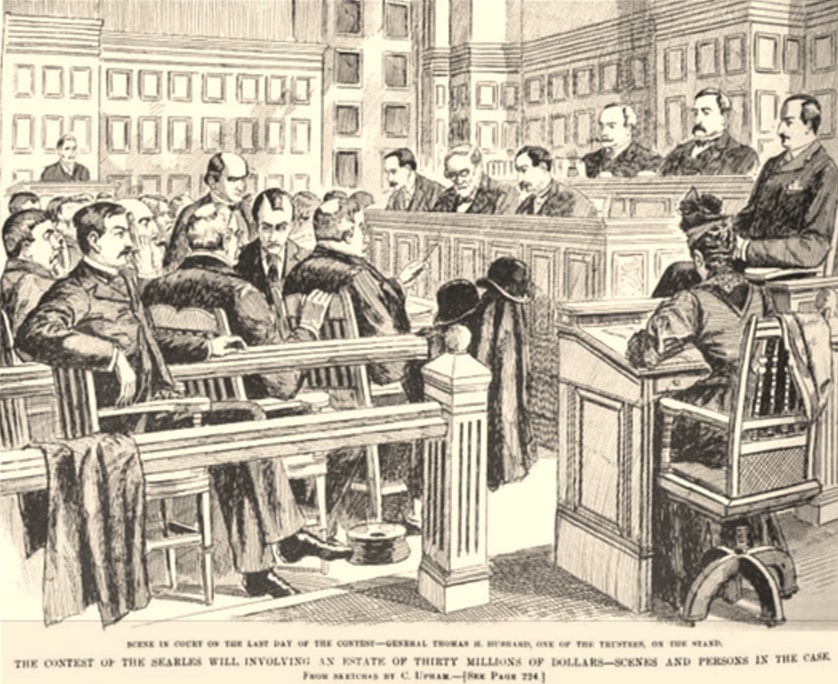
Below is a sketch of the court scene in Salem, Massachusetts, where the will was contested. On the stand is General Thomas Hamlin Hubbard, a trustee appointed to the will.
The Hopkins family and friends testified that Mary engaged in the world of occultism and held seances, often consulting mediums on her life matters including financial decisions.
Edward saw an opportunity and slipped into the role of spiritual consultant to Mary on matters of money and matrimony. To catch up on the drama see the links to past posts at the end of this article.
According to the Pittsburg Dispatch, Timothy Hopkins (Mary’s adopted son) testified that the influence the fraudulent manifestations had over Mary was used by Searles to cut Timothy out of the inheritance. He also sought to prove that when Mary fell ill before her death, Searles locked her away from friends and relatives, keeping a strong hold on her 24 hours a day.
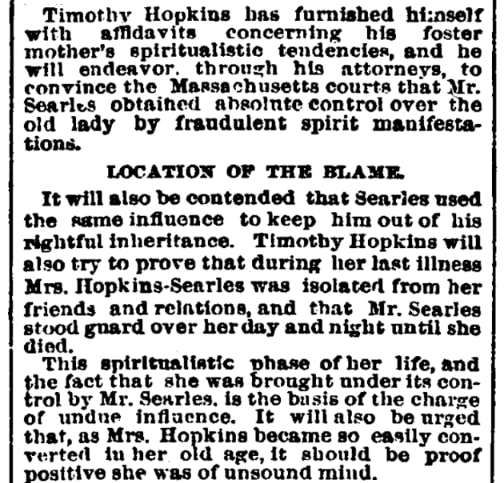
This article reports:
Timothy Hopkins has furnished himself with affidavits concerning his foster mother’s spiritualistic tendencies, and he will endeavor, through his attorneys, to convince the Massachusetts courts that Mr. Searles obtained absolute control over the old lady by fraudulent spirit manifestations.
Location of the Blame
It will also be contended that Searles used the same influence to keep him [Timothy] out of his rightful inheritance. Timothy Hopkins will also try to prove that during her last illness Mrs. Hopkins-Searles was isolated from her friends and relations, and that Mr. Searles stood guard over her day and night until she died.
This spiritualistic phase of her life, and the fact that she was brought under its control by Mr. Searles, is the basis of the charge of undue influence. It will also be urged that, as Mrs. Hopkins became so easily converted in her old age, it should be proof positive she was of unsound mind.
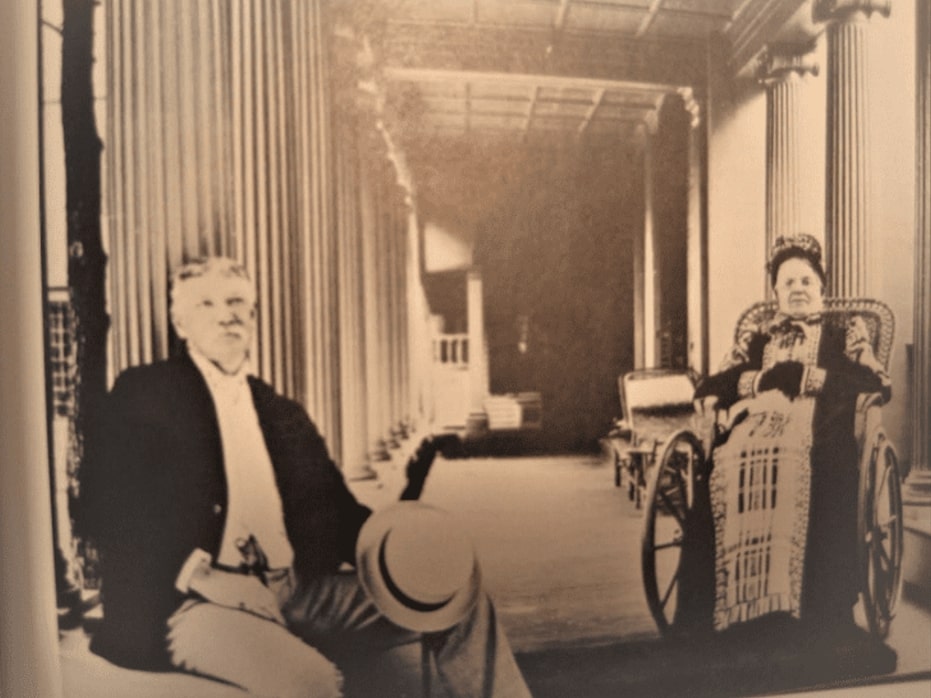
The will that Mary made, leaving all the loot to Edward, was questioned by Timothy’s attorneys.
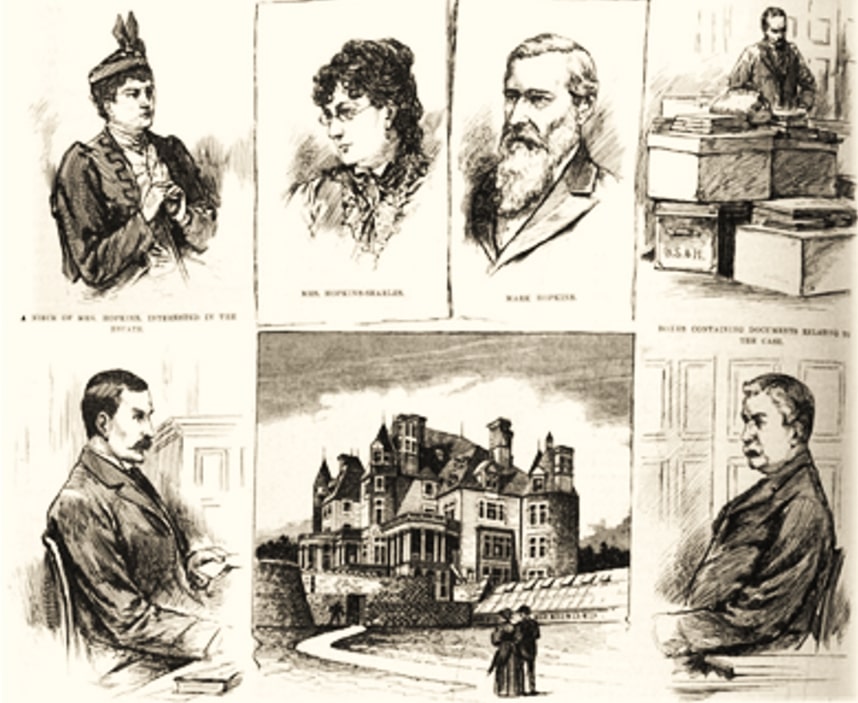
Here is a collage of images about the contested will of Mary (Hopkins) Searles: (top, left to right) Mrs. Annie Severance, Mary’s niece, testifying; Mary Hopkins; Mark Hopkins; boxes of court files; (bottom, left to right) Timothy Hopkins; Kellogg Terrace in Great Barrington, Massachusetts; and Edward Searles.
When Mary died on 25 July 1891 in Methuen, Massachusetts, at “Pine Ridge,” one of the many estates owned by her and Edward, reports from several newspapers asserted the initial cause of death was grip – but later reports changed it to dropsy. No one really knew and the natives grew restless.
Edward had taken Mary to Methuen about two weeks prior to her death and locked himself away with her and only a few servants. He had little contact with the outside world or his wife’s familial relations.
When news came that her vitality was sapped reporters swarmed “Pine Ridge” looking for answers, but Edward hired plain-clothed detectives who shut them out.
The Methuen folks who were acquainted with Mary wanted to pay their respects but were met with barred gates.
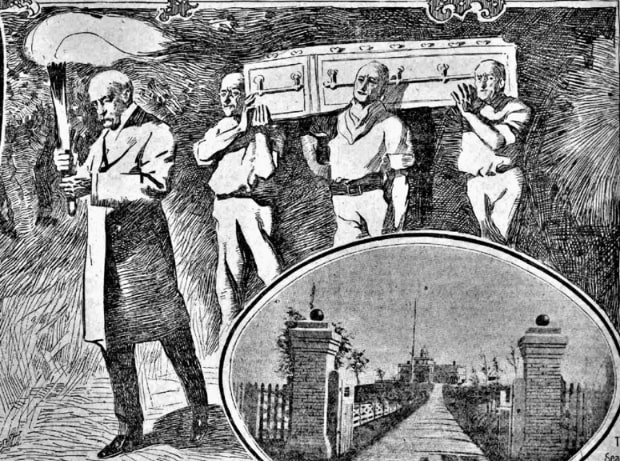
The funeral was strictly private, and Mary’s coffin was carried by liveried servants headed by Edward holding a torch.
In reporting the scandal, newspapers stated that two sisters, Mary’s aunts, claimed Mary had promised them money: Harriet Hebbard and Mrs. Jane (Hebbard) Smith, both born to Nathaniel and Abigail (Sherwood) Hebbard.
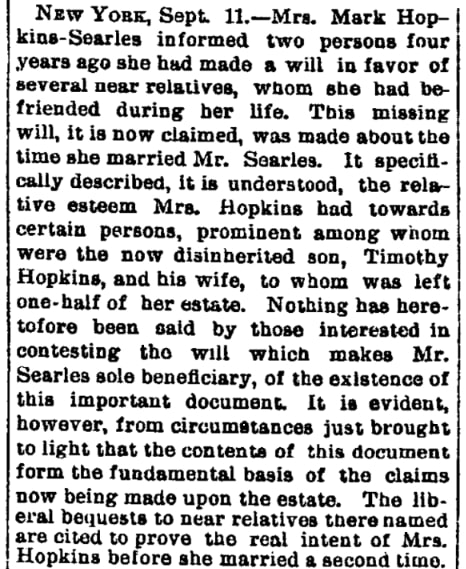
This article reports:
Mrs. Mark Hopkins-Searles informed two persons four years ago she had made a will in favor of several near relatives, whom she had befriended during her life. This missing will, it is now claimed, was made about the time she married Mr. Searles. It specifically described, it is understood, the relative esteem Mrs. Hopkins had towards certain persons, prominent among whom were the now disinherited son, Timothy Hopkins, and his wife, to whom was left one-half of her estate. Nothing has heretofore been said by those interested in contesting the [revised] will, which makes Mr. Searles sole beneficiary, of the existence of this important document. It is evident, however, from circumstances just brought to light that the contents of this document form the fundamental basis of the claims now being made upon the estate. The liberal bequests to near relatives there named are cited to prove the real intent of Mrs. Hopkins before she married a second time…
In the list of contestants filed when the will was offered for probate at Salem, Mass., last Tuesday, the names of Jane L. Smith and Harriet Hebbard are missing. In point of relationship these women have the strongest ties upon Mrs. Searles, for in her lifetime she gave them practical evidences of her esteem. To Mrs. Smith personally Mrs. Searles made generous promises, which were contained in the missing will. Mrs. Smith and Miss Hebbard are first cousins of Mrs. Searles. Mrs. Smith was of the same age, and in their girlhood days they were especially intimate.
The Hebbard sisters’ niece, Maria Elma (Hebbard) Bresee, testified on 7 October 1891. Newspaper headlines read “Minister’s Wife After Millions,” and noted that Maria’s claim was the first document of formal declaration to add much clout to support Timothy’s claim. It also provided intrigue for the public who could not get enough of the controversial case. Read more: More Hopkins Saga: Minister’s Wife Battles Edward Searles.
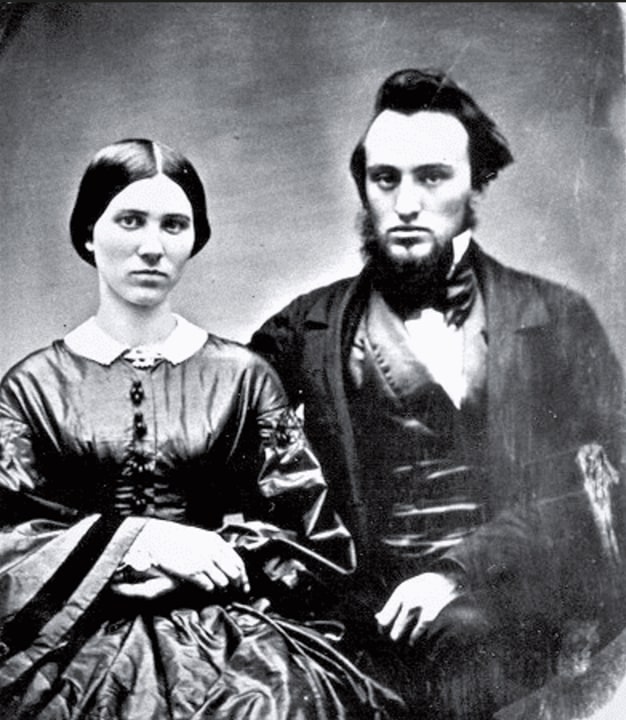
Maria’s complaint stated that the decedent (Mary Hopkins-Searles) was not competent, and not free from duress, fraud, or undue influence. Therefore, Maria asserted, the revised will was not valid and Searles, with the aid of others unknown to her, were attempting to gain all rights to the estate.
The revised will (cutting out adopted son Timothy and all her relatives) made by Mary on 18 July 1888, with attorney William W. Dodge, was scrutinized by the court.
Mary’s revised will was drawn up in Methuen at “Pine Lodge” and witnessed by two workers on the estate: Charles M. Thornton, a landscape gardener from Lawrence; and William O. Norris, a carpenter from Methuen.
When Thornton and Norris were called to take the stand, attorney Burley asked them to read parts of the will and interpret the content. Both men could not read or write beyond their own names, nor could they comprehend what was in the will.
Despite their damaging testimonies, Mary’s revised will stood as is. On 24 October 1891 Judge Harmon announced his decision: Edward Francis Searles was Mary’s sole heir.
Searles did partial settlements with a few contesters including Timothy, who received $3.2 million in stocks, cash, and land.
More scandal came for Edward in September 1892 when he was sued in Suffolk County by Lowell Mason Maxham for non-payment to control and track witnesses during this trial.
Stay tuned as more scandal is uncovered for Edward Searles and the many more mansions he purchased with his cash win!
Create a free account at GenealogyBank for 7 days to start your journey and discover the stories your ancestors left behind.
Note on the header image: “Mayflower in Plymouth Harbor,” by William Halsall, 1882. Credit: Wikimedia Commons.
Related Articles:
- Fake Wills & Forged Bibles Lay Claim to Mark Hopkins’ Huge Estate
- The Gilded Age Palace: What Mark Hopkins Bankrolled
- Mad Scramble to Claim Mark Hopkins’ Riches: A ‘New Gold Rush’
- Pedigree, Pearls, and Pooches: The Hopkins Saga Continues
- The Mysterious Death of Heiress Lydia Kellogg Hopkins, Part I
- The Mysterious Death of Heiress Lydia Kellogg Hopkins, Part II
- America’s Richest Widow Restores Church and Cemetery of Great Barrington, MA
- Moss’ Hoax: A Scam for the Hopkins Fortune
- More Legal Battles over the Mark Hopkins Railroad Fortune
- Scams to Get the Hopkins Fortune: Seances, Table Tipping, and Slate Writing
- More Hopkins Saga: Minister’s Wife Battles Edward Searles
- Kin of America’s Richest Widow Battle Edward Searles in Probate Court
- Mayflower Descendants: Who’s Who, Part 48 (part 1)
- Mayflower Descendants: Who’s Who, Part 48 (part 2)
- Mayflower Descendants: Who’s Who, Part 48 (part 3)
- Mayflower Descendants: Who’s Who, Part 48 (part 4)
- Mayflower Descendants: Who’s Who, Part 48 (part 5)
