
 October 8, 2025
Introduction: In this article, Melissa Davenport Berry describes the mysterious, abandoned village of Dogtown on Cape Ann, Massachusetts, focusing on Revolutionary War soldier Isaac Dade. Melissa is a genealogist who has a website, americana-archives.com, and a Facebook group, New England Family Genealogy and History.
Today I continue with the early history of the abandoned village in Gloucester on Cape Ann in Massachusetts, known as Dogtown.
Before it became known as Dogtown, it was called “the Commons,” or “the Common Settlement,” and was a thriving farming village, considered the most cultivated section of Gloucester. It was a locale that housed many prominent families of enterprise and patriotism.
With the boom of the dangerous whaling and fishing industries, the Commons became overrun with widows and their watch dogs. Hence the name “Dogtown.”
To recap: Part 1 covered Tristram Coffin (1762-1852), the third son of State Senator the Hon. Peter Coffin and his wife Mary (Currier) Coffin.
Below is a map from Charles E. Mann’s book, In the Heart of Cape Ann — The Story of Dogtown, published in 1896 and drawn in the author’s own hand.

The only traces of the homes that once stood in this now-abandoned village are cellars, some marked with numbers.
This map shows the cellar numbers of the homes from the abandoned village. It is from Art, Plays and Poetry About Dogtown, published by Kitty Parsons in 1936.

Cellar no. 18 was the home of Isaac Dade, a Revolutionary War soldier with a colorful history and background who left many descendants. Some local genealogies even note that one of Dade’s later descendants was a third cousin to families connected with early Gloucester settlers, showing how intertwined the community remained across generations.
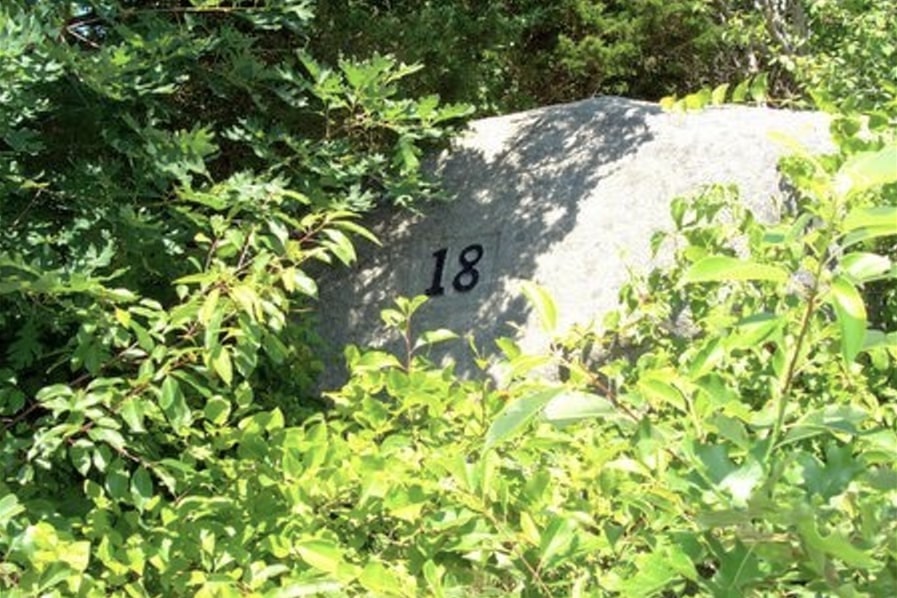
In Cape Ann: A Tourist Guide, authored by Roger W. Babson and Foster H. Saville, a little background is given on Dade:
One day during the Revolution, when this English man-of-war was anchored off of Gloucester, Dade stole ashore and boarded a Gloucester vessel bound for Virginia.
He [Dane] enlisted in the Continental Army and was at Yorktown when Lord Cornwallis surrendered. [Company of Captain Gardner in the Regiment of Colonel Henry Lee of Virginia.]
The Revolutionary War crippled him for life. [Dane received a terrible wound at the Battle of Brandywine.]
Furthermore, he brought home a severe saber scar across the back of his neck. He married Fanny Blundle, whose father had a plantation adjoining that of George Washington’s mother.
After this he brought his wife by vessel to Gloucester and settled in Dogtown. Isaac Dade and his family kept up their acquaintance with the Washington family…
Other sources say that Dade rowed across the Delaware River with George Washington.
I found a Boston Herald newsclip which references another source on Dade.
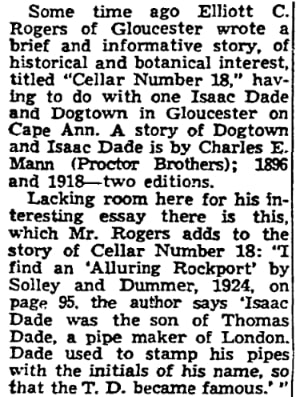
This article reports:
Some time ago Elliott C. Rogers of Gloucester wrote a brief and informative story, of historical and botanical interest, titled “Cellar Number 18,” having to do with one Isaac Dade and Dogtown in Gloucester on Cape Ann.
I found a copy of Roger’s narrative on the Facebook community group Friends of Dogtown.
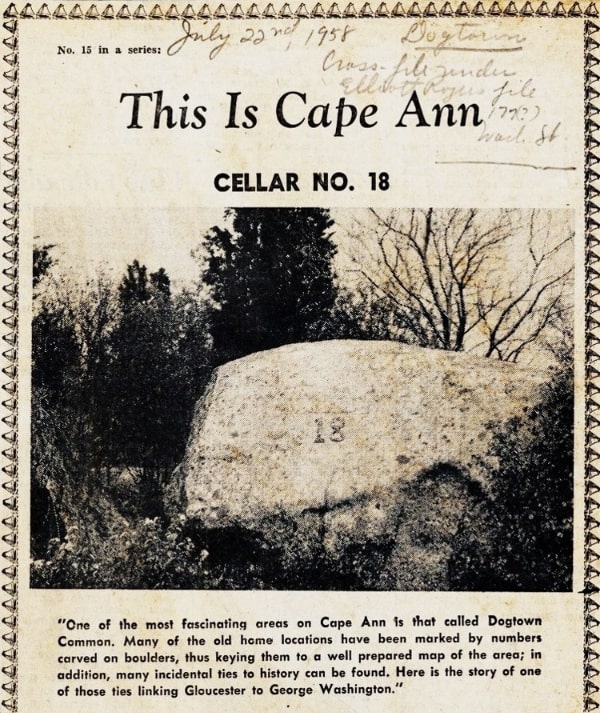
It reads:
History tells us that Isaac Dade, a London school boy, whose father was Thomas Dade, the maker of the famous TD pipes of yesterday, was impressed on board an English man-of-war during the American Revolution. While anchored off Gloucester, he noticed a fishing vessel ready to sail, and while rowing an officer ashore, determined to escape to her, which he did, and sailed with a cargo of fish to Virginia. Later joining the Continental Army, he was badly wounded, after engaging in several important battles. After the surrender at Yorktown, Captain Dade married Fanny Brundel who lived near, and was on intimate terms with the family of General Washington.
His health being poor, and remembering Gloucester, Isaac came back, built a house on the Dogtown Road, not far from Dogtown Square, and lived there the rest of his life.
On a boulder in his yard is carved the number 18. Close to this boulder is a bushy tree about 20 feet tall, which should not be growing on Cape Ann. It is a paper mulberry, seen frequently growing in that part of Virginia where Fanny lived.
We like to think that the Dades brought the original seeds or cuttings of this tree from their home in Virginia.
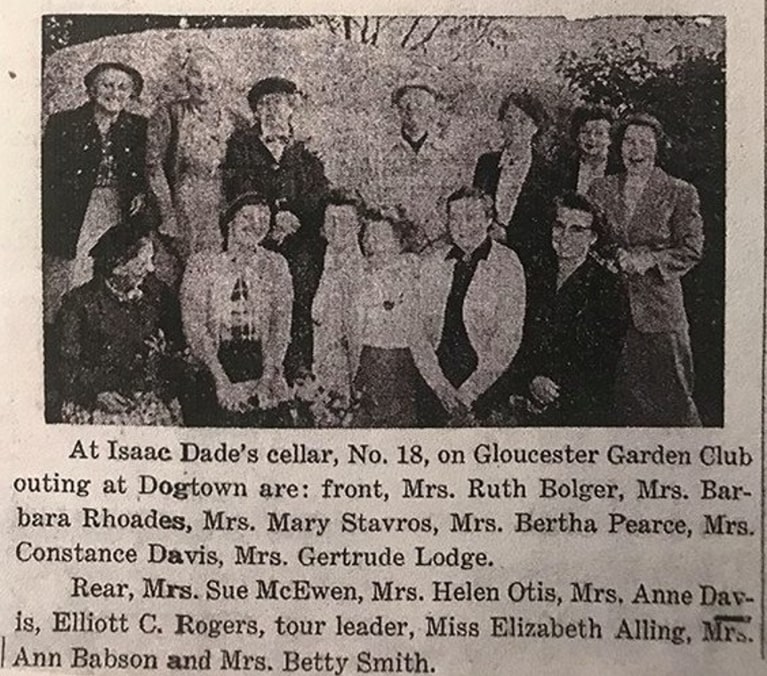
Below is a photo from 6 October 1955 with Elliott Rogers and a Gloucester Garden Club tour group standing in front of Isaac’s boulder at Dogtown.
You can read another account by Isaac’s granddaughter, Hannah Gott (Dade) Wetherbee (1840-1902), in In the Heart of Cape Ann, or, The story of Dogtown, on pages 50-54. Hannah is the daughter of Reuben and Lucinda (Brooks) Dade and wife of Europe Reuben Wetherbee.

According to a family needlepoint genealogy tree sampler shown below, Dade was purported to be born in Boston in 1756.
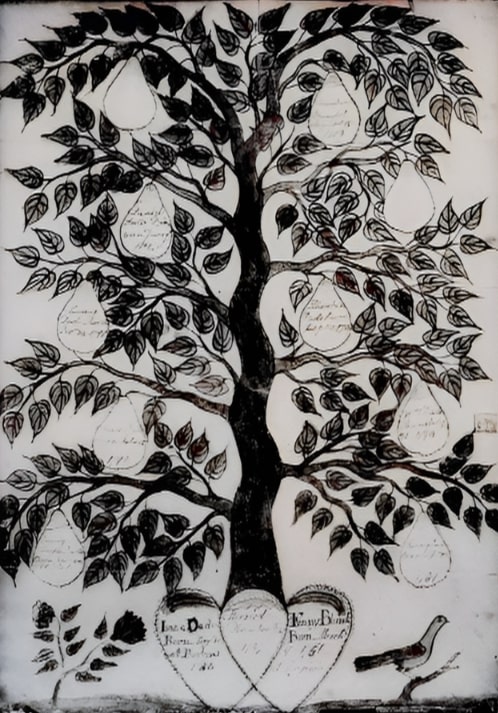
An image of the sampler was published in the “Southern Campaign American Revolution Pension Statements & Rosters,” which also furnishes some of Dade’s military history.
Isaac Dades’ daughter Fanny (Dade) Brewer and her husband Clark Brewer of Boston certified that the family record had been in her possession for 30 years. Here is some of the information it contains:
- Isaac Dade born May 10 at Boston 1756
- Married December 22, 1787
- Fanny Blundel born March 27, 1766, at Virginia
- Nancy Hayes Dade born Nov’r 22, 1788
- Fanny Dade born Sep’r 28, 1789
- Isaac Dade born Feb’y 25, 1792
- Dade born July 21, 1794
- Thomas Dade born Dec’r 24, 1797
- Rheuben Dade born Feb’y 9, 1799
- Daniel Foster Dade born June 9, 1802
Isaac died on 4 February 1819, and William Ferson was the administrator for his estate.
Below is a photo of Isaac Dade Jr. (1792-1881), who served in the War of 1812. He married Rachel Witham, daughter of Benjamin Jr. and Sarah (Elwell) Witham. The couple left descendants.

Stay tuned for Dogtown resident Nathaniel Day, who fathered 17 children including two sets of twins!
Create a free account at GenealogyBank for 7 days to start your journey and discover the stories your ancestors left behind.
Note on the header image: Dogtown, Massachusetts, 1908. Credit: Alice Curtis; Wikimedia Commons.
Related Article:
