
 September 22, 2026
Introduction: In this article – the fourth in a four-part series – Katie Rebecca Merkley concludes her story of Mary Drapoe’s astonishing eight marriages! Katie specializes in U.S. research for family history, enjoys writing and researching, and is developing curricula for teaching children genealogy. She has a website: krgarnergenealogy.com
Genealogy is more than gathering names and dates. Sometimes newspaper articles provide juicy details about our ancestors that go far beyond the vital information and make our research more interesting. This was certainly the case when I researched Mary J. Drapoe.
So far in the first three parts of this series, we have learned that Mary liked rich men, and she was successful in catching husbands because of her skill at wooing them. We learned this from newspapers covering her marriage history as she transitioned from husband to husband. In today’s article we look at more of her marriage drama as covered in the newspapers, and conclude this series by examining the history of her time in an attempt to put all this in context.
Photo credit: https://depositphotos.com/home.html
The Drama Continues
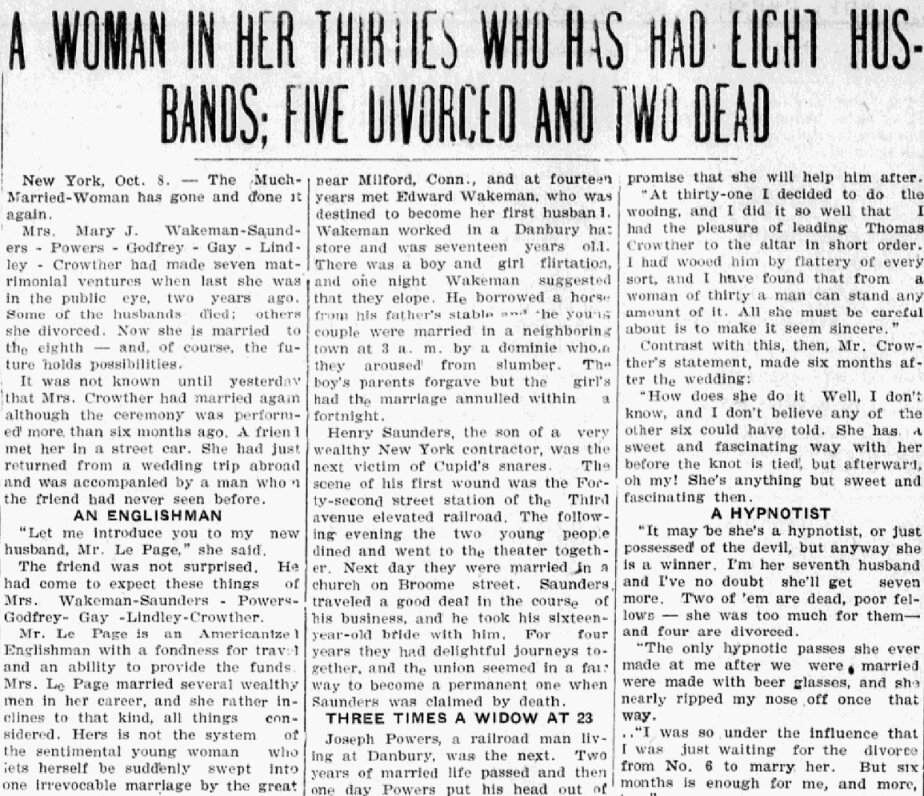
This article tells how Mary met her husbands and how the first three marriages ended. At age 14, she met husband #1, Edward Wakeman, and had “a boy and girl flirtation.” He suggested eloping, so they rode a borrowed horse to a neighboring town at 3 AM. Her parents had the marriage annulled.
When she met husband #2 Henry Saunders at age 16, they went to dinner and the theater together and married the next day. He traveled for work and took her with him. They were happy together until he died. None of the newspapers says how he died.
Her next husband, Joseph Powers (#3), was a railroad man. He died two years after their marriage in an accident at work.
Widowed again at 23, Mary opened a boarding house. Interestingly, this article says she was widowed thrice – but it reports one annulment and two deaths. She met husband #4, John Godfrey, while shopping. They married, then divorced three years later.
Her next husband, William Gay (#5), “was no better than the others.” He persuaded her out of divorce by “taking her a-traveling, and otherwise showering money on her.” She still divorced him.
The next husbands were James H. Lindley (#6) and Thomas Crowther (#7).
The article reports Mr. Crowther’s side of the story regarding their courtship and divorce. He said he didn’t know how she managed to woo him and was certain that her previous husbands couldn’t say either:
“How does she do it? Well, I don’t know, and I don’t believe any of the other six could have told. She has a sweet and fascinating way with her before the knot is tied, but afterward, oh my! She’s anything but sweet and fascinating then.
“It may be she’s a hypnotist, or just possessed of the devil, but anyway she is a winner. I’m her seventh husband and I’ve no doubt she’ll get seven more. Two of ’em are dead, poor fellows – she was too much for them – and four are divorced.”
Some comments are of particular interest here. Namely, Crowther’s comment about Mary being different before and after marriage. It seems that Mary wooed men by not being herself.
It seems her sincerity was questionable. Indeed, in her 1904 newspaper article she had written:
“At thirty-one I decided to do the wooing, and I did it so well that I had the pleasure of leading Thomas Crowther to the altar in short order. I had wooed him by flattery of every sort, and I have found that from a woman of thirty a man can stand any amount of it. All she must be careful about is to make it seem sincere.”
In all this drama, Mary insisted she was always innocent:
“Of course, I was always the innocent party.”
In another newspaper interview, Mary called Crowther’s claims foolish.
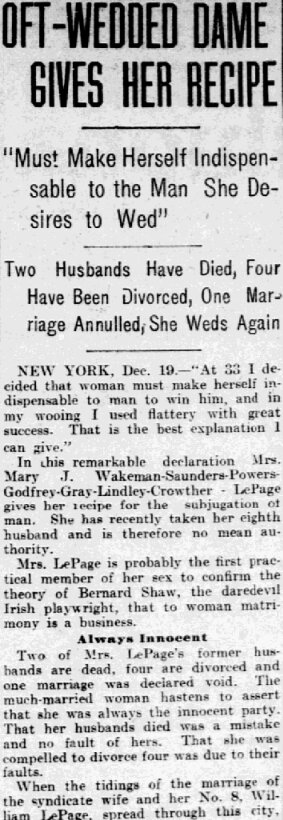
In this article, she declares:
“In the divorce case, in his countersuit against me, Mr. Crowther alleged that I had hypnotic power. Foolishness! He also said that I had hurled household goods at him in quarrels. But the court gave me the decree I sought.”
She maintained her innocence in this article as well:
Two of Mrs. LePage’s former husbands are dead, four are divorced and one marriage was declared void. The much-married woman hastens to assert that she was always the innocent party. That her husbands died was a mistake and no fault of hers. That she was compelled to divorce four was due to their faults.
You may be shaking your head, questioning Mary’s inability to keep husbands or to choose husbands wisely. This is an example of why understanding historical context is important in genealogy.
Historical Context
In the 1890s and early 1900s, society had a different view of divorce than we do now. Additionally, divorce laws were different back then. Divorces are easier to obtain than they were in Mary J. Drapoe’s day. Before the no-fault divorce was allowed, divorce lawyers would make up a fault to grant a divorce to a couple that didn’t want to stay married. (1)
Divorce is more normal and common today than it was back then. However, America was undergoing a period of reform. Divorce rates had been climbing steadily since the Civil War. People were debating the morality of divorce. Opponents of divorce pushed for stricter divorce laws, fearing that divorce would ruin families and, therefore, society. Defenders of divorce included feminists. Many were recognizing that traditional marriages discriminated against women, and divorce offered an escape for women in abusive marriages. (2)
Media – newspapers and magazines – in the late 19th and early 20th centuries gradually began to publish articles favoring divorce. (3) However, newspapers liked to show extreme cases of divorce. Newspapers, much like news networks today, were very capable of portraying crises or making things seem more like crises than they really were. (4) Such was the case of the media coverage of Mary’s divorce from her 7th husband.
It is also important to note how gender roles played a role in this. In the 19th century, fault was an important factor in divorce. This was usually defined by which spouse was not following their gendered norms. In many divorce cases back then, the woman was portrayed as the passive victim while the husband was the aggressor. (5) This worked in Mary’s favor, as discussed above.
Not only do newspapers give us juicy stories about our ancestors, but they also portray society’s attitudes in our ancestors’ time. The news reports of Mary’s 8th marriage portray her as someone successful in catching husbands.
The Philadelphia Inquirer newspaper article above reports:
When the tidings of the marriage of the syndicate wife and her No. 8, William LePage, spread through this city [New York], many curious persons rushed to interview the woman upon the all-important subject: “How have you managed to marry eight men when so many women can’t even land one?”
The article gives Mary’s “recipe for the subjugation of man”:
“At 33 I decided that woman must make herself indispensable to man to win him, and in my wooing I used flattery with great success. That is the best explanation I can give.”
Many things have changed in American society since the early 1900s. By understanding our ancestors’ times, we can better understand what the newspapers portray about our ancestors.
Create a free account at GenealogyBank for 7 days to start your journey and discover the stories your ancestors left behind.
Note on the header image: wedding cake and champagne glasses. Credit: https://depositphotos.com/home.html [061626]
______________
(1) Coontz, S. (2005). Marriage, a History: From Obedience to Intimacy, or How Love Conquered Marriage. Viking Press.
(2) O’Neill, W. L. (1965). “Divorce in the Progressive Era.” American Quarterly, 17(2), 203. https://doi.org/10.2307/2711354 ; accessed 30 May 2026.
(3) Ibid.
(4) Ibid.
(5) Naomi Cahn, “Faithless Wives and Lazy Husbands: Gender Norms in Nineteenth Century Divorce Law,” 2002; U. Ill. L. Rev. 651 (2002); https://scholarship.law.gwu.edu/cgi/viewcontent.cgi?article=1371&context=faculty_publications; accessed 30 May 2026.
Related Articles:
- Genealogy Challenge: Tracing Mary Drapoe’s 8 Marriages (part 1)
- Genealogy Challenge: Tracing Mary Drapoe’s 8 Marriages (part 2)
- Genealogy Challenge: Tracing Mary Drapoe’s 8 Marriages (part 3)
