
 December 31, 2025
Introduction: In this article, Melissa Davenport Berry highlights an American heroine born on New Year’s Day in 1752: Betsy Ross. Melissa is a genealogist who has a website, americana-archives.com, and a Facebook group, New England Family Genealogy and History.
The upcoming New Year marks America’s 250th anniversary of the signing of the Declaration of Independence, and I am putting together a score of stories to commemorate and celebrate this most important milestone in our country’s history.
To kick off the New Year and America 250, my subjects are two popular Revolutionary War figures: Betsy Ross and Paul Revere, both born on New Year’s Day.

Betsy Ross
I begin with Betsy Ross.
On New Year’s Day, 1 January 1752, in Gloucester City, New Jersey, a baby girl was born who was destined to play a part in the history of our country, which time cannot efface.
Elizabeth Griscom (aka Betsy Ross), the eighth child of the seventeen born to Quakers Samuel and Rebecca (James) Griscom, became the wife of John Ross.
Betsy, a skilled and talented seamstress, is credited for designing and sewing the first American flag known as “Stars and Stripes.”
While many historians dispute claims about Ross and her role as the initial United States freedom flag maker, new discoveries may reveal some truth beyond the family claims made back in the 19th century. (Much more on this coming in next week’s article. So, stay tuned.)
One thing for sure: Betsy had quite a colorful history in the romance department.
Quakers Shunned Betsy Ross, She Eloped Once, Wed Thrice
Ross, a true Patriot and Revolutionary War figure, was not without scandal. The word is she stirred up some drama among her religious sect via her impertinent marriages. Here is the skinny from the Daily Record newspaper (with some added genealogy).
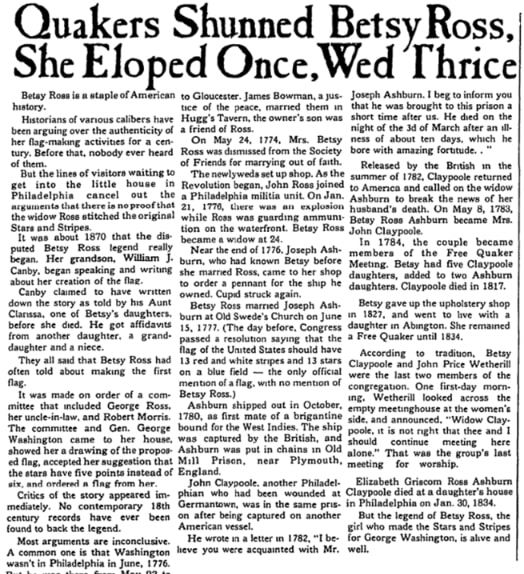
This article reports:
Betsy’s great-grandfather [Andrew Griscom] settled in New Jersey in the 17th century. Her father, Samuel Griscom, was a carpenter who helped build the first steeple on Independence Hall in 1754.
Samuel married Rebecca James [daughter of George and Susannah (Hingston) James], sister of prominent Quaker merchant Abel James. They had 17 children.
Elizabeth Griscom was born on Jan. 1, 1752. After a Quaker education, the blue-eyed girl, nicknamed Betsy, began learning upholstery in William Webster’s shop.
Also at Webster’s was John Ross, son of the Rev. Aneas Ross, an Episcopal minister. Betsy and John fell in love, but her parents didn’t approve of her marrying out of Friends Meeting.
On Nov. 4, 1773, the couple eloped, rowing across the Delaware [River] to Gloucester. James Bowman, a justice of the peace, married them in Hugg’s Tavern; the owner’s son was a friend of Ross.
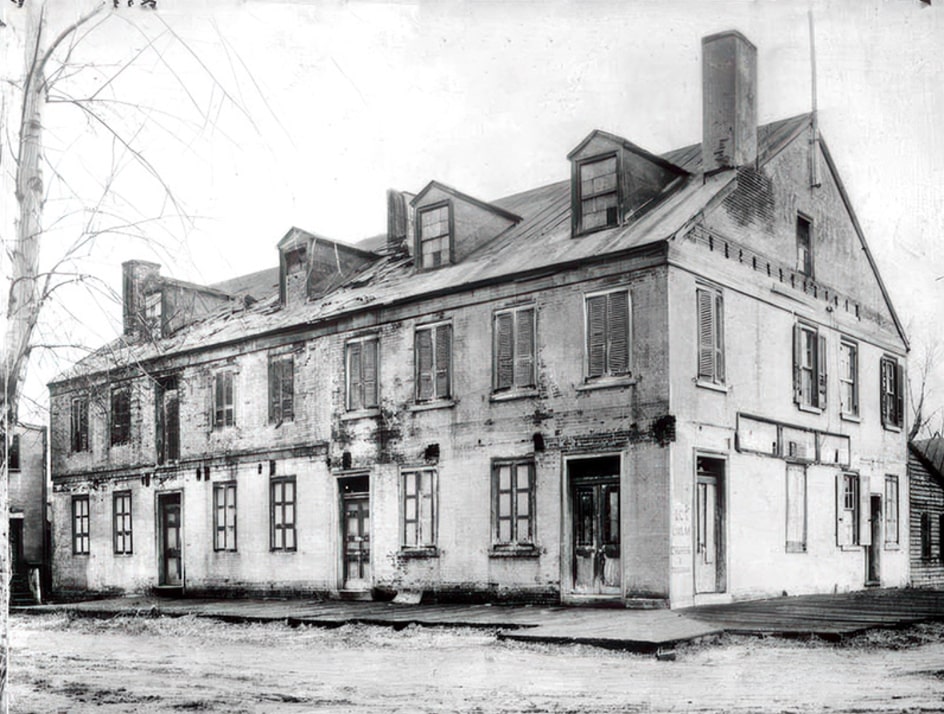
On May 24, 1774, Mrs. Betsy Ross was dismissed from the Society of Friends for marrying out of faith.
The newlyweds set up shop. As the Revolution began, John Ross joined a Philadelphia militia unit. On Jan. 21, 1776, there was an explosion while Ross was guarding ammunition on the waterfront. Betsy Ross became a widow at 24.
Near the end of 1776, Joseph Ashburn, who had known Betsy before she married Ross, came to her shop to order a pennant for the ship he owned. Cupid struck again.
Betsy Ross married Joseph Ashburn at Old Swede’s Church on June 15, 1777. (The day before, Congress passed a resolution saying that the flag of the United States should have 13 red and white stripes and 13 stars on a blue field – the only official mention of a flag, with no mention of Betsy Ross.)
Ashburn shipped out in October 1780, as first mate of a brigantine [the Patty] bound for the West Indies. The ship was captured by the British, and Ashburn was put in chains in Old Mill Prison, near Plymouth, England.
John Claypoole, another Philadelphian who had been wounded at Germantown, was in the same prison after being captured on another American vessel.
He wrote in a letter in 1782, “I believe you were acquainted with Mr. Joseph Ashburn. I beg to inform you that he was brought to this prison a short time after us. He died on the night of the 3d of March after an illness of about ten days, which he bore with amazing fortitude…”
Released by the British in the summer of 1782, Claypoole returned to America and called on the widow Ashburn to break the news of her husband’s death [in person]. On May 8, 1783, Besty Ross Ashburn became Mrs. John Claypoole.
In 1784, the couple became members of the Free Quaker Meeting. Betsy had five Claypoole daughters, added to two Ashburn daughters [only one survived to adulthood – Elizabeth Ashburn, who married Capt. Isaac Silliman]. Claypoole died in 1817.
His diary and Revolutionary War ship chest are housed at the Museum of the American Revolution in Philadelphia. Below is a photo courtesy of the museum.
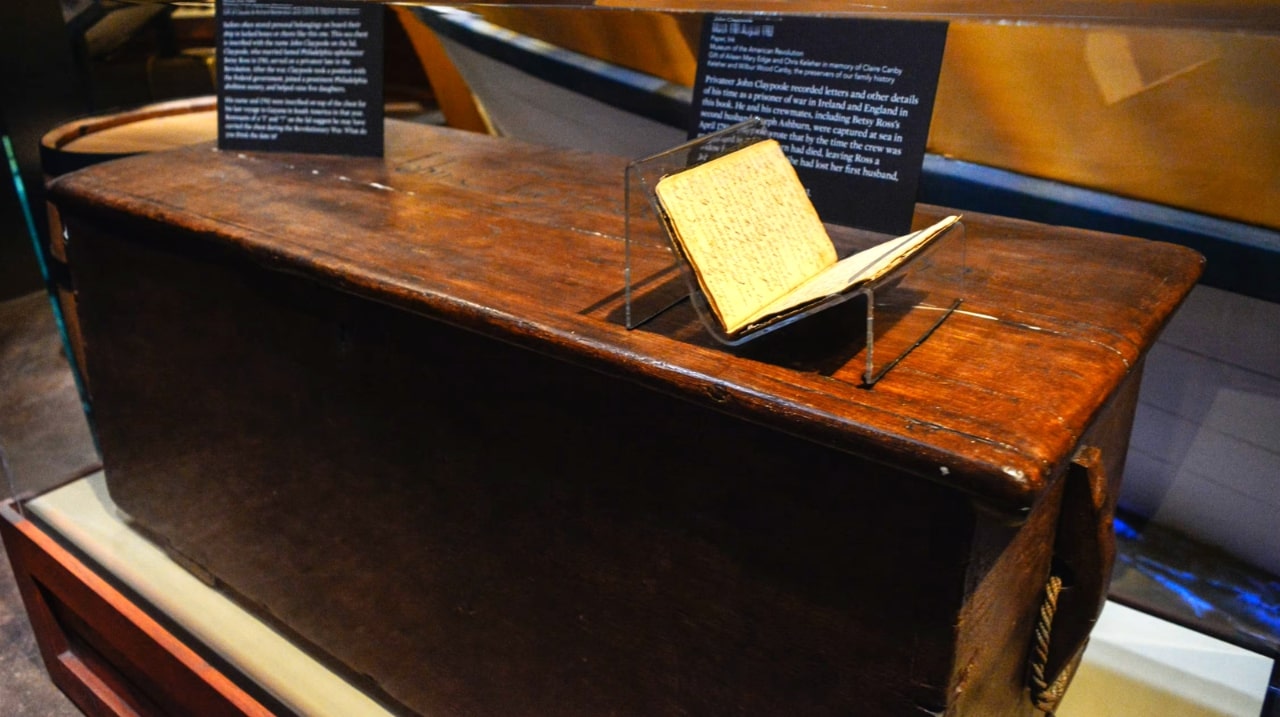
The chest and diary, which includes letters and songs, were donated by Aileen Edge and her husband David. Aileen’s mother, Claire Canby Keleher, is a descendant of Betsy and John Claypoole.
A Namesake Sees Betsy Ross Stamps
Below is a photo of 9-year-old Betsy Ross observing a sheet of stamps honoring her namesake.
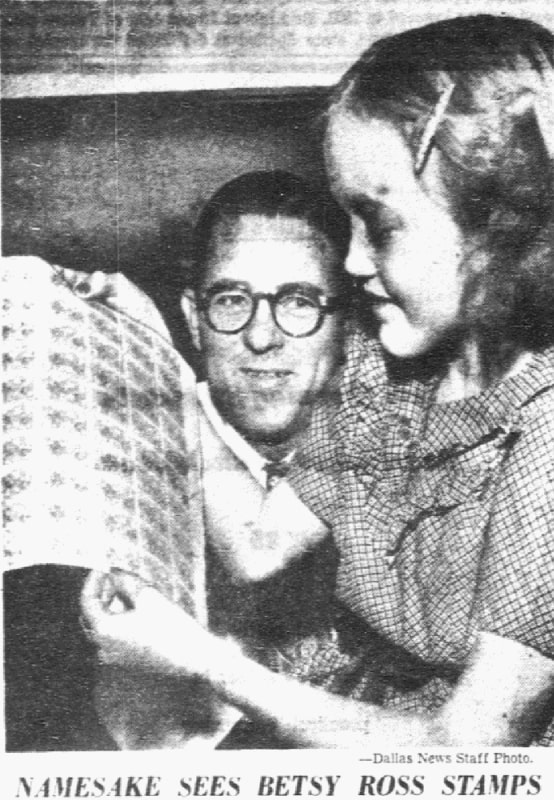
The photo caption reads:
A 9-year-old student at Elisha M. Pease School has a considerable interest in the new 3c stamp commemorating the 200th anniversary of the birth of Betsy Ross. Her reason: she has the same name as the woman crediting with designing and sewing the first flag of the United States during the Revolutionary War. The Dallas Betsy Ross is the daughter of Mr. and Mrs. C. B. Ross of 5009 Chapparral. Here, Vernon Brownlee, a clerk at the Trinity Heights Post Office, shows Betsy a sheet of the stamps honoring the eighteenth-century Betsy.
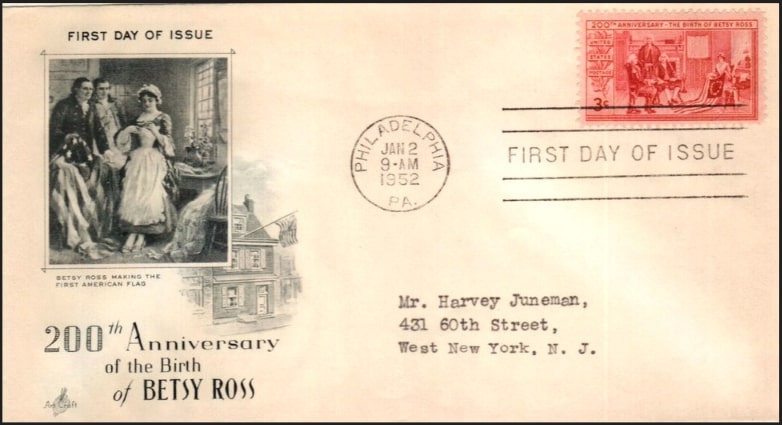
Here is an image of the 3-cent Betsy Ross stamp on an envelope addressed to Mr. Harvey Juneman in New York.
Below is a photo of actress Ina Claire as Betsy Ross.

Stay tuned for more in the New Year. And Happy New Year to everyone!
Create a free account at GenealogyBank for 7 days to start your journey and discover the stories your ancestors left behind.
Note on the header image: “The Birth of Old Glory,” by Edward Percy Moran, c. 1917. Credit: Library of Congress, Prints and Photographs Division.
