
 November 18, 2025
Introduction: In this article, James Pylant concludes a true-crime story from November 1918, once again showing that some family history has a dark side. James is an editor at GenealogyMagazine.com and author for JacobusBooks.com, is an award-winning historical true-crime writer, and authorized celebrity biographer.

In Waynesboro, Pennsylvania, on the afternoon of 23 November 1918, 20-year-old Russell Potter ran into a grocery store and excitedly told a clerk to call a doctor.
“My wife has shot herself,” he explained, moaning and wringing his hands.
Dr. J. W. Croft arrived and met Russell at the house. It was too late: his 14-year-old wife, Mary (Hardsock) Potter, was dead. In the parlor, Croft found the blood-soaked body of Mary Potter with a bullet wound in the heart.
An autopsy revealed that the interior of Mary’s left hand was powder-burned. Two wounds in the palm indicated a bullet had passed through her hand.
A jury at the coroner’s inquest ruled that death resulted from “the effects of a pistol shot wound inflicted by her husband.” Russell was arrested on November 29 and held at the county jail awaiting trial.

This article reports:
The tragedy resulted in the course of a quarrel early after dinner, in which, as the Commonwealth charges, Potter seized a revolver from a nail in the kitchen pantry, chased his wife into the parlor, and shot her through the heart. She was found by neighbors shortly after, lying in a pool of blood on the floor. Potter, who summoned a physician, told [the doctor] that his wife shot herself after threatening to shoot him and that the shooting occurred at the door of the pantry in which the revolver was kept. He persisted in this version of the affair at the coroner’s inquest which followed, but the incriminating weakness of his story was that no blood stains were found on the floor of the pantry to the parlor, a distance of thirty-five feet, and that scars were found in the palm of the wife’s left hand made by the course of the bullet, which clearly indicated that she had clutched the barrel of the gun to deflect it when aimed at her breast.
It was further shown at the inquest that the husband was a vicious character when under the influence of drink; that he had frequently assaulted his wife, and, on one occasion, driven her from the house late at night with a butcher knife. Her life was only saved probably by her escape to the house of a neighbor. The coroner’s jury had no difficulty in finding it a case of felonious murder and the uxoricide was locked up in a cell in the county jail to await his trial, which will be called by District Attorney Charles Clippinger early the coming week.
The murder trial began on 5 February 1919.
Mildred Hardsock, Mary’s 12-year-old sister, testified that the Potters’ marriage was quarrelsome. Her testimony was reported in the Record-Herald.
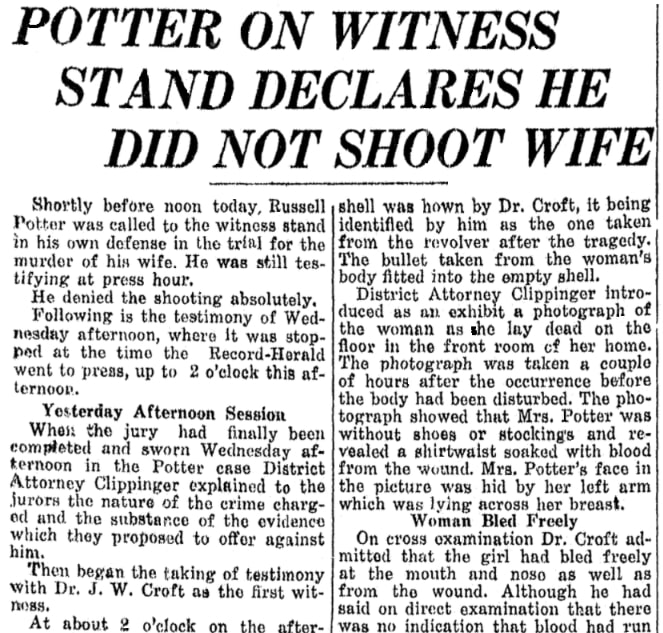
Mildred said Mary and Russell visited the Hardsock family on Monday, 18 November 1918, and that she went home with them later that day, staying until Tuesday evening, as Russell didn’t work that day.
This article reports:
On Monday night before they retired, Mildred stated, Russell took the revolver and loaded it and hung it on a nail in the pantry. When Mary went to bed, she took the revolver along and laid it on her dresser, where it was allowed to remain all night. The next morning Russell took the revolver and put it in his pocket, and Mary went and sat on his lap and fished it out of his pocket. The revolver was then hung back in the pantry.
At this point in the taking of testimony the eternal triangle developed for Mildred’s tale of a quarrel which took place on Tuesday afternoon [which] introduced the name of Mary Kriner, with whom, it developed, Mrs. Potter had lived before she was married. It appears that Russell was intimate with the Kriner girl for, according to the story of Mildren, when Mary came downstairs with a crocheting box which belonged to her, Russell wanted to write Mary Kriner’s name on it, and when he attempted to do so Mary broke up the box and threw it away.
Mildred did not see this quarrel as they had sent her to the store, but Mary told her about it in Russell’s presence when she returned. According to what Mary told Mildred, Mary was standing at the kitchen window with her back turned towards Russell when she heard the click of a revolver – and when she turned around, Russell was pointing the revolver at her. He had pulled the trigger, but the [cartridge] did not explode. Even after Mildred returned from the store there was more scrapping and Russell started to get the revolver again from its place in the pantry but stopped short when Mary screamed and Mildred cried. Then Mary threatened to leave and went and got her clothes. Russell knocked the clothing out of her hand and locked the door, telling her that if she left, he would go up and live with Mary Kriner.
On the witness stand, Russell denied Mildred’s story. He hadn’t threatened Mary, nor had they quarreled after his return home from work.
“Did you shoot your wife?” his attorney asked.
“No, sir,” he said with a smile.
A barefoot Mary had been “jumping about” in the kitchen after dinner, Russell said. As he prepared to go downtown to buy furniture, Mary entered the parlor brandishing the revolver, playfully pointing it at him, saying, “Honey, I’ll shoot you.”
She then stepped into the pantry, and he heard gunfire. Mary emerged a moment later, half bent over clutching her breast, and headed for the parlor.
Russell said he rushed to the Klines next door before bolting for the grocery store to telephone a doctor.
B. F. Kline, who lived in the duplex, testified that he heard the quarrelling Potters calling the other a “damned liar,” followed by a thump that jarred the house. A woman screamed, and then a gun fired. Potter came to the Klines’ door and asked them to “come over, she’s pointing a gun at me.” They refused.
Coroner J. H. Kinter testified that Mary couldn’t have run the 34 feet from the pantry to the parlor; such a wound would cause death within a second or fraction of a second.
Neighbor R. E. Galbreath testified that he heard the gunshot and saw Russell running to the store. Afterwards, Russell asked Galbreath to come over, that his wife had shot herself. They had been “cutting up,” he said, and Mary had placed the revolver under her breast and said she was going to shoot herself. He begged her to stop, but “she did it anyhow.”
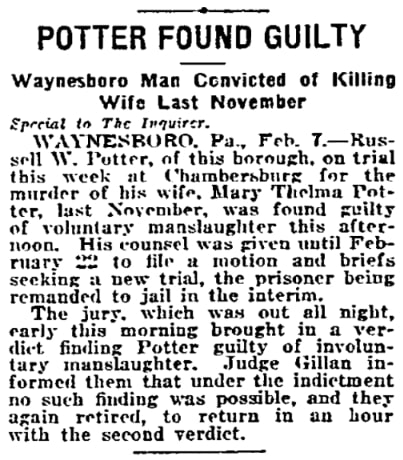
After a two-day trial, a verdict was reached on February 7.
This article reports:
WAYNESBORO, Pa., Feb. 7. – Russell W. Potter, of this borough, on trial this week at Chambersburg for the murder of his wife, Mary Thelma Potter, last November, was found guilty of voluntary manslaughter this afternoon. His counsel was given until February 22 to file a motion and briefs seeking a new trial, the prisoner being remanded to jail in the interim.
The jury, which was out all night, early this morning brought in a verdict finding Potter guilty of involuntary manslaughter. Judge Gillan informed them that under the indictment no such finding was possible, and they again retired, to return in an hour with the second verdict.
Reportedly, Potter was given a three-year prison sentence. However, his prison record specified a six-year minimum and eight-year maximum sentence. (1)
An argument for a new trial heard later that month was refused – as was a petition for a writ of habeas corpus by the Supreme Court in April 1919. And in December, the Board of Pardons also rejected his application. The following year, he was enumerated in the 1920 census as a prisoner at Eastern State Penitentiary in Philadelphia.
In June 1923, the convicted man’s request for a rehearing was rejected. (2)
Newspaper accounts do not detail Potter’s release.
He remarried and had four children. Calling himself John Potter, he lived in York County but claimed to be a New York City native. (3) As an experienced machinist, he worked at a lumber mill as of 1940. He was also known as Russell J. William Potter.
Retiring in 1966, he then worked for a supply company until 1972. Russell W. Potter lived 65 years after the shooting death of first wife Mary. He died at age 85 on 19 February 1984. (4)
Create a free account at GenealogyBank for 7 days to start your journey and discover the stories your ancestors left behind.
Note on the header image: “Investigating a Mystery.” Designed by Freepik (www.freepik.com)
Related Article:
________________
(1) Russell W. Potter, no B9670, “Pennsylvania, U.S. Prison, Reformatory, and Workhouse Records, 1829-1971,” online database, Ancestry (www.ancestry.com: accessed 27 October 2025).
(2) “Board Refuses Potter Re-hearing,” Public Opinion, 29 June 1923, p. 1.
(3) John Potter Jr. death certificate, no. 62431 (1934), “Pennsylvania, U.S. Death Certificates, 1906-1972,” online database, Ancestry (www.ancestry.com: accessed 24 October 2025), as per informant, John Potter.
(4) Russell W. Potter obituary, York Dispatch (York, PA), 20 February 1984, p. 30.
