
 November 24, 2026
Introduction: In this article, James Pylant writes about an unexpected Thanksgiving night that occurred in Missouri in 1907. James is an editor at GenealogyMagazine.com and author for JacobusBooks.com, is an award-winning historical true-crime writer, and authorized celebrity biographer.
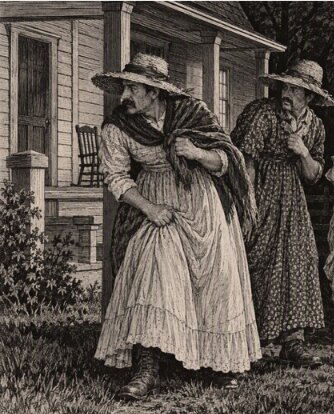
’Twas the night of Thanksgiving, when all through the house, not a creature was stirring, not even a mouse – until twenty women barged in and assaulted three men.
It happened in Sleepy Hollow, and it began as a feud with the Hatfields, though not Washington Irving’s Sleepy Hollow nor the infamous dispute with the McCoys. As it turns out, the home invaders were not really women.
Instead, Sleepy Hollow was in Ray County, Missouri. In this west-central county in the Show-Me State, Kentucky native Patrick Henry Berry supported himself, his wife, and their nine children on their 92-acre farm.
The incident at Sleepy Hollow occurred on Thanksgiving night in 1907, but according to Henry Berry, the feud began seven years earlier and had continued into 1909.
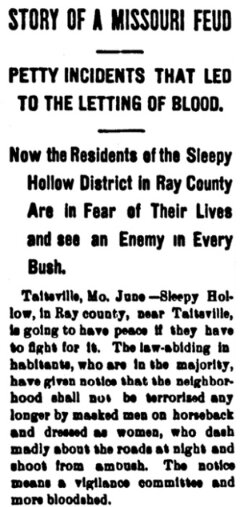
This article reports:
“Along about nine years ago burglars stole a suit and three razors from my home,” Berry said. “I traced the theft until I found out the four young men that did it. They belonged to good families, but I didn’t make any bones about telling who they were to anyone I chanced to meet.”
The thefts and other acts of mischief continued.
Dr. J. O. Wilkerson’s barn was burglarized and burned, killing his horse and cattle.
Another fire claimed Wiley Yoakum’s eleven head of stock.
Berry talked to Wilkerson and Yoakum about joining him in stopping the ravages. “They were for peace, and I let it go at that,” he said.
Things calmed for a few years.
And then one night in 1907 Berry’s sons, Will and Grover, on their way home from an opossum hunt, encountered Ed Clinton and Frank Kincaid and five other boys from the neighborhood. “These boys wanted my sons to cook the ’possum then, and they refused.” An altercation ensued, and one of Berry’s sons cut one of the Kincaids, what he called “slightly in the back.” The Berry brothers were fined $11 each. The father, who felt his sons had been coerced into the fight, said they were outnumbered. “The Kincaids are related to about half the people in the county,” he added.
It turned into an ongoing feud.
At school, the Berrys and the Kincaids and their friends were fighting or threatening each other.
In October that year, Henry Berry heard that Alvis Kincaid and his sons were going to “gang” Berry’s sons at church. “I dared the whole gang away from the place of worship so I could fight freely without desecrating any spot,” he said. “They refused.”
On Thanksgiving night, as the Berrys slept, twenty masked men – dressed as women – slipped into their home and forced them outside, where Henry Berry and two of his sons were tied to trees and whipped.
“After they untied me, they attempted to put a rope around my neck,” said Berry, who managed to escape and run inside his house long enough to grab his Winchester. The band was already heading out, but they hurried when they saw Berry toting the firearm. In his haste, one of them left behind a revolver lying in the road, which Berry retrieved and kept.
His complaint to law enforcement led eleven men to be indicted, yet the case stalled.
On 30 May, on his way home from a trip to Richmond, Missouri, Berry and his 14-year-old son, Charlie, were ambushed by four men dressed as women. “They had three shotguns and a revolver, and I was peppered good.” Gunfire destroyed sight in his right eye. “I recognized Alvis Kincaid, he had on a dress and a straw hat,” Henry Berry testified in court in July. (1)
Berry visited the home of Clyde Hatfield and asked him to reveal what he knew about “this night riding business.” Berry said Hatfield admitted what he knew to an extent, promising to tell more at “the proper time,” which he interpreted to mean as trial testimony.
On the night of 13 June 1909, someone saw a man dressed as a woman entering shrubbery surrounding Hatfield’s home. Gunfire erupted from the shrubbery, fatally striking Hatfield.
“I don’t know what will become of me,” said Berry. “I suppose I will be killed.” But in a newspaper interview, he let it be known that the Berry home was an arsenal of sorts, with Winchesters and revolvers in every corner. His children had been trained to shoot.
On 15 July, warrants were issued for the arrests of Alvis Kincaid and Kell Smith on charges of assault with attempt to commit murder. (2)
What became of the case against Kincaid and Smith is not found in surviving newspapers, but in September, Henry Berry went to South Missouri to “look for a new location where land is cheaper.” (3) However, those plans may have changed. In April 1910, a newspaper correspondent reported that Alvis Kincaid “has been sick for some time.” (4) In June, 55-year-old Kincaid died of tuberculosis. (5) “A good man gone to rest,” reported a newspaper. (6)
Henry Berry lived another 18 years, dying in Ray County at age 76 in 1927 of bronchial pneumonia. (7)
It is likely Henry and his family never forgot that Thanksgiving night 20 years earlier, when terror rather than gratitude visited Sleepy Hollow.
Create a free account at GenealogyBank for 7 days to start your journey and discover the stories your ancestors left behind.
Note on the header image: assassins dressed as women spread terror in Sleepy Hollow on Thanksgiving night. Credit: James Pylant using Microsoft Copilot.
_____________
(1) “The Berry Preliminary,” Richmond Missourian, 29 July 1909, pp. 1-2.
(2) “Arrest in Bush Case,” Richmond Missourian, 15 July 1909, p. 1.
(3) “Local News,” Richmond Missourian, 9 September 1909, p. 2.
(4) “Dry Ridge News,” Richmond Missourian, 7 April 1910, p. 2.
(5) Alvis Kincaid death certificate, no. 16650 (1910), Missouri State Board of Health; “Missouri Death Certificates, 1910-1975,” online database with images, Missouri State Archives (www.sos.mo.gov/images/archives/deathcerts/1910/1910_00017709.PDF: accessed 29 October 2026).
(6) “A Grand Man Gone,” Richmond Missourian, 30 June 1910, p. 4.
(7) Patrick Henry Berry death certificate, no. 28122 (1927), Missouri State Board of Health; “Missouri Death Certificates, 1910-1975,” online database with images, Missouri State Archives (www.sos.mo.gov/images/archives/deathcerts/1927/1927_00029397.PDF: accessed 29 October 2026).
