
 December 22, 2025
Introduction: In this article – the third in a series of three – Katie Rebecca Merkley explores the legend of St. Nicholas/Santa Claus and other gift-giving Christmas figures. Katie specializes in U.S. research for family history, enjoys writing and researching, and is developing curricula for teaching children genealogy. She has a website: krgarnergenealogy.com
In the first two articles of this three-part series, we learned about various European gift-bringers, including St. Nicholas and his helpers (see links at the end of this article). When these traditions were brought over to America, the American Santa Claus began to take shape.
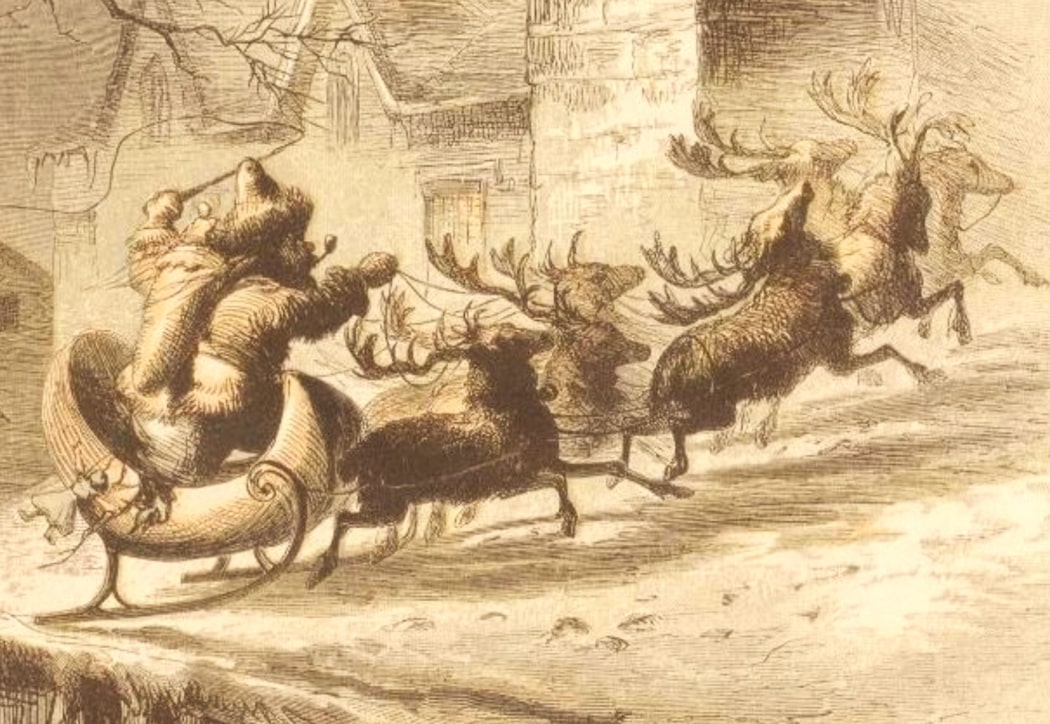
The Dutch brought Sinterklaas, which was anglicized to Santeclaus and then to Santa Claus. The Germans brought Christkindl, which was anglicized to Krist Kingle then Kriss Kringle. They also brought Knecht Ruprecht, whose name was changed to Belsnickel. Additionally, St. Nicholas was shortened to St. Nick. (1) The New York Historical Society wanted to honor its Dutch roots by celebrating St Nicholas Day. (2)
Santa Claus as we know him today came about in 19th-century America, hugely influenced by Clement Clarke Moore’s poem “A Visit from St. Nicholas,” first published in 1823.
Here is another early illustration of St. Nick.

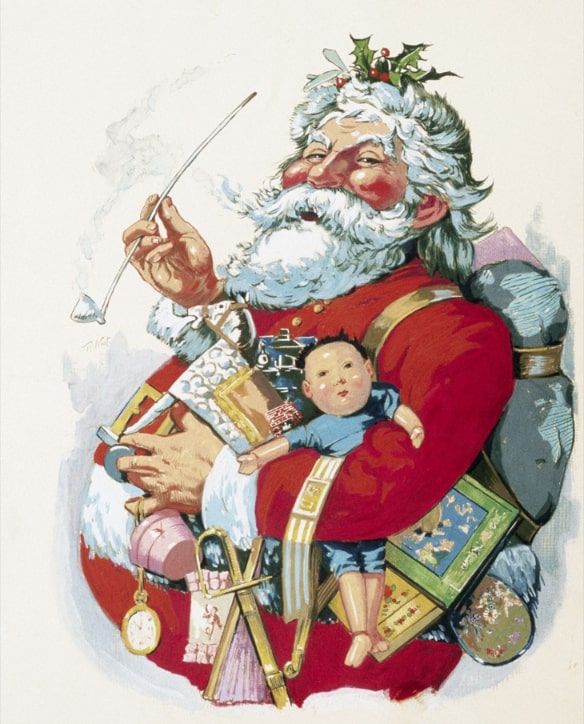
It is American cartoonist Thomas Nast’s 1863 illustration “Merry Old Santa Claus,” inspired by Moore’s poem, that most of us think of when we picture Santa Claus today.
The poem now known as “The Night Before Christmas” was first published in newspapers anonymously in 1823 as “Account of a Visit from St. Nicholas.” Clement Clarke Moore later claimed to have written the poem. Before it was published, he recited it to his children at Christmastime. (Some critics contend that Henry Livingston wrote the poem.) Below is an 1825 reprint of the famous poem.
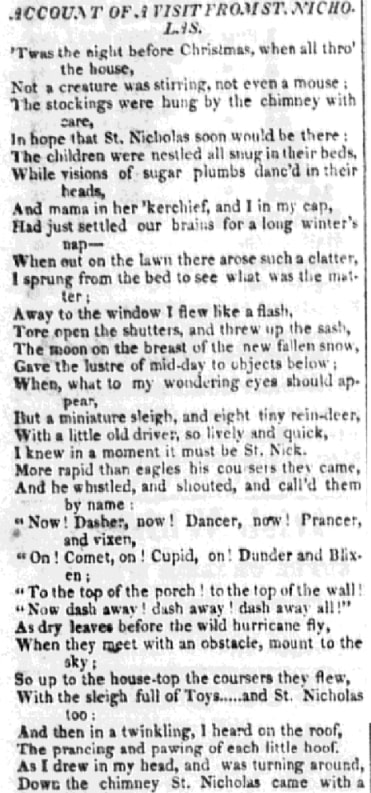
Moore’s poem was the first widely published work to depict Santa in a reindeer-drawn sleigh, and to name the eight reindeer. Rudolph the Red-Nosed Reindeer would later be added as the ninth reindeer. This poem also portrayed Santa as a jolly, lovable elf, wearing furs which suggested he came from a faraway place up north. (3)
Thomas Nast, a German immigrant to New York, used his art to transform the Santa Claus lore. Before he came along, there was no agreement on Santa’s appearance. He was portrayed as fat or thin, as a fully grown human or a gnome-like creature, etc. Thomas Nast first began drawing Santa in 1863 and continued for over 30 years. His portrayal of Santa settled the debate. He drew Santa as a fully-grown man with a jolly face, full beard, and a wide belt around a rotund waist. His drawings of Santa also added to the lore: Santa making toys in his workshop, elves as assistants, giant ledgers of children’s names, and treats left for Santa. He also popularized the portrayal of reindeer.
In addition to the famous 1863 Santa Claus illustration shown above, Nast made other drawings of Santa, such as this one from 1889.
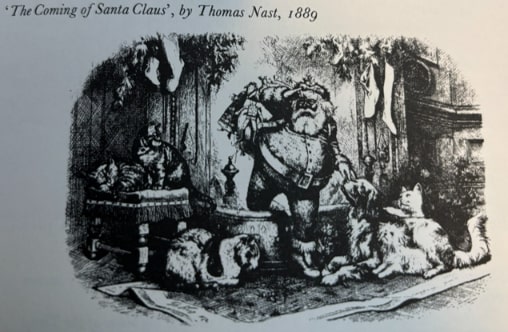
In 1882, Nast’s portrayal of Santa Claus’ headquarters in the North Pole came, enabling children to write him letters. (4)
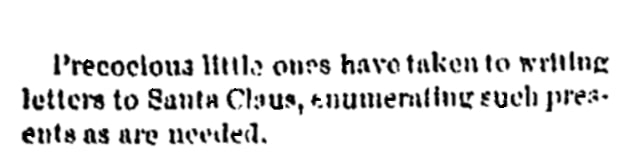
However, children were writing to Santa earlier than that, evidenced by newspaper clippings found in GenealogyBank’s Historical Newspaper Archives. The earliest one was from 1872. Additionally, European children had been writing to their respective magical gift-bringers, telling them what they wanted for Christmas. (5)
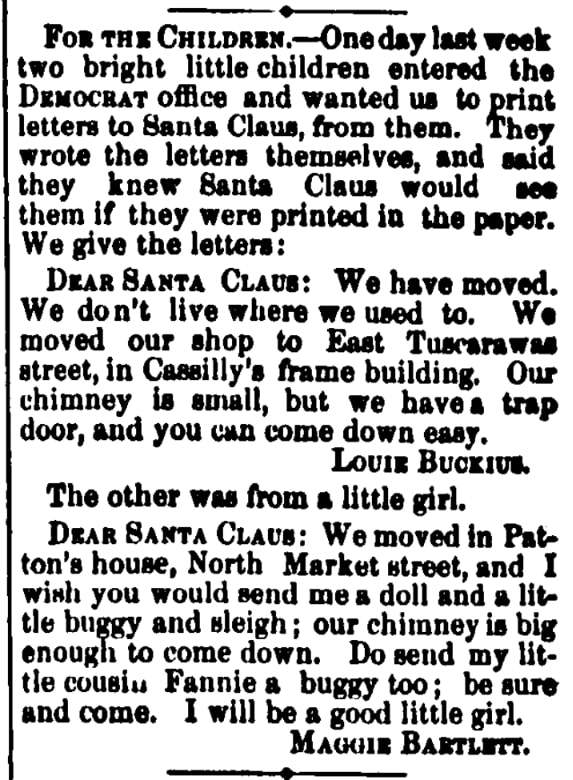
In 1874, Louie Buckius and Maggie Bartlett, not knowing where to send their letters to Santa, went to their local newspaper office. The editor of the Stark County Democrat posted their letters in the newspaper. The children knew Santa would see their letters if they were printed in the newspaper.
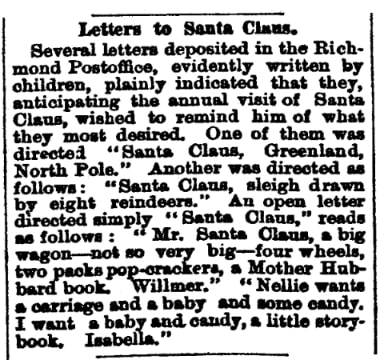
Louie and Maggie were evidently not the only children writing to Santa that Christmas. The following February, a note was published in the newspaper about the letters to Santa that had been sent through the post office. One child addressed their letter to “Santa Claus, Greenland, North Pole,” and another to “Santa Claus, sleigh drawn by eight reindeer.” Others just said “Santa Claus.” The newspaper also quoted some of the things children asked for, such as books or toys. Two children even asked for a baby.
Other newspaper articles show that letters to Santa were addressed to the North Pole, and letters to Kriss Kringle were addressed to Lapland. One child had addressed their letter “to the man with the little round belly that shakes when he laughs like a bowl full of jelly.”
Perhaps Thomas Nast did not invent the idea that Santa Claus lives at the North Pole, but he may have helped popularize it through his art.
Santa Claus is evidently real enough to write letters to, as encouraged by 19th-century newspaper editors. As mentioned in the first article in this series, the Sun’s editor believed in Santa and encouraged a little girl, Virginia, to believe in him, too. That article has been reposted for over a century. Santa’s magic is just as real now as it was then. His magic is just as real as that of St. Nicholas, Christkindl, and the other gift-bringers of Christmas.
Merry Christmas everyone!
Create a free account at GenealogyBank for 7 days to start your journey and discover the stories your ancestors left behind.
Note on the header image: frontispiece from “The Coming of Father Christmas” by Eliza F. Manning, 1894. Credit: The British Library; Wikimedia Commons.
Related Articles:
___________
(1) Bruce David Forbes. (2008). Christmas: A Candid History (Chapter 4), University Of California Press.
and;
Gulevich, T. (2000). Encyclopedia of Christmas, entries for Santa Claus and Knecht Ruprecht.
and;
Collins, A. (2003). Stories Behind the Great Traditions of Christmas (pp. 159–172), Zondervan.
(2) Bruce David Forbes. (2008). Christmas: A Candid History (Chapter 4), University Of California Press.
(3) Ibid.
and;
Gulevich, T. (2000). Encyclopedia of Christmas, entries for North Pole and reindeer.
(4) Bruce David Forbes. (2008). Christmas: A Candid History (Chapter 4), University Of California Press.
(5) Gulevich, T. (2000). Encyclopedia of Christmas, entry for Children’s Letters.
